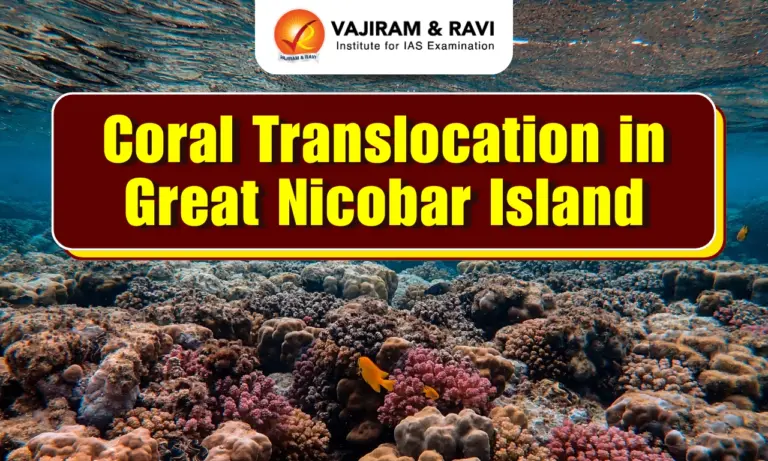
The Zoological Survey of India (ZSI) has identified four new translocation sites on the west coast of Great Nicobar Island for shifting coral colonies and Giant Clams that will be disturbed by the transhipment port being constructed at Galathea Bay as part of the Great Nicobar Island (GNI) mega project.
Coral Translocation Meaning and Process
Coral translocation involves the scientific relocation of coral colonies from areas facing ecological disturbance to suitable habitats where they can continue to survive and grow. Key Components of Translocation include:
- Identification and mapping of coral colonies within project impact zones.
- Selection of suitable recipient sites possessing similar environmental characteristics.
- Physical relocation of coral colonies using specialised scientific techniques.
- Long-term monitoring of survival rates and ecological adaptation.
Conditions Necessary for Successful Translocation: Experts emphasise that recipient sites should possess environmental conditions similar to the original habitat, including: comparable water depth, similar current patterns, adequate light availability, appropriate water pressure and suitable ecological characteristics for coral growth.
Coral Translocation under the Great Nicobar Project
Coral Translocation under the Great Nicobar Project is a major environmental mitigation measure aimed at reducing the ecological impact of the proposed Galathea Bay Transhipment Port.
-
- As part of the conditions attached to the project’s Environmental Clearance (EC) and Coastal Regulation Zone (CRZ) clearance, coral colonies and Giant Clams located within the project impact area must be relocated before major construction activities commence.
- Objective: The objective is to minimise biodiversity loss and reduce damage to sensitive marine ecosystems.
- Scale of Coral Presence and Translocation: Scientific surveys conducted in the project area recorded approximately 20,668 coral colonies within a 10-hectare area of Galathea Bay. Of these, around 16,150 coral colonies have been identified for translocation, while the remaining 4,518 colonies are under scientific observation before a final decision is taken regarding their relocation.
- Monitoring and Scientific Tracking: To ensure effective monitoring after relocation, GPS tags will be attached to each translocated colony. This will enable scientists to maintain systematic records and track survival, growth, and adaptation of coral colonies over time. Continuous monitoring will help assess the long-term success of the translocation programme.
- Legal and Regulatory Safeguards: Coral colonies and Giant Clams are protected under Schedule I of the Wildlife (Protection) Act, 1972, which gives them the highest level of protection. Therefore, ZSI must obtain all necessary statutory approvals before handling or relocating them.
- Role of Zoological Survey of India: The Zoological Survey of India (ZSI) is the main scientific agency responsible for implementing coral translocation in the Great Nicobar project. It conducts detailed surveys of the 10-hectare impact area in Galathea Bay and has proposed translocation of around 16,150 coral colonies, while the remaining are under observation. ZSI ensures that relocation is carried out before construction begins, in line with Environmental Clearance conditions.
- Role of the National Green Tribunal (NGT): The National Green Tribunal (NGT) examined the Great Nicobar project from an environmental perspective and allowed it to proceed with strict safeguards. It directed the authorities to ensure protection of coral reefs in the affected coastal stretch and to undertake coral regeneration in suitable adjoining areas to minimise ecological damage.
Institutional Oversight and Biodiversity Conservation
Biodiversity Monitoring Committee: The coral translocation programme is being supervised through a biodiversity-related monitoring committee constituted under the project’s Environmental Management Plan.
- Its primary responsibility is to oversee wildlife conservation measures and ensure that biodiversity protection commitments are effectively implemented during various stages of the project.
- The committee monitors conservation efforts relating to several ecologically important and endemic species, including:
- Nicobar Megapode – an endemic bird species found only in the Nicobar Islands.
- Leatherback Sea Turtle – one of the world’s largest marine turtles and a globally significant species.
- Saltwater Crocodile – an apex predator inhabiting coastal and estuarine ecosystems.
- Nicobar Macaque – a primate species endemic to the Nicobar Islands
- Robber Crab (Coconut Crab) – the world’s largest terrestrial arthropod.
- Coral reefs and Giant Clams – critical components of marine biodiversity.
Integrated Environmental Management: Apart from the biodiversity committee, two additional committees have been constituted to oversee:
- Pollution control and environmental quality management.
- Welfare and protection of the Shompen and Nicobarese tribal communities.
Together, these mechanisms aim to ensure that developmental objectives are pursued alongside biodiversity conservation and social safeguards.


About Galathea Bay
Galathea Bay is an ecologically significant coastal region located at the southern tip of Great Nicobar Island.
- The bay supports rich marine biodiversity, including coral reefs, Giant Clams, and several endemic coastal and marine species.
- It is recognised as one of the most important nesting sites in the world for the Leatherback Sea Turtle.
- The area forms part of the biodiversity-rich environment of Great Nicobar Island, which is known for its high levels of endemism.
- Galathea Bay has been selected as the location for the proposed transhipment port, one of the four major components of the Great Nicobar Mega Project.
Previous Coral Restoration Efforts in India
India has undertaken coral restoration and transplantation projects in several regions.
- Gulf of Mannar (2002–present): India’s largest coral restoration programme, led by Sugamya Development and Marine Research Institute (SDMRI), has transplanted over 51,000 coral fragments of 20 native species, significantly increasing live coral cover.
- Gulf of Kutch, Gujarat: The Zoological Survey of India (ZSI) and the Gujarat Forest Department pioneered the use of Biorock (Mineral Accretion) Technology.The technology uses low-voltage electrical currents to accelerate coral growth by 4–6 times compared to natural conditions. The initiative successfully reintroduced a staghorn coral species that had disappeared from the region for more than 10,000 years.
- Andaman & Nicobar Islands: ReefWatch Marine Conservation has been transplanting corals onto artificial reef structures since 2018, while ZSI has developed coral nurseries for heat-resistant species.
- Lakshadweep (Kavaratti and Agatti): Coral nurseries established using coral fragments on mesh-frame structures have improved live coral cover and demonstrated the feasibility of reef restoration.
- Sindhudurg, Maharashtra: Coral fragments were cultivated on concrete frames and later deployed in suitable marine habitats. The project demonstrated the feasibility of ex-situ coral cultivation followed by in-situ transplantation.
About Corals
Corals are marine animals belonging to the phylum Cnidaria. They consist of thousands of tiny organisms called polyps, which live together in colonies and secrete limestone skeletons that gradually form coral reefs over thousands of years. Key Features of Corals include:
- Corals are living animals, not plants or rocks.
- Individual coral organisms are called polyps.
- Polyps live in large colonies and function as a single unit.
- Hard corals build coral reefs by secreting calcium carbonate (limestone) skeletons.
- Microscopic algae called zooxanthellae live inside coral tissues and provide nutrients through photosynthesis.
- These algae are also responsible for the colourful appearance of corals.
- Coral reefs are often called the “Rainforests of the Sea” because of their rich biodiversity.
Significance of Coral Reefs
Coral reefs are among the most productive and biodiverse ecosystems on Earth, providing ecological, economic, and coastal protection benefits.
- Natural Coastal Barriers: Absorb up to 97% of wave energy, protecting coastlines from storms, cyclones, and flooding.
- Support Marine Biodiversity: Provide habitat, breeding grounds, and shelter for thousands of marine species.
- Prevent Coastal Erosion: Act as natural wave breaks and reduce shoreline degradation.
- Enhance Fisheries: Support fish populations and sustain livelihoods of coastal communities.
- Economic Value: Generate commercial goods and ecosystem services worth billions of dollars annually.
- Source of Medicinal Compounds: Contain bioactive substances used in research on cancer, pain management, and other diseases.
- Promote Tourism: Attract diving, snorkeling, and marine tourism activities.
- Carbon and Nutrient Cycling: Contribute to nutrient recycling and ecological balance in marine ecosystems.
- Indicators of Ocean Health: Serve as sensitive indicators of climate change, ocean warming, and marine pollution.

 Last updated on Oct, 2026
→ UPSC 2027 Notification will be released on 13 January 2027 at upsconline.nic.in.
→ Check Nobel Prize 2026 Winners List here.
→ Download PIB PRiSM Monthly Magazine 2026 here.
→ Check UPSC Monthly Current Affairs Magazine The Recitals here.
→ Check out the latest UPSC Syllabus here.
→ Download UPSC Model Answers for Mains 2026
→ UPSC Mains Question Paper 2026 is out now for Essay & GS Paper 1, 2, 3 & 4.
→ UPSC Calendar 2027 has been released.
→ Enroll in Vajiram & Ravi’s UPSC Mains Test Series 2027 for structured answer writing practice, expert evaluation, and exam-oriented feedback.
→ Join Vajiram & Ravi’s UPSC Mentorship Program 2027 for personalized guidance, strategy planning, and one-to-one support from experienced mentors.
→ Go through the UPSC Mains Previous Year Papers to enhance your preparation.
→ UPSC has released UPSC Toppers List 2025 with the Civil Services final result on its official website.
→ Also check Best UPSC Coaching in India
Coral Translocation in Great Nicobar Island FAQs
Q1. What is coral translocation and why is it being undertaken in Great Nicobar Island?+
Q2. What role is being played by the Zoological Survey of India (ZSI) in the Great Nicobar Project?+
Q3. Why is Galathea Bay ecologically important?+
Q4. Why are coral reefs often called the “Rainforests of the Sea”?+
Q5. What measures have been adopted to ensure the success of coral translocation under the Great Nicobar Project?+