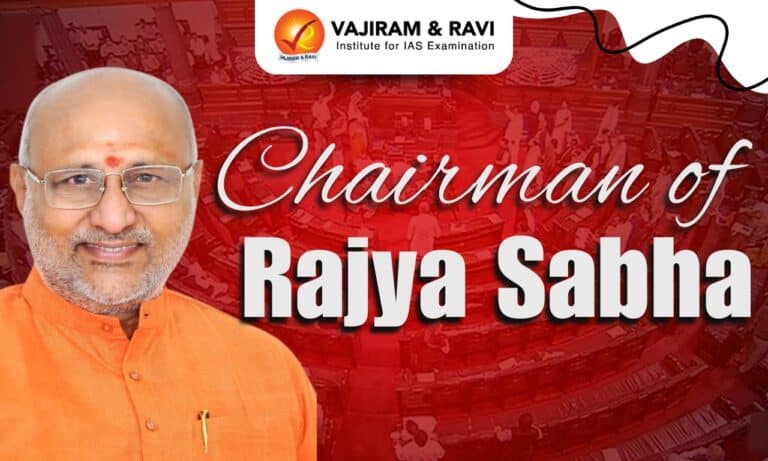
The Chairman of Rajya Sabha is the presiding officer of the Upper House of the Indian Parliament. As per the Constitution of India, the Vice President of India serves as the ex-officio Chairman of the Rajya Sabha. The Chairman plays a crucial role in ensuring the smooth functioning of the House, maintaining order during debates, interpreting parliamentary rules, and safeguarding the rights and privileges of members. Being a non-member of the House, the Chairman is expected to function impartially and uphold the dignity of parliamentary proceedings.
Chairman of Rajya Sabha Constitutional Provision
The office of the Chairman of Rajya Sabha is established under the Constitution of India. Various constitutional provisions define the powers, position, and responsibilities of the Chairman.
- Article 64 states that the Vice President of India shall be the ex-officio Chairman of the Rajya Sabha.
- Article 89(1) provides for the office of the Chairman and Deputy Chairman of the Rajya Sabha.
- The Chairman acts as the presiding officer of the Upper House and ensures that proceedings are conducted according to constitutional and parliamentary rules.
- The office symbolizes the principle of parliamentary neutrality and fairness.
- The Chairman safeguards the rights and privileges of members and protects the autonomy of the House.
- The Chairman does not belong to the regular membership of Rajya Sabha and functions independently.
- The Constitution empowers the Chairman to interpret and enforce the Rules of Procedure and Conduct of Business in the Rajya Sabha.
Election and Appointment of the Chairman of Rajya Sabha
The Chairman of Rajya Sabha is not elected separately for the office. The position is automatically held by the Vice President of India upon election.
- The Vice President of India is elected by an electoral college consisting of members of both Houses of Parliament.
- The election is conducted through the system of proportional representation by means of a single transferable vote.
- Voting takes place through a secret ballot.
- After being elected as Vice President, the individual automatically becomes the Chairman of Rajya Sabha.
- There is no separate oath for assuming the office of Chairman, as the Vice President takes an oath before entering office.
- The Chairman remains politically neutral while presiding over the proceedings of the House.
- The office ensures a clear separation between executive influence and legislative functioning.


Tenure of the Chairman of Rajya Sabha
The tenure of the Chairman is linked with the tenure of the Vice President of India.
- The Chairman holds office for five years from the date on which he enters office as Vice President.
- The Chairman continues until a successor assumes office.
- The office-holder may resign by submitting a resignation to the President of India.
- The Chairman may be removed before completion of tenure through a constitutional process.
- A person may be re-elected as Vice President and consequently continue as Chairman of Rajya Sabha.
- During a vacancy in the office of Vice President, the Deputy Chairman presides over the proceedings of the Rajya Sabha.
- The tenure provides stability and continuity in the functioning of the Upper House.
Chairman of Rajya Sabha Powers and Functions
The Chairman of Rajya Sabha performs several legislative, administrative, disciplinary, and procedural functions essential for the efficient functioning of Parliament.
- Presides over sittings of the Rajya Sabha and conducts the proceedings of the House.
- Maintains order and decorum during debates and discussions.
- Decides who may speak and regulates the time allotted for speeches.
- Interprets the Rules of Procedure and Conduct of Business.
- Ensures that parliamentary debates are conducted in a fair and orderly manner.
- Admits or rejects various motions, resolutions, and notices submitted by members.
- Can suspend members for unruly or disorderly conduct.
- Protects the privileges and rights of members of the House.
- Refers matters to various Parliamentary Committees whenever required.
- Allows discussions on matters of public importance.
- Acts as the custodian of parliamentary traditions and conventions.
- Exercises administrative control over the Rajya Sabha Secretariat.
- Represents the Rajya Sabha in national and international parliamentary forums.
- Decides procedural issues that arise during House proceedings.
- Unlike the Speaker of Lok Sabha, the Chairman does not have an ordinary vote but may exercise a casting vote in case of a tie.
Removal of the Chairman of Rajya Sabha
The Chairman can be removed only through the removal of the Vice President from office, as both positions are constitutionally linked.
- The procedure is provided under Article 67(b) of the Constitution.
- A resolution for removal may be initiated only in the Rajya Sabha.
- At least 14 days’ notice must be given before moving the resolution.
- The resolution must be passed by a majority of all the then members of the Rajya Sabha.
- After being passed in the Rajya Sabha, it must be agreed to by the Lok Sabha.
- During the consideration of the resolution, the Chairman cannot preside over the sitting of the House.
- The Deputy Chairman or another authorized member presides over the proceedings.
- The Chairman has the right to participate in discussions regarding the resolution.
Key Committees and Responsibilities Under the Chairman
The Chairman plays an important role in parliamentary committee functioning and administration.
- Nominates members to various Department-related Standing Committees.
- Refers bills and parliamentary matters to relevant committees for detailed examination.
- Supervises the functioning of several committees connected with Rajya Sabha.
- Plays a significant role in the Business Advisory Committee.
- Oversees matters relating to parliamentary privileges and ethics.
- Ensures committees function effectively and submit reports on time.
- Facilitates coordination between committees and the House.
- Exercises administrative supervision over the Rajya Sabha Secretariat.
- Encourages informed legislative scrutiny through committee mechanisms.
- Promotes accountability, transparency, and efficiency in parliamentary work.
Chairman of Rajya Sabha vs Speaker of Lok Sabha
The Chairman of Rajya Sabha and the Speaker of Lok Sabha are the presiding officers of the two Houses of Parliament. While both are responsible for maintaining order and ensuring the smooth conduct of legislative business, their constitutional position, method of election, powers, and functions differ significantly.
| Chairman of Rajya Sabha vs Speaker of Lok Sabha | ||
|
Basis of Comparison |
Chairman of Rajya Sabha |
Speaker of Lok Sabha |
|
Constitutional Position |
The Vice President of India serves as the ex-officio Chairman of Rajya Sabha. |
The Speaker is the presiding officer elected by the members of Lok Sabha. |
|
Constitutional Provision |
Governed by Articles 64 and 89 of the Constitution. |
Governed by Articles 93 to 97 of the Constitution. |
|
House Presided Over |
Presides over the Rajya Sabha (Upper House). |
Presides over the Lok Sabha (Lower House). |
|
Membership of the House |
Not a member of the Rajya Sabha. |
Must be a member of the Lok Sabha. |
|
Method of Election |
Becomes Chairman automatically upon election as Vice President of India. |
Elected by the members of the Lok Sabha from among themselves. |
|
Tenure |
Holds office for five years as Vice President. |
Continues until the dissolution of the Lok Sabha and until a new Speaker is elected. |
|
Voting Power |
Does not vote in the first instance but can exercise a casting vote in case of a tie. |
Does not vote ordinarily but exercises a casting vote when votes are equally divided. |
|
Money Bill Certification |
Has no role in certifying a Money Bill. |
Has the exclusive power to certify whether a Bill is a Money Bill. |
|
Joint Sitting of Parliament |
Does not preside over a Joint Sitting. |
Presides over the Joint Sitting of Parliament under Article 108. |
|
Removal Procedure |
Removed through a resolution for the removal of the Vice President under Article 67(b). |
Removed by a resolution passed by a majority of Lok Sabha members. |
|
Role in Parliamentary Committees |
Nominates members to several Rajya Sabha committees and supervises their functioning. |
Heads and supervises various Lok Sabha committees and parliamentary bodies. |
|
Control Over Secretariat |
Exercises administrative control over the Rajya Sabha Secretariat. |
Exercises administrative control over the Lok Sabha Secretariat. |
|
Role in Anti-Defection Cases |
No direct role in deciding disqualification of Rajya Sabha members under the Tenth Schedule. |
Decides disqualification petitions relating to Lok Sabha members under the Anti-Defection Law. |
|
Political Neutrality |
Expected to remain neutral as the constitutional head of the Upper House. |
Expected to function impartially despite being elected from a political party. |
|
Importance |
Ensures smooth functioning of the Upper House and protects federal interests represented in Rajya Sabha. |
Acts as the guardian of the Lower House and plays a crucial role in legislative and financial matters. |

 Last updated on Oct, 2026
→ UPSC 2027 Notification will be released on 13 January 2027 at upsconline.nic.in.
→ Check Nobel Prize 2026 Winners List here.
→ Download PIB PRiSM Monthly Magazine 2026 here.
→ Check UPSC Monthly Current Affairs Magazine The Recitals here.
→ Check out the latest UPSC Syllabus here.
→ Download UPSC Model Answers for Mains 2026
→ UPSC Mains Question Paper 2026 is out now for Essay & GS Paper 1, 2, 3 & 4.
→ UPSC Calendar 2027 has been released.
→ Enroll in Vajiram & Ravi’s UPSC Mains Test Series 2027 for structured answer writing practice, expert evaluation, and exam-oriented feedback.
→ Join Vajiram & Ravi’s UPSC Mentorship Program 2027 for personalized guidance, strategy planning, and one-to-one support from experienced mentors.
→ Go through the UPSC Mains Previous Year Papers to enhance your preparation.
→ UPSC has released UPSC Toppers List 2025 with the Civil Services final result on its official website.
→ Also check Best UPSC Coaching in India
Chairman of Rajya Sabha FAQs
Q1. Who is the Chairman of Rajya Sabha?+
Q2. Which Article of the Constitution provides for the Chairman of Rajya Sabha?+
Q3. Is the Chairman of Rajya Sabha a member of the House?+
Q4. How is the Chairman of Rajya Sabha elected?+
Q5. What is the tenure of the Chairman of Rajya Sabha?+
Q6. Can the Chairman of Rajya Sabha vote in the House?+
Q7. What are the main functions of the Chairman of Rajya Sabha?+
Tags: chairman of rajya sabha indian polity