US-Iran MoU Latest News
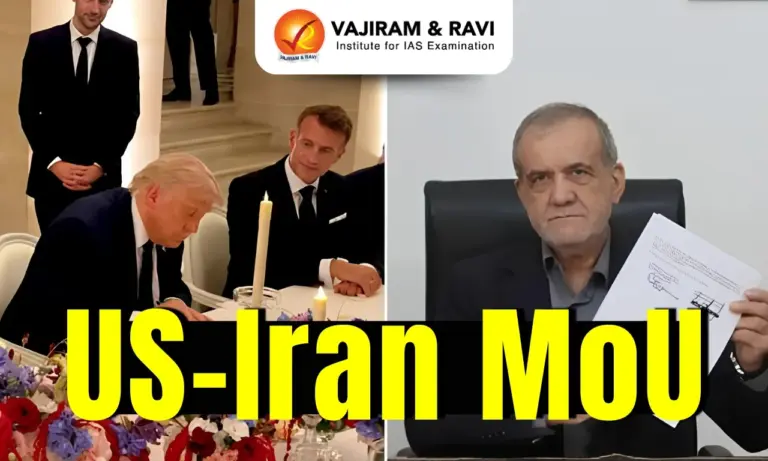
- The US and Iran formally signed a 14-clause Memorandum of Understanding (MoU) recently – the US signing at the Palace of Versailles, France, and Iran signing in Tehran.
- The MoU initiates a 60-day negotiation window for a final comprehensive deal. Unlike the 2015 JCPOA (which only addressed Iran’s nuclear programme), this MoU covers the entire US-Iran political relationship — making it potentially the most significant West Asia agreement since 1979.
The Big Picture: What Makes This MoU Different
- The 2015 JCPOA was purely a nuclear deal — Iran capped enrichment, the US eased sanctions. The 2026 MoU goes much further. It covers:
- War termination and ceasefire
- Hormuz navigation rights
- Sanctions relief
- Economic reconstruction
- Nuclear status quo
- Military withdrawal
- Non-interference in internal affairs
- Crucially, ballistic missiles and Iran’s regional proxy networks (Axis of Resistance) are NOT mentioned in any clause — a major gain for Tehran.
- The Axis of Resistance is an informal, Iran-led military coalition of state-controlled forces and armed militant groups operating across the Middle East.
- It includes – Iran, Hezbollah, The Houthis, Palestinian Militant Groups, Iraqi Militias.
- The expert’s key assessment: these terms could make Iran stronger than at any point since the 1979 Islamic Revolution.


Clause-by-Clause Summary
Clause 1 — End to Hostilities on All Fronts, Including Lebanon
- This is the principal war termination clause. The key advance over the April 8 ceasefire is that Lebanon is now explicitly included in the cessation of hostilities — something Israel had consistently resisted.
- The risk of Israel resuming strikes on Lebanon remains during the 60-day period.
- Iran has already demonstrated its flexibility — on June 14, it accepted US concessions (naval blockade removal) and held back from retaliating against Israel’s Beirut bombing, setting a new precedent.
Clause 2 — No US Interference in Iran’s Internal Affairs
- Between January and February 2026, the Trump administration oscillated between two justifications for military action — regime change and de-nuclearisation.
- This clause removes the regime change rationale permanently. For Tehran, this is historically significant given decades of US interventionism in Iranian internal politics.
Clause 3 — Option to Extend the 60-Day Period
- Both sides can mutually agree to extend the 60-day negotiation window before finalising a deal.
- However, any extension also prolongs the period during which Iran must keep Hormuz unconditionally open and the US must continue its military drawdown — creating domestic pressure on Tehran.
Clause 4 — Removal of US Naval Blockade
- The US Navy has already effectively withdrawn its blockade (by June 16). Full withdrawal refers to the remaining US Carrier Strike Groups deployed to the Strait of Hormuz.
Clause 5 — Passage Through the Strait of Hormuz
- Iran guarantees unconditional transit passage to all commercial shipping through Hormuz.
- However, the clause also allows Iran and Oman to define the future administration of the Strait — Iran’s consistent demand that Hormuz cannot return to its pre-war status.
- This is a significant geopolitical gain. Iran and Oman could potentially create a fee-based transit framework similar to Turkey’s arrangements for the Dardanelles and Bosphorus under the Montreux Convention.
- Given that 20–25% of global oil and 20% of global gas shipping passes through Hormuz, potential annual revenue could exceed $11–13 billion.
Clause 6 — $300 Billion Reconstruction Plan for Iran
- This is the most economically significant clause and the key difference from the 2015 JCPOA.
- The reconstruction fund is Iran’s pathway back into the international economy. It also contains incentives for businesses linked to Trump and Steve Witkoff (US Special Envoy to the Middle East) — suggesting commercial interests in deal durability.
Clause 7 — Full Sanctions Relief in Final Deal
- The final agreement must address multiple categories of US sanctions on Iran — covering energy, shipping, nuclear activities, and counter-terrorism designations.
- A Wall Street Journal estimate suggests Iranian oil and fuel sales post-sanctions relief could generate ~$60 billion annually.
Clause 8 — Iran Commits Not to Develop Nuclear Weapons
- Iran reaffirms its commitment not to pursue nuclear weapons — a position it has maintained since 2003. Two important nuances:
- US strikes on Natanz, Fordow, Arak, and Isfahan (June 2025) have already reduced Iran’s future enrichment capacity — making this commitment easier to give.
- However, Iran retains its stockpile of 60% enriched uranium — the MoU does NOT require transfer to a third country, a significant departure from the original US position.
- By late 2025, the IAEA had declared a “loss of continuity of knowledge” on Iran’s nuclear programme — meaning international monitoring had effectively broken down. Restoring this oversight will be a key challenge in the final agreement.
Clause 9 — Status Quo Until Final Deal
- Iran maintains the nuclear status quo (no further enrichment) for 60 days pending a final agreement.
- Critically, no clause mentions ballistic missiles or Iran’s support for regional non-state actors — Hezbollah, Houthis, Iraqi militias remain outside the MoU’s scope.
- Trump himself implied willingness to let Iran retain ballistic missile capabilities.
Clause 10 — Interim Sanctions Waivers
- Acts as a bridge arrangement — sanctions waivers apply immediately while full sanctions removal (Clause 7) is negotiated in the 60-day window.
Clause 11 — Unfreezing Iranian Assets
- Iran holds over $100 billion in frozen funds in foreign banks. Around $12 billion has already been unfrozen, facilitated through banks in Qatar and the UAE.
- Iranian President Pezeshkian stated these funds would be used to pay pending government salaries — indicating the depth of Iran’s economic distress.
Clause 12 — Monitoring Mechanism
- Creates an executive mechanism to monitor MoU implementation. This is essential for Clause 3 (extension of 60-day period) to work credibly — both sides need confidence that commitments are being honoured before agreeing to extend.
Clause 13 — Hierarchy of Priorities
- Sets the sequencing and priority order of issues to be negotiated during the 60-day window.
Clause 14 — UN Security Council Endorsement
- The final deal will be endorsed by a UN Security Council Resolution — notable given Trump’s general disdain for multilateral institutions.
- The 2015 JCPOA was endorsed by UNSCR 2231 under Article 25 of the UN Charter.
- However, the UNSC’s inability to prevent Trump’s 2018 unilateral withdrawal from JCPOA proved the limits of such endorsement. This time, Iran may seek stronger fail-safe arrangements within the UNSC framework.
Conclusion
- The 2026 MoU is not just a ceasefire — it is a potential reordering of West Asia’s geopolitical architecture.
- Iran emerges from the war not weakened but diplomatically empowered, economically recovering, and militarily unrestrained in its missile and proxy capabilities.
- The next 60 days will determine whether this fragile opening becomes a lasting realignment — or another chapter in the long history of broken US-Iran agreements.

 Last updated on Oct, 2026
→ UPSC 2027 Notification will be released on 13 January 2027 at upsconline.nic.in.
→ Check Nobel Prize 2026 Winners List here.
→ Download PIB PRiSM Monthly Magazine 2026 here.
→ Check UPSC Monthly Current Affairs Magazine The Recitals here.
→ Check out the latest UPSC Syllabus here.
→ Download UPSC Model Answers for Mains 2026
→ UPSC Mains Question Paper 2026 is out now for Essay & GS Paper 1, 2, 3 & 4.
→ UPSC Calendar 2027 has been released.
→ Enroll in Vajiram & Ravi’s UPSC Mains Test Series 2027 for structured answer writing practice, expert evaluation, and exam-oriented feedback.
→ Join Vajiram & Ravi’s UPSC Mentorship Program 2027 for personalized guidance, strategy planning, and one-to-one support from experienced mentors.
→ Go through the UPSC Mains Previous Year Papers to enhance your preparation.
→ UPSC has released UPSC Toppers List 2025 with the Civil Services final result on its official website.
→ Also check Best UPSC Coaching in India
US-Iran MoU FAQs
Q1. Why is the US-Iran MoU considered different from the 2015 JCPOA?+
Q2. What are the key objectives of the US-Iran MoU?+
Q3. How does the US-Iran MoU address Iran's nuclear programme?+
Q4. What economic benefits are envisaged under the US-Iran MoU?+
Q5. Why is the Strait of Hormuz important in the US-Iran MoU?+
Tags: mains articles upsc current affairs upsc mains current affairs US-Iran MoU