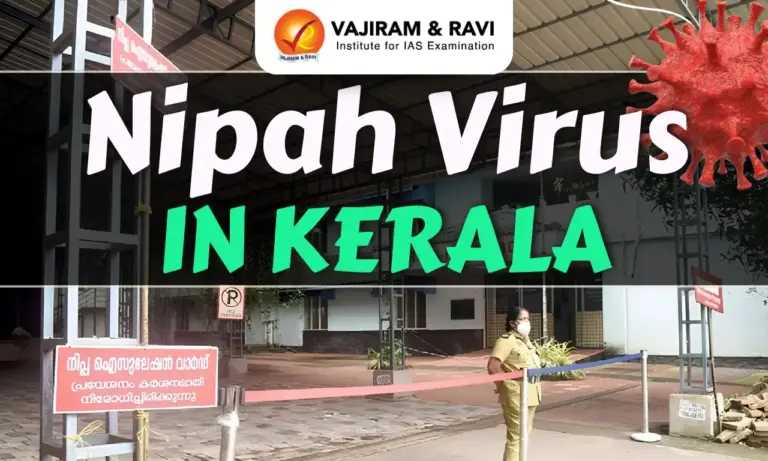
Nipah Virus in Kerala Latest News
- Nipah Virus (NiV) has resurfaced in Kozhikode, Kerala, with a 43-year-old patient currently battling for life at Kozhikode Medical College.
- This marks yet another spillover event in a state that has now faced recurring Nipah outbreaks since 2018, prompting renewed scrutiny of Kerala’s unique vulnerability to this high-threat pathogen.
Kerala’s Nipah Timeline: A Pattern of Recurrence
- The pattern reveals near-annual spillover events, mostly independent of each other — indicating the virus is endemically established in Kerala’s environment, not arriving from a single source.


The Natural Reservoir: Fruit Bats
- Research has consistently identified the Indian flying fox (Pteropus medius), or fruit bat, as the natural reservoir of Nipah virus in Kerala.
- In the 2018 outbreak, ~25% of sampled bats tested positive for Nipah viral RNA.
- Subsequent outbreaks have repeatedly confirmed NiV presence in bat populations.
- A mapping study by the Kerala Forest Research Institute’s Department of Wildlife Biology found that almost all bat roosting sites are located near human habitats — dramatically increasing zoonotic exposure risk.
Why Kerala: The Ecological and Demographic Convergence
- Kerala’s vulnerability stems from a unique convergence of factors:
- Seasonal Spillover Window
- Peak Nipah risk occurs April to September, when:
- Fruit-laden trees are abundant (attracting bats)
- Bat foraging activity increases
- Bat breeding season coincides
- Viral shedding dynamics peak
- This pattern has remained consistent since the 2018 outbreak.
- Peak Nipah risk occurs April to September, when:
- Western Ghats Biodiversity Pressure
- The Western Ghats, one of the world’s richest biodiversity hotspots, lies along Kerala’s eastern flank.
- Only about 1,60,000 sq. km of this rich biosphere is formally protected.
- Kerala’s high population density combined with settlements, plantations, and farmland abutting forest fringes creates intense human-wildlife interface.
- Habitat Disruption
- Scientific literature links emerging zoonosis to: Deforestation; Habitat fragmentation; Urbanisation; Agricultural intensification.
- When wildlife habitats are disturbed, animals are pushed into closer contact with human settlements — increasing spillover risk.
- Climate-related ecological disruptions are flagged as a growing future risk factor.
Beyond Nipah: Kerala’s Broader Zoonotic Risk Profile
- Nipah is just one part of a wider pattern. Kerala also faces recurring risk from: Kyasanur Forest Disease (KFD); Leptospirosis; Scrub typhus; Japanese encephalitis; West Nile fever; Rabies; Avian influenza.
- The WHO has flagged Kerala for vigilance on three High Threat Pathogens: Nipah; Avian Influenza (H5N1); KFD.
- These share high mortality, high transmissibility, and pandemic potential.
- Nipah specifically has been classified by WHO as a priority pathogen due to its lethality, unpredictability, and potential to trigger the next pandemic.
From Crisis to Resilience: Kerala’s Health System Response
- The 2018 Wake-Up Call – The first outbreak caught the health system off guard. Of 23 cases:
- Only the index case was community-acquired.
- All remaining cases resulted from nosocomial transmission (hospital-acquired infection) across three different hospitals.
- Reforms Since 2018 – Kerala converted this crisis into systemic learning:
- Developed a clinical algorithm for emerging viral infections at tertiary care level.
- Strengthened diagnostic and research capacities.
- Augmented hospital infection control practices.
- Built clinician capacity to maintain high index of suspicion for unusual Acute Encephalitis Syndrome (AES) cases and case clustering.
- Established stringent monitoring of all AES cases of unknown origin and severe respiratory infections.
- Expanded the Virus Research and Diagnostic Laboratory (VRDL) network for early lab confirmation.
- In every outbreak since 2018, the health system has rapidly identified the index case and swiftly contained the event.
- Human-to-human transmission has occurred only once since 2018 — in the 2023 cluster.
The ‘One Health’ Strategy
- Kerala has adopted a ‘One Health’ approach — recognising the interconnection between human, animal, and environmental health.
Key Initiatives
- Community-based surveillance network of over 2.5 lakh trained volunteers tracking unusual disease trends, including abnormal animal/bird deaths, enabling early detection of zoonotic outbreaks (Nipah, Mpox).
- One Health Centre for Nipah Research and Resilience, established in 2023 at Kozhikode — focused on community awareness, resilience-building, and rapid response capacity.
- Documentation of every Nipah outbreak in the state, prioritising future research on epidemiology, sero-surveillance, and host factors.
- Collaboration with the National Institute of Virology (NIV) to develop indigenous monoclonal antibodies specific to the Bangladesh strain of NiV circulating in Kerala.
Key Takeaway: Spillover Cannot Be Prevented, Only Managed
- Because Kerala harbours a perennial natural reservoir of Nipah virus in its bat populations, complete prevention of spillover events may not be possible. The state’s strategy has therefore shifted from prevention to:
- Reducing bat-human interface through community awareness
- Early detection through robust surveillance
- Rapid containment to prevent wider outbreaks

 Last updated on Oct, 2026
→ UPSC 2027 Notification will be released on 13 January 2027 at upsconline.nic.in.
→ Check Nobel Prize 2026 Winners List here.
→ Download PIB PRiSM Monthly Magazine 2026 here.
→ Check UPSC Monthly Current Affairs Magazine The Recitals here.
→ Check out the latest UPSC Syllabus here.
→ Download UPSC Model Answers for Mains 2026
→ UPSC Mains Question Paper 2026 is out now for Essay & GS Paper 1, 2, 3 & 4.
→ UPSC Calendar 2027 has been released.
→ Enroll in Vajiram & Ravi’s UPSC Mains Test Series 2027 for structured answer writing practice, expert evaluation, and exam-oriented feedback.
→ Join Vajiram & Ravi’s UPSC Mentorship Program 2027 for personalized guidance, strategy planning, and one-to-one support from experienced mentors.
→ Go through the UPSC Mains Previous Year Papers to enhance your preparation.
→ UPSC has released UPSC Toppers List 2025 with the Civil Services final result on its official website.
→ Also check Best UPSC Coaching in India
Nipah Virus in Kerala FAQs
Q1. Why does Nipah Virus in Kerala recur frequently?+
Q2. What role do fruit bats play in Nipah Virus in Kerala outbreaks?+
Q3. How has Kerala responded to Nipah Virus in Kerala since 2018?+
Q4. What is the One Health approach to managing Nipah Virus in Kerala?+
Q5. Can Nipah Virus in Kerala be completely prevented?+
Tags: mains articles Nipah Virus in Kerala upsc current affairs upsc mains current affair