Fundamental Right to Walk Latest News
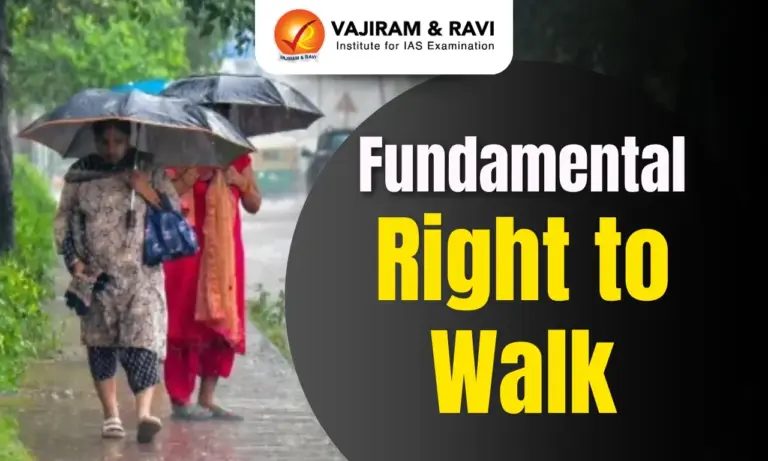
- In a landmark judgment delivered, the Supreme Court of India held that the right to walk on safe and demarcated footpaths is a Fundamental Right under Part III of the Constitution.
- It declared that pedestrian rights take precedence over the movement of motorised vehicles and called for a comprehensive legal framework to protect walkers.
Constitutional Recognition of the Right to Walk
- The SC ruled that the right to walk is an intrinsic component of:
- Article 19(1)(d) – Freedom of movement.
- Article 19(1)(a) – Freedom of expression.
- Article 19(1)(b) – Freedom of assembly.
- Article 19(1)(c) – Freedom of association.
- Article 21 – Right to life and personal liberty.
- The Court observed that walking is the most basic form of human movement and predates all motorised transport.
- Therefore, access to safe and well-maintained footpaths is an essential constitutional entitlement.


Footpaths as an Enforceable Constitutional Right
- The judgment established that wherever a road exists, there is a corresponding legal duty to provide and maintain pedestrian infrastructure.
- Duty bearers identified:
- The responsibility lies with the Urban Development Authorities, Municipal Corporations, Municipalities, and Panchayats.
- These bodies must demarcate footpaths, construct and maintain pedestrian facilities, protect footpaths from encroachment and neglect, and ensure safe pedestrian movement.
- The Court made this obligation judicially enforceable, transforming pedestrian infrastructure from a governance concern into a constitutional requirement.
Pedestrian Rights Above Motorised Traffic
- The Court unequivocally held that the fundamental right to walk on demarcated footpaths has priority over the privilege of movement by motorised vehicles.
- It criticised the prevailing urban planning approach that disproportionately favours automobiles while marginalising pedestrians.
- According to the Court, roads and public spaces cannot become the monopoly of the motorised class; equitable access must be ensured for all citizens.
Compensation and Legal Remedies
- A significant aspect of the judgment is the recognition of independent remedies for violation of pedestrian rights.
- Citizens suffering injury, loss, or hardship due to absence of footpaths, encroached footpaths, and poorly maintained pedestrian infrastructure, can seek:
- Constitutional remedies,
- Restitution,
- Compensation from public authorities.
- These remedies are separate from compensation available under the Motor Vehicles Act, 1988.
The Case Behind the Judgment
- The ruling emerged from a compensation dispute involving a five-year-old boy who died after being hit by a tanker while walking to school with his father.
- Compensation timeline:
- Motor Accident Claims Tribunal (MACT): ₹7.82 lakh compensation.
- High Court: Reduced compensation to ₹4.70 lakh.
- SC: Enhanced compensation to ₹11.44 lakh with directions for payment within two months.
- The Court noted that the accident site lacked both a footpath and a pedestrian crossing, highlighting systemic neglect of pedestrian safety.
Critique of Existing Legal Framework
- The Court observed that the Motor Vehicles Act, 1988 primarily regulates drivers and vehicles but does not adequately recognise pedestrian rights.
- Key observations:
- Existing laws impose duties on drivers but fail to establish a right to walk safely.
- Pedestrian interests have remained secondary to motor traffic.
- Urban planning has historically prioritised roads for vehicles rather than people.
- The Bench described the neglect of walkers as a long-standing “civilisational problem“.
Cultural and Democratic Significance of Walking
- The judgment emphasised that walking is not merely a mode of transport but also:
- A means of expression.
- A form of social interaction and association.
- An instrument of political mobilisation and resistance.
- A part of India’s cultural and freedom movement heritage.
- The Court linked walking to democratic freedoms protected under Article 19 and the constitutional duty under Article 51A to cherish the ideals of the freedom struggle.
Need for a Dedicated Law and Regulator
- Recognising the absence of a comprehensive legal framework, the Court urged the government to enact legislation that would:
- Formally declare the right to walk.
- Clearly identify duty bearers.
- Provide quick remedies for violations.
- Protect and enhance pedestrian infrastructure.
- Establish a full-time regulatory authority for planning, implementation, monitoring and enforcement.
- The Court stressed that institutional accountability and expert oversight are essential for meaningful implementation.
Conclusion
- A truly inclusive democracy is measured not by the speed of its vehicles but by the safety, accessibility and dignity it affords its most vulnerable road users.
- Going forward, embedding pedestrian-centric urban planning within the framework of sustainable development and the right to the city can help create safer, healthier and more equitable public spaces.

 Last updated on Oct, 2026
→ UPSC 2027 Notification will be released on 13 January 2027 at upsconline.nic.in.
→ Check Nobel Prize 2026 Winners List here.
→ Download PIB PRiSM Monthly Magazine 2026 here.
→ Check UPSC Monthly Current Affairs Magazine The Recitals here.
→ Check out the latest UPSC Syllabus here.
→ Download UPSC Model Answers for Mains 2026
→ UPSC Mains Question Paper 2026 is out now for Essay & GS Paper 1, 2, 3 & 4.
→ UPSC Calendar 2027 has been released.
→ Enroll in Vajiram & Ravi’s UPSC Mains Test Series 2027 for structured answer writing practice, expert evaluation, and exam-oriented feedback.
→ Join Vajiram & Ravi’s UPSC Mentorship Program 2027 for personalized guidance, strategy planning, and one-to-one support from experienced mentors.
→ Go through the UPSC Mains Previous Year Papers to enhance your preparation.
→ UPSC has released UPSC Toppers List 2025 with the Civil Services final result on its official website.
→ Also check Best UPSC Coaching in India
Fundamental Right to Walk FAQs
Q1. How did the SC derive the right to walk as a Fundamental Right under the Constitution?+
Q2. Why is the SC's judgment on pedestrian rights significant for urban governance?+
Q3. What obligations has the SC imposed on local authorities regarding pedestrian infrastructure?+
Q4. Why did the Supreme Court criticise the Motor Vehicles Act, 1988?+
Q5. How does the judgment contribute to the goals of sustainable and inclusive urban development?+
Tags: fundamental right to walk mains articles upsc current affairs upsc mains current affair