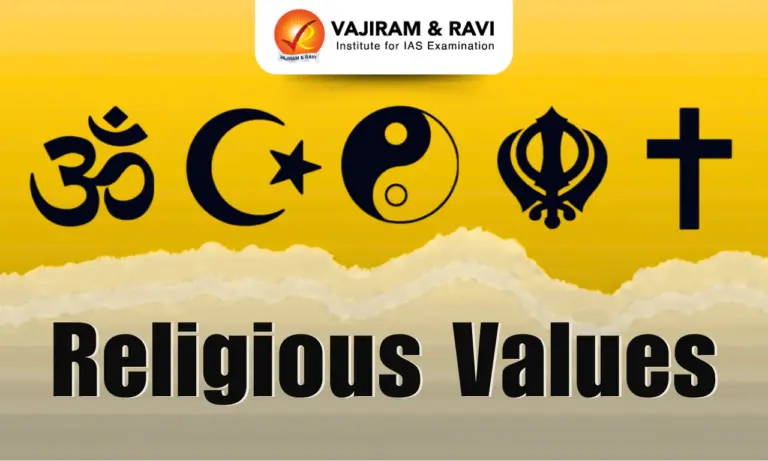
Religious Values refer to the moral and ethical principles that are inspired by different religions and spiritual traditions. These values guide individuals in distinguishing between right and wrong and encourage qualities like compassion, honesty, tolerance, and respect for others. In a general sense, religious values help in building a sense of inner discipline, harmony, and moral responsibility in society. They also promote peaceful coexistence, unity in diversity, and ethical living, making them important for both personal growth and social well-being.
Relationship between Religion & Ethics
Religion and ethics are closely connected as both deal with human conduct and moral values, though they differ in their approach. The discussion below explores their differences, common ground, and how they together shape moral behavior in society.
Basic Difference between Religion and Ethics
- Religion is mainly based on faith, beliefs, and traditions that are followed by people often without questioning, as they are considered sacred and rooted in spiritual authority.
- Ethics, in contrast, is based on reason and logical thinking, where ideas of right and wrong can be questioned, debated, and improved over time.
- The standards of religion come from holy books, customs, and divine teachings, whereas ethics develops from human reasoning, experience, and social needs.
- Religion focuses more on the relationship between humans and a higher power or soul, while ethics deals with human actions and their impact on others.
- Religion often emphasizes belief and devotion, whereas ethics emphasizes justification of actions through rational thinking.
- While religions may differ across regions and cultures, ethical principles generally aim to be universal and applicable to all humans.
Shared Foundations of Religion and Ethics
- Both religion and ethics promote universal human values such as truth, honesty, compassion, forgiveness, and justice, which are essential for a good society.
- Most religions teach people to lead a moral and disciplined life, which aligns closely with ethical behavior.
- The ideas of right and wrong conduct are central to both, even though religion explains them through faith and ethics explains them through reason.
- In many societies, religion acts as the first source of moral learning, especially during early life.
- Values like peace, harmony, respect, and inclusiveness are shared by both religious teachings and ethical principles.
- Ethics often helps in interpreting religious teachings in a modern and practical way, especially in changing social contexts.
- Together, they aim to create a balanced and responsible society where individuals act with awareness and morality.
Also Read : Human Values
Key Religious Values in Indian Society
- Tolerance and Pluralism: The principle of Sarva Dharma Sambhava promotes equal respect for all religions. It supports unity in diversity by enabling peaceful coexistence. It also fosters mutual respect and social harmony in society.
- Compassion and Non-violence: Values like Ahimsa (non-violence) and Dayaa (compassion) emphasize kindness towards all living beings. Rooted in religions like Hinduism, Buddhism, and Jainism, they encourage avoiding harm and practicing empathy. They promote peaceful living and influence ethical behavior and lifestyle choices.
- Duty and Righteousness: The concepts of Dharma and Karma guide individuals to perform their duties sincerely and ethically without attachment to outcomes. Dharma represents moral responsibility and righteous conduct, while karma highlights accountability for one’s actions, shaping disciplined and value-based living.
- Charity and Social Welfare: Practices such as Zakat, Daana, and Seva promote the spirit of giving and helping the underprivileged. These values encourage wealth sharing, reduce social inequalities, and foster a sense of collective responsibility towards society, strengthening the welfare-oriented nature of communities.
- Respect for Nature and Life: Indian religious traditions emphasize the interconnectedness of all life forms, promoting environmental responsibility. Nature is often considered sacred, leading to practices that protect animals, forests, and rivers, thereby encouraging sustainable living and ecological balance.
- Spiritual Discipline: Practices like prayer, meditation, fasting, and yoga help develop self-control, patience, and inner peace. These disciplines not only enhance spiritual growth but also contribute to mental well-being, emotional stability, and ethical decision-making in daily life.
- Karma and Rebirth: The belief in karma and rebirth teaches that actions in the present life influence future outcomes. This creates a strong sense of moral accountability, motivating individuals to act ethically and avoid wrongdoing, as consequences are seen as inevitable.
- Respect for Elders and Traditions: Respecting elders and ancestors is a deeply ingrained value across religions in India. It helps maintain family unity, cultural continuity, and social stability, while also promoting humility and gratitude among younger generations.
- Hospitality and Generosity: Ideals like Atithi Devo Bhava (guest is God) highlight the importance of hospitality and kindness. This value fosters warmth, generosity, and a welcoming attitude in social interactions, strengthening community bonds.
Also Read : Spiritual Values


Role of Religion as an Ethical Guide
- Religion acts as an internal moral guide, helping individuals make ethical choices even when there is no external supervision.
- Belief in a higher power creates a sense of moral responsibility and accountability, discouraging unethical behavior like corruption.
- Teachings like Nishkama Karma promote selfless action, which is especially important in public service.
- Religious values encourage empathy, compassion, and service to others, which are essential qualities for civil servants.
- It also helps in building strong character, honesty, and integrity, which are crucial in governance.
- Religion provides mental strength and emotional balance, helping individuals deal with stress and ethical dilemmas.
- It inspires individuals to work for the larger good of society rather than personal benefit.
Causes of Conflict between Religion and Ethics
- Since religion is based on faith and emotions, questioning it can hurt people’s sentiments and lead to conflicts.
- Ethical thinking based on logic and rationality may challenge outdated or rigid religious practices.
- Conflicts arise between constitutional morality (modern laws and rights) and traditional social or religious practices.
- Feelings of religious superiority or intolerance can create division and misunderstandings.
- Misinterpretation or selective use of religious teachings can lead to biased or unethical actions.
- Political misuse of religion can result in communal tensions and social unrest.
- Lack of awareness and education further deepens the gap between faith-based beliefs and rational ethics.
Challenges and Limitations
- Dogma vs Rationality: Blindly following rigid beliefs can hinder social progress and necessary reforms.
- Communalism: Religion can sometimes be misused to create division, hatred, and conflict among communities.
- Exclusivity of Practices: Some religious practices may promote group identity over universal human values, leading to friction.
- Resistance to Change: Certain beliefs may oppose modern ideas like gender equality, scientific thinking, and human rights.
- Conflict with Constitutional Values: Some practices may clash with principles of equality, liberty, and justice.
- Moral Policing: Imposing religious values on others can restrict individual freedom and personal choices.
Ways to Address Conflicts
- A balanced approach that respects both faith and rational thinking can help reduce conflicts, as it allows individuals to value traditions while also accepting logical and ethical reasoning.
- Promoting interfaith dialogue and mutual respect helps different communities understand each other’s beliefs, reducing misunderstandings and building social harmony.
- Strengthening constitutional morality ensures that laws are fair, equal, and just for all citizens, even when they differ from certain traditional or religious practices.
- Education and awareness play a key role in developing critical thinking and ethical understanding, which helps people move beyond blind faith and make informed decisions.
- Emphasizing common universal values like compassion, tolerance, and respect can unite people despite religious differences and create a sense of shared humanity.
- Governments and leaders should promote inclusive, secular, and unbiased policies to ensure that no group feels marginalized or discriminated against.
- Society should focus more on shared human values rather than differences in beliefs, encouraging cooperation, peace, and collective progress.
Religion in Modern Society
- Religion still plays an important role in shaping social behavior, traditions, and moral values.
- However, modernization has increased the importance of science, rationality, and individual thinking.
- In some societies, the decline of religious influence has raised concerns about loss of moral values.
- Many countries now recognize the need to combine modern education with moral and ethical teachings.
- Practices like meditation, mindfulness, and yoga are widely used today for mental peace and clarity.
- In professional life, spiritual values help improve decision-making, stress management, and leadership qualities.
- A balanced integration of modern ethics and positive religious teachings is becoming essential in today’s world.

 Last updated on Oct, 2026
→ UPSC 2027 Notification will be released on 13 January 2027 at upsconline.nic.in.
→ Check Nobel Prize 2026 Winners List here.
→ Download PIB PRiSM Monthly Magazine 2026 here.
→ Check UPSC Monthly Current Affairs Magazine The Recitals here.
→ Check out the latest UPSC Syllabus here.
→ Download UPSC Model Answers for Mains 2026
→ UPSC Mains Question Paper 2026 is out now for Essay & GS Paper 1, 2, 3 & 4.
→ UPSC Calendar 2027 has been released.
→ Enroll in Vajiram & Ravi’s UPSC Mains Test Series 2027 for structured answer writing practice, expert evaluation, and exam-oriented feedback.
→ Join Vajiram & Ravi’s UPSC Mentorship Program 2027 for personalized guidance, strategy planning, and one-to-one support from experienced mentors.
→ Go through the UPSC Mains Previous Year Papers to enhance your preparation.
→ UPSC has released UPSC Toppers List 2025 with the Civil Services final result on its official website.
→ Also check Best UPSC Coaching in India
Religious Values FAQs
Q1. What are Religious Values?+
Q2. What is the difference between Religion and Ethics?+
Q3. How are Religion and Ethics related?+
Q4. What are the key religious values in Indian society?+
Q5. What is Sarva Dharma Sambhava?+
Tags: ethics ethics notes religious values