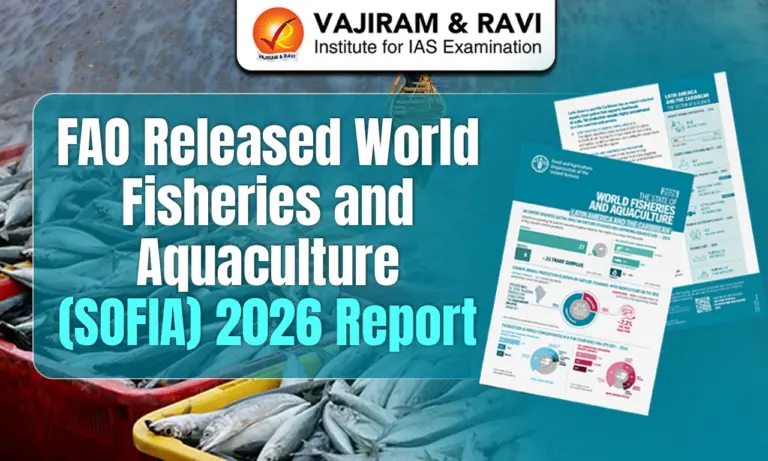
The Food and Agriculture Organization (FAO) released the State of World Fisheries and Aquaculture (SOFIA) 2026 Report, which highlights record global fisheries production, the growing importance of aquaculture, India’s emergence as a leading fisheries producer, and concerns over the sustainability of marine fish stocks.
State of World Fisheries and Aquaculture (SOFIA) 2026 Report Global Findings
State of World Fisheries and Aquaculture (SOFIA) 2026 Report highlights the growing importance of fisheries and aquaculture in global food systems while drawing attention to sustainability concerns.
- Global fisheries and aquaculture production reached a historic high of 235 million tonnes in 2024, including 195 million tonnes of aquatic animals and 40 million tonnes of algae, registering a growth of 5.2% over 2022.
- Aquaculture production touched a record 142 million tonnes, emerging as the principal driver of growth in aquatic food production worldwide.
- China, Indonesia, India, Vietnam and Bangladesh together accounted for 84% of global aquaculture production.
- Global per capita availability of aquatic foods increased to 21.3 kg in 2024, reflecting their growing contribution to food and nutritional security.
India’s Performance
India emerged as one of the leading fisheries and aquaculture nations, strengthening its position in the global aquatic food economy.
- Second-Largest Aquatic Animal Producer: India contributed 9% of global aquatic animal production in 2024, ranking second only to China.
- World Leader in Inland Fisheries: India produced 2.2 million tonnes from inland capture fisheries, making it the largest producer globally.
- Second-Largest Aquaculture Producer: India accounted for 12% of global farmed aquatic animal production, ranking second in aquaculture output.
- Major Contributor to Global Aquaculture: India is part of the five-country group that produces 82% of the world’s farmed aquatic animals.


Drivers of India’s Performance
India’s success in fisheries and aquaculture is the result of policy support, technological advancement and resource utilisation.
- Inland fisheries leadership driven by scientific fish farming, pond aquaculture, reservoir fisheries and cage culture, making inland waters the main driver of production growth.
- Strong government support through Pradhan Mantri Matsya Sampada Yojana, Blue Revolution, Fisheries and Aquaculture Infrastructure Development Fund and Pradhan Mantri Matsya Kisan Samridhi Sah-Yojana, with public investment exceeding ₹38,500 crore since 2015.
- Abundant inland water resources including rivers, reservoirs, ponds, lakes, tanks and wetlands providing a strong natural base for fisheries expansion.
- Technological modernisation through improved hatcheries, quality fish seed, scientific feed management and disease control, increasing aquaculture productivity from about 3 tonnes per hectare to 4.7 tonnes per hectare in 2025.
- Expansion of modern systems such as cage culture, recirculatory aquaculture systems and biofloc technology enhancing productivity and efficiency.
- Export-led growth driven by global demand for Indian seafood, especially frozen shrimp, strengthening commercial aquaculture and private investment.
- Growth in fisheries exports from ₹46,663 crore in 2019–20 to ₹62,408 crore in 2024–25, positioning India among leading global seafood exporters.
- Expansion of institutional credit and farmer collectivisation through more than 4.5 lakh Kisan Credit Cards and over 2,195 Fish Farmer Producer Organisations improving access to finance and markets.
- Development of infrastructure such as cold chains, ice plants, transport facilities, kiosks and aqua parks reducing post-harvest losses and improving value chains.
Significance for India
The report highlights the strategic importance of fisheries and aquaculture for India’s economy, food security and Blue Economy ambitions.
- Food and Nutritional Security: Fisheries provide an affordable source of protein and micronutrients for a large population.
- Livelihood Generation: The sector supports millions of fishers, fish farmers, processors and workers across coastal and inland regions.
- Boost to Blue Economy: Strong fisheries growth supports India’s vision of sustainable utilisation of marine and aquatic resources.
- Export Potential: Rising production enhances seafood exports and foreign exchange earnings.
- Rural Development: Expansion of aquaculture creates employment opportunities and diversifies rural incomes.
Challenges Highlighted by the SOFIA 2026 Report
Despite record growth in fisheries and aquaculture production, the report warns that ensuring sustainable and equitable growth of the sector remains a major global challenge.
- The share of marine fish stocks being harvested within biologically sustainable levels declined from 64.5% in 2021 to 62.4% in 2023, indicating increasing pressure on global marine resources.
- Growing demand for fish and aquatic foods is leading to overfishing in several regions, threatening the long-term health and productivity of marine ecosystems.
- Climate change is affecting fisheries through rising ocean temperatures, changing fish migration patterns, ocean acidification and extreme weather events, creating uncertainties for fishers and coastal communities.
- Although aquaculture is driving global production growth, its rapid expansion requires sustainable management of water resources, feed, disease control and environmental impacts to prevent ecological degradation.
- Significant regional disparities continue to exist in access to aquatic foods. While Asia recorded the highest per capita availability at 26.3 kg, Africa averaged only 9.1 kg, highlighting unequal access to nutrition and food resources.
The report emphasises that future growth in fisheries and aquaculture must be accompanied by stronger resource conservation, ecosystem-based management, climate resilience and sustainable production practices to ensure long-term food security and livelihood protection.

 Last updated on Oct, 2026
→ UPSC 2027 Notification will be released on 13 January 2027 at upsconline.nic.in.
→ Asian Games 2026 are being held in Aichi-Nagoya, Japan, from 19 September to 4 October.
→ Check Nobel Prize 2026 Winners List here.
→ Download PIB PRiSM Monthly Magazine 2026 here.
→ Check UPSC Monthly Current Affairs Magazine The Recitals here.
→ Check out the latest UPSC Syllabus here.
→ Download UPSC Model Answers for Mains 2026
→ UPSC Mains Question Paper 2026 is out now for Essay & GS Paper 1, 2, 3 & 4.
→ UPSC Calendar 2027 has been released.
→ Enroll in Vajiram & Ravi’s UPSC Mains Test Series 2027 for structured answer writing practice, expert evaluation, and exam-oriented feedback.
→ Join Vajiram & Ravi’s UPSC Mentorship Program 2027 for personalized guidance, strategy planning, and one-to-one support from experienced mentors.
→ Go through the UPSC Mains Previous Year Papers to enhance your preparation.
→ UPSC has released UPSC Toppers List 2025 with the Civil Services final result on its official website.
→ Also check Best UPSC Coaching in India
FAO State of World Fisheries and Aquaculture (SOFIA) 2026 Report FAQs
Q1. What is the State of World Fisheries and Aquaculture 2026 Report?+
Q2. What are the key global findings of the State of World Fisheries and Aquaculture 2026 Report?+
Q3. What is India’s position in global fisheries and aquaculture?+
Q4. What are the major drivers of India’s fisheries growth?+
Q5. What are the major concerns highlighted in the State of World Fisheries and Aquaculture 2026 Report?+