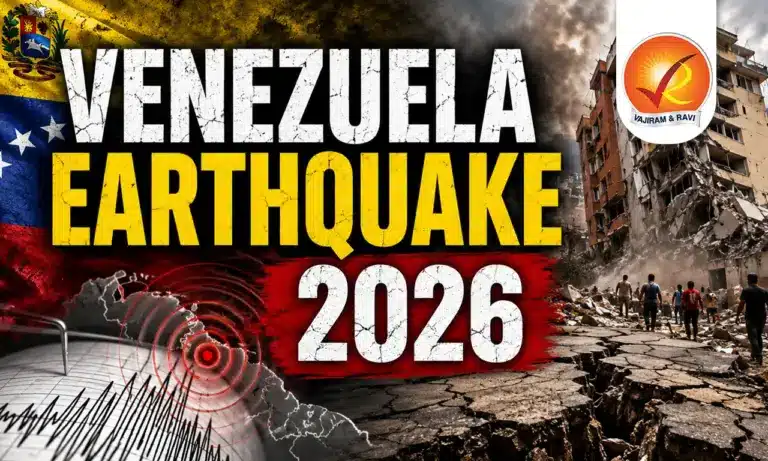
The Venezuela Earthquake of June 2026 is among the most powerful seismic events recorded in the country in more than a century. Two major earthquakes struck within seconds of each other has caused widespread destruction across Caracas and several north-central states. The disaster led to significant loss of life, large scale infrastructure damage and emergency response operations. The event is important for understanding earthquake hazards, tectonic activity, disaster management and vulnerability in northern South America.
Venezuela Earthquake
Two powerful earthquakes struck Venezuela on 25 June 2026, causing severe destruction and triggering a nationwide emergency response.
- Twin Earthquake Event and Epicenter: A magnitude 7.2 earthquake struck about 24 km from San Felipe in Yaracuy state. Just 39 seconds later, a stronger magnitude 7.5 earthquake occurred near Morón in Carabobo state, around 168 km west of Caracas.
- Human Casualties: The Acting President confirmed at least 32 deaths and around 700 injuries.
- Historic Magnitude: The magnitude 7.5 earthquake became the strongest recorded earthquake in Venezuela or its nearby coastal region since 1900. The previous major event was the 1900 San Narciso earthquake of magnitude 7.7.
- Affected Areas: Caracas, Miranda, La Guaira, Aragua, Carabobo and Falcón experienced extensive damage.
- National Emergency: The Venezuela Government declared a nationwide state of emergency as continued seismic activity complicated rescue efforts and increased structural risks.
Venezuela Earthquake Causes
Venezuela lies along the boundary between the Caribbean Plate and the South American Plate. Continuous movement between these plates makes the region one of the most seismically active zones in northern South America.
- According to the USGS, the magnitude 7.5 earthquake resulted from shallow strike slip faulting. In this process, rock masses move horizontally past each other along a fault, generating powerful seismic energy.
- The magnitude 7.2 earthquake was classified as a foreshock, while the magnitude 7.5 event became the mainshock.
- The two earthquakes occurred only 39 seconds apart and had comparable magnitudes. This rare phenomenon is known as a Seismic Doublet.


Venezuela Earthquake Impacts
The Venezuela Earthquake produced widespread social, economic and infrastructural consequences across Venezuela.
- Regional Effects: Tremors were felt beyond Venezuela, including in Bogotá, Colombia.
- Damage Assessment: The US Geological Survey estimated that the disaster had the potential to cause very high casualties, with preliminary projections ranging from 10,000 to 100,000 deaths if destruction proved more extensive.
- Rescue Challenges: Continuous aftershocks and damaged infrastructure complicated search and rescue operations.
- Economic Consequences: The disaster added pressure to Venezuela’s already strained economy. Reconstruction costs, infrastructure repairs and disruption of transportation networks are expected to create additional financial burdens.
- Transport Disruptions: Closure of Simón Bolívar International Airport disrupted domestic and international connectivity.
- Way Forward: The event highlighted the importance of earthquake resistant construction, early emergency response systems, public preparedness and risk reduction strategies in tectonically active regions.
What is a Seismic Doublet?
A Seismic Doublet is a rare earthquake phenomenon where two powerful earthquakes of similar magnitude occur within a short period.
- Meaning: A doublet earthquake occurs when two major earthquakes of comparable magnitude strike close together in time and location, making both events capable of causing significant destruction.
- How It Forms: Seismologists explain that stress released by the first earthquake can rapidly transfer to a nearby fault segment, triggering another large rupture before geological stability is restored.
- Difference from Aftershocks: In a normal earthquake sequence, smaller aftershocks follow a major mainshock. In a seismic doublet, both earthquakes are large and considered independent primary seismic events.
- Examples: Well known doublet earthquakes have been recorded near Sumatra in 2007, the Kuril Islands in 2006, and in regions such as Alaska, Japan, the Philippines and the Pacific Ring of Fire.

 Last updated on Oct, 2026
→ UPSC 2027 Notification will be released on 13 January 2027 at upsconline.nic.in.
→ Check Nobel Prize 2026 Winners List here.
→ Download PIB PRiSM Monthly Magazine 2026 here.
→ Check UPSC Monthly Current Affairs Magazine The Recitals here.
→ Check out the latest UPSC Syllabus here.
→ Download UPSC Model Answers for Mains 2026
→ UPSC Mains Question Paper 2026 is out now for Essay & GS Paper 1, 2, 3 & 4.
→ UPSC Calendar 2027 has been released.
→ Enroll in Vajiram & Ravi’s UPSC Mains Test Series 2027 for structured answer writing practice, expert evaluation, and exam-oriented feedback.
→ Join Vajiram & Ravi’s UPSC Mentorship Program 2027 for personalized guidance, strategy planning, and one-to-one support from experienced mentors.
→ Go through the UPSC Mains Previous Year Papers to enhance your preparation.
→ UPSC has released UPSC Toppers List 2025 with the Civil Services final result on its official website.
→ Also check Best UPSC Coaching in India
Venezuela Earthquake FAQs
Q1. What was the magnitude of the Venezuela Earthquake 2026?+
Q2. What is the death toll and casualties of the Venezuela Earthquake 2026?+
Q3. Why is the Venezuela Earthquake 2026 considered historic?+
Q4. What caused the Venezuela Earthquake 2026?+
Q5. What is a Seismic Doublet in the Venezuela Earthquake case?+
Tags: earthquake venezuela venezuela earthquake