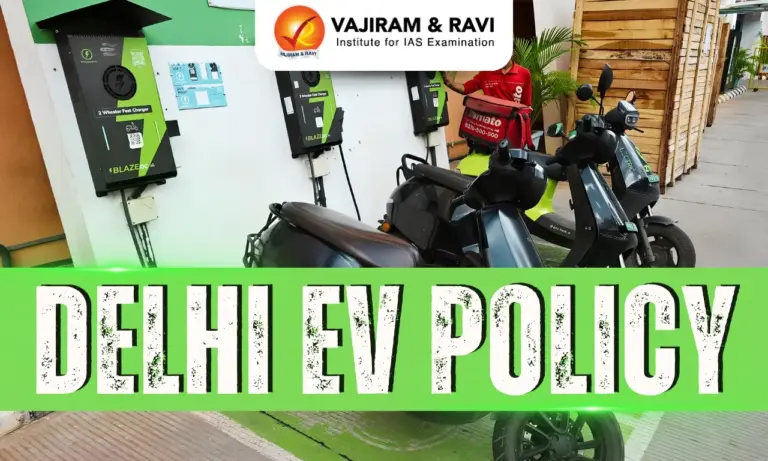
Delhi EV Policy Latest News
- The Delhi government has announced its EV Policy 2.0, mandating that all new two- and three-wheelers registered in the city be electric from April 2028 to combat the capital’s chronic air pollution.
Background: Delhi’s Air Pollution and Transport Sector
- Delhi consistently ranks among the most polluted cities in the world, with the transport sector being one of the most significant contributors to its air pollution.
- While winter episodes of severe air quality draw the most attention, vehicular emissions remain a persistent source of pollution throughout the year.
- According to the Commission for Air Quality Management (CAQM) report, ‘Identification of the Causes for Worsening AQI in Delhi-NCR‘:
- Vehicular emissions contribute around 23% of Delhi’s PM2.5 pollution during winter, making transport the single largest pollution source within the city.
- Two-wheelers constitute nearly 67% of Delhi’s vehicle stock, making their rapid electrification critical.
- Three-wheelers, commercial cars, and N1 category goods vehicles (up to 3.5 tonnes) are priority segments due to their high daily utilisation.
- Multiple studies, including those by TERI, IIT Kanpur, and SAFAR, have consistently identified transport, particularly two-wheelers, as the largest contributor to PM2.5, PM10, and other pollutants.
- Notably, secondary particulate matter formed from vehicular NOx and VOCs accounts for about 27% of winter PM2.5 in Delhi.


Understanding Electric Vehicles (EVs)
- Electric Vehicles (EVs) are vehicles powered by electric motors using energy stored in batteries, rather than internal combustion engines running on petrol or diesel. They are categorised as:
- Battery Electric Vehicles (BEVs): Pure EVs running entirely on batteries with zero tailpipe emissions.
- Hybrid Electric Vehicles (HEVs): Combine an internal combustion engine with an electric motor.
- Strong/Plug-in Hybrids (PHEVs): Can run on electric power for limited distances before switching to fuel.
- Pure EVs offer superior environmental benefits as zero-emission vehicles, which is the focus of Delhi’s new policy.
News Summary
- The Delhi government announced its EV Policy 2.0, representing a sweeping, first-of-its-kind policy reform in the country.
- The policy comes into effect on July 1, following approval from the Lieutenant Governor.
- Key Mandates
- The policy introduces phased mandates for electrification:
- No petrol motorcycles and scooters can be registered in Delhi after March 31, 2028.
- Registration of new CNG auto-rickshaws will stop at the end of 2026.
- From April 2028, every new two- and three-wheeler sold in Delhi must be an electric vehicle.
- The government clarified that existing non-electric two-wheelers will not be forced off the roads; only new registrations will be restricted, giving customers and manufacturers a two-year transition window.
- The policy introduces phased mandates for electrification:
- Objectives
- Make Delhi pollution-free by March 31, 2030
- Achieve a minimum 30% electrification of Delhi’s vehicle fleet by March 2030
- Government investment of Rs. 15,000 crore on incentives and charging infrastructure
- Cash Incentives
- The policy offers substantial purchase incentives:
- Electric two-wheeler: Year-1 (Rs. 30,000); Year-2 (Rs. 20,000); Year-3 (Rs. 10,000)
- Passenger three-wheeler: Year-1 (Rs. 50,000); Year-2 (Rs. 40,000); Year-3 (Rs. 30,000)
- The policy offers substantial purchase incentives:
- Scrappage Benefits
- BS-IV or older two-wheelers: Rs. 10,000 for scrapping.
- Three-wheelers: Rs. 25,000 for scrapping.
- N1 electric trucks: Subsidy up to Rs. 1 lakh in the first year; Rs. 50,000 for scrapping older N1 trucks.
- Gramin Seva vehicles: Rs. 15,000 scrapping incentive.
- First 1 lakh owners scrapping BS-IV or older four-wheelers: Rs. 1 lakh incentive.
- Road Tax Waiver
- 100% waiver on road tax and registration charges for fully electric vehicles.
- For four-wheelers, the exemption applies to vehicles priced up to Rs. 30 lakh (ex-showroom).
- EVs bought under the policy cannot be sold or registered in another state for three years.
Focus on Pure EVs
- Notably, the final policy dropped the incentive for strong hybrid vehicles that had been proposed in the draft.
- The draft had suggested a 50% exemption of road tax and registration charges for strong hybrids up to Rs. 30 lakh, intended as a transition bridge.
- The government chose to focus exclusively on pure EVs, which offer superior zero-emission benefits.
- Charging Infrastructure
- A major constraint to EV adoption has been limited charging infrastructure. The new policy envisages the establishment of more than 30,000 public charging points across the capital.
Significance and Challenges
- Why It Matters
- Two out of every three vehicles in Delhi are two-wheelers, making the mandate enormously significant.
- Currently, electric two-wheelers make up only about 7.5% of annual two-wheeler registrations (36,962 out of 4,92,288 in 2025).
- Going from 7.5% to 100% in less than two years is a hugely ambitious target.
- Broader Impact
- Delhi has historically led the country in clean air interventions.
- The policy is expected to influence other states, particularly those in the NCR region, to consider similar electrification mandates.
- Challenges
- Rapid scaling of charging infrastructure to meet demand.
- Manufacturer readiness to supply electric two- and three-wheelers at scale.
- Affordability and consumer acceptance.
- Grid capacity to handle increased electricity demand.
- Battery disposal and recycling concerns.

 Last updated on August, 2026
→ UPSC Mains Question Paper 2026 is out now for Essay & GS Paper 1, 2, 3 & 4.
→ UPSC Mains GS Paper 1 2026 is out now.
→ UPSC Mains GS Paper 2 2026 is out now.
→ UPSC Mains GS Paper 3 2026 is out now.
→ UPSC Mains GS Paper 4 2026 is out now.
→ UPSC Mains Indian Language Paper & English Compulsory Paper are out now.
→ Check out the latest UPSC Syllabus 2026 here.
→ UPSC Mains Admit Card 2026 is now out.
→ Enroll in Vajiram & Ravi’s UPSC Mains Test Series 2027 for structured answer writing practice, expert evaluation, and exam-oriented feedback.
→ Join Vajiram & Ravi’s UPSC Mentorship Program 2027 for personalized guidance, strategy planning, and one-to-one support from experienced mentors.
→ Go through the UPSC Mains Previous Year Papers to enhance your preparation.
→ Download UPSC Mains Essay Paper 2025, UPSC Mains GS Paper-I 2025, UPSC Mains GS Paper-II 2025, UPSC Mains GS Paper-III 2025, UPSC Mains GS Paper-IV 2025, UPSC Mains English (Compulsory) Paper 2025, UPSC Mains Hindi (Qualifying) Paper 2025 here.
→ UPSC has released UPSC Toppers List 2025 with the Civil Services final result on its official website.
→ UPSC Calendar 2027 has been released.
→ Also check Best UPSC Coaching in India
Delhi EV Policy FAQs
Q1. What is the key mandate of Delhi's EV Policy 2.0?+
Q2. What incentive is offered for buying an electric two-wheeler?+
Q3. Why does the policy focus on two-wheelers?+
Q4. Did the final policy include incentives for strong hybrid vehicles?+
Q5. How many charging points does the policy envisage?+
Tags: Delhi EV Policy mains articles upsc current affairs upsc mains current affairs