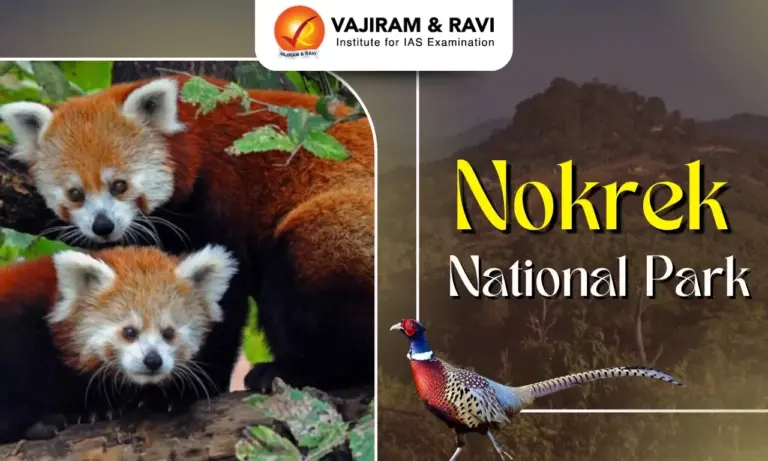
Nokrek National Park is a beautiful and peaceful wildlife area located in the state of Meghalaya, India. Surrounded by lush green forests and hills, it is known for its rich biodiversity and natural beauty. The park is home to many rare plants and animals, including the famous red panda and the unique citrus fruit species found only in this region. It is also an important part of the Nokrek Biosphere Reserve, helping to protect nature and maintain ecological balance.
Nokrek National Park Location and Establishment
- Nokrek National Park is situated in the Garo Hills region of Meghalaya, and it spreads across the districts of East Garo Hills, West Garo Hills, and South Garo Hills, making it an important protected area in northeastern India.
- The park was officially declared a National Park in 1986, while the final legal notification was issued later in 1997, ensuring stronger protection and conservation measures.
- Although the park itself is relatively small in size, it forms the core area of the Nokrek Biosphere Reserve, which covers a much larger landscape of about 82,000 hectares.
- An important feature of this park is that the land was acquired by the Government of Meghalaya through purchase from local communities, reflecting cooperation between authorities and indigenous people.
Nokrek National Park Physical Features and Landscape
- The terrain of Nokrek National Park is completely hilly and rugged, with variations in slope and elevation that give the area a distinct natural character.
- The northern slopes are comparatively gentle, making them less steep, while the southern side consists of moderate to very steep slopes, creating a more challenging and uneven landscape.
- The region is marked by dense clusters of low hills, and a prominent ridge known as the Tura Ridge runs through the park from the northwest to the northeast direction.
- The Tura Ridge acts as the backbone of the Garo Hills and is located at the western edge of the Meghalaya Plateau, playing a key role in shaping the region’s geography.
- The average elevation of the park is around 1,200 meters above sea level, and the terrain is often rocky with very little topsoil in certain areas, which affects vegetation growth.


Nokrek National Park Rivers and Climate
- Nokrek is the source region for several important rivers and streams, which originate in the hills and flow through narrow, rocky channels before joining larger river systems.
- These rivers eventually drain into major river basins like the Brahmaputra and Meghna, highlighting the park’s hydrological importance.
- Key rivers originating from this region include the Simsang River (the longest in the Garo Hills) along with Ganol, Dareng, Nitai, and Bhugi rivers.
- The climate of the park is tropical in nature, characterized by high temperatures, heavy rainfall, and high humidity, especially during the monsoon season.
Nokrek National Park Vegetation and Forest Types
- The forests in Nokrek National Park are mainly classified as Tropical Semi-evergreen forests, according to the classification by Champion and Seth (1968).
- At higher elevations, the forests often turn into cloud forests, where the area remains covered with clouds for long periods, especially during the monsoon season.
- The southern slopes have limited vegetation, mainly consisting of patches of moist deciduous forests along with areas of secondary scrub vegetation.
- In contrast, the northern slopes have very little vegetation, mostly restricted to narrow stretches of evergreen forests and semi-evergreen forests along the ridge.
- The park is especially significant for its population of Citrus indica, a rare and primitive wild citrus species believed to be one of the earliest relatives of cultivated citrus fruits.
Nokrek National Park Biodiversity Importance (KBA Status)
- Nokrek National Park is recognized as a Key Biodiversity Area (KBA) of international significance, which means it is crucial for the conservation of global biodiversity.
- The site meets important conservation criteria, including those used to identify Important Bird and Biodiversity Areas (IBA) and Alliance for Zero Extinction (AZE) sites.
- Its classification is based on globally accepted standards such as the IUCN Red List (2002), emphasizing the presence of threatened and unique species.
Flora of Nokrek National Park
- Nokrek National Park, part of the UNESCO-recognized Nokrek Biosphere Reserve in Meghalaya, is dominated by dense tropical evergreen and semi-evergreen forests, covering nearly 90% of the area.
- This rich vegetation supports a wide variety of plant species adapted to humid subtropical conditions.
- One of the most important features of the park is the presence of Citrus indica, locally known as Memang Narang or the “orange of the spirits.” It is considered the primitive ancestor of modern citrus fruits, which led to the establishment of a National Citrus Gene Sanctuary within the biosphere reserve.
- The forest canopy is formed by tall and well-developed trees, including species such as silk cotton tree (Bombax ceiba), hairy sterculia (Sterculia villosa), and golden shower tree (Cassia fistula). Other common trees like champak and white meranti further add to the dense forest cover.
- The park also contains extensive bamboo vegetation, especially in the lower hills and valleys. Species such as Bambusa tulda and Dendrocalamus strictus grow in thick clusters and play an important ecological role.
- Nokrek is known for its rich diversity of orchids and ferns, both epiphytic (growing on trees) and terrestrial. Beautiful species like Cymbidium elegans, Dendrobium densiflorum, and Eria reticulata are commonly found, adding color and variety to the forest.
- The moist and humid environment supports a wide range of medicinal plants and herbs, which are traditionally used by local communities. Important species include Swertia chirata, Dioscorea bulbifera, and wild lemongrass, highlighting the park’s ecological and medicinal importance.
Nokrek National Park Bird Diversity (Avifauna)
- Around 150 species of birds have been recorded in the park, making it an important site for bird conservation and study.
- The park includes restricted-range species as well as several species that are specific to particular ecological regions or biomes.
- Due to its elevation range (600-1400 m), Nokrek falls under two major biomes: the Indo-Chinese Tropical Moist Forest and the Sino-Himalayan Subtropical Forest.
- Species such as the Oriental White-backed Vulture and Slender-billed Vulture have been observed here, indicating the ecological importance of the park.
- Although local communities report the presence of the Rufous-necked Hornbill, more scientific surveys are needed to confirm its status.
- Because of its rich bird diversity and presence of threatened species, the park has been identified as an Important Bird Area (IBA).
- The park is known for its diversity of wild cats, including Tiger, Leopard, Clouded Leopard, Golden Cat, and Leopard Cat, which play a key role in maintaining ecological balance.
- Other carnivores found here include the Golden Jackal, Wild Dog (Dhole), and Himalayan Black Bear, which are important predators in the ecosystem.
- The park is home to several primate species such as the Hoolock Gibbon, Capped Langur, Rhesus Macaque, and Stump-tailed Macaque, highlighting its rich biodiversity.
- Common herbivores include Wild Boar, Sambar, Barking Deer, Serow, and Gaur, which form an essential part of the food chain.
- Smaller carnivores like civets and the Binturong are also found here, along with a significant population of the Indian Elephant, which uses this region as part of its natural habitat.
Nokrek National Park Significance
- Nokrek National Park is an important biodiversity hotspot and forms part of a UNESCO-recognized biosphere reserve, making it globally significant.
- It is known for rare and endangered species such as the red panda, clouded leopard, and Asian elephant, which attract conservation attention.
- The presence of ancient citrus species adds to its scientific and ecological importance.
- Overall, the park plays a crucial role in protecting wildlife, maintaining ecological balance, and preserving the natural heritage of the region.

 Last updated on Sep, 2026
→ UPSC Mains Question Paper 2026 is out now for Essay & GS Paper 1, 2, 3 & 4.
→ UPSC Mains GS Paper 1 2026 is out now.
→ UPSC Mains GS Paper 2 2026 is out now.
→ UPSC Mains GS Paper 3 2026 is out now.
→ UPSC Mains GS Paper 4 2026 is out now.
→ UPSC Mains Indian Language Paper & English Compulsory Paper are out now.
→ Check out the latest UPSC Syllabus 2026 here.
→ UPSC Mains Admit Card 2026 is now out.
→ Enroll in Vajiram & Ravi’s UPSC Mains Test Series 2027 for structured answer writing practice, expert evaluation, and exam-oriented feedback.
→ Join Vajiram & Ravi’s UPSC Mentorship Program 2027 for personalized guidance, strategy planning, and one-to-one support from experienced mentors.
→ Go through the UPSC Mains Previous Year Papers to enhance your preparation.
→ Download UPSC Mains Essay Paper 2025, UPSC Mains GS Paper-I 2025, UPSC Mains GS Paper-II 2025, UPSC Mains GS Paper-III 2025, UPSC Mains GS Paper-IV 2025, UPSC Mains English (Compulsory) Paper 2025, UPSC Mains Hindi (Qualifying) Paper 2025 here.
→ UPSC has released UPSC Toppers List 2025 with the Civil Services final result on its official website.
→ UPSC Calendar 2027 has been released.
→ Also check Best UPSC Coaching in India
Nokrek National Park FAQs
Q1. Where is Nokrek National Park located?+
Q2. When was Nokrek National Park established?+
Q3. What is Nokrek National Park famous for?+
Q4. What is the Nokrek Biosphere Reserve?+
Q5. Why is Nokrek a Key Biodiversity Area (KBA)?+
Tags: environment environment notes nokrek national park