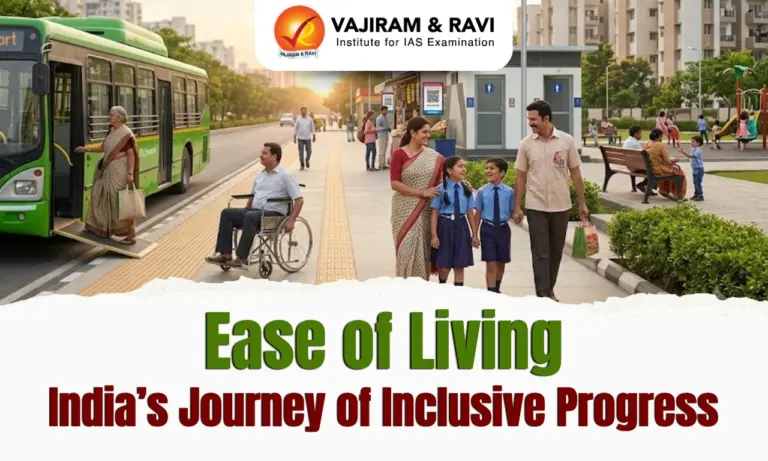
Ease of Living means ensuring that every citizen has access to quality housing, basic amenities, financial services, modern infrastructure and responsive governance. Between 2014 and 2026, India adopted a citizen-centric, technology-driven and mission-mode approach that transformed everyday life through greater dignity, convenience and opportunity, laying a strong foundation for Viksit Bharat 2047.
Housing and Urban Transformation
Since 2014, India has significantly expanded affordable housing while strengthening urban infrastructure to improve the quality of life.
- Pradhan Mantri Awas Yojana (PMAY) transformed housing delivery in both urban and rural India.
- Under PMAY-Urban, launched in 2015, over 1.25 crore houses have been sanctioned and more than 98 lakh completed, compared to only 8 lakh houses completed under previous schemes (2005–14). PMAY-U 2.0 (2024) provides financial assistance up to ₹2.5 lakh, with mandatory ownership or co-ownership by women, promoting gender empowerment.
- Similarly, PMAY-Gramin, launched in 2016, sanctioned 3.91 crore rural houses, of which 3.05 crore have been completed. Nearly 75% of these houses are owned solely or jointly by women, while every house is integrated with toilets, electricity and drinking water.
- Urban development also expanded beyond housing through the Atal Mission for Rejuvenation and Urban Transformation (AMRUT). While AMRUT (2015) improved water supply, sewerage, green spaces and urban transport across 500 cities, AMRUT 2.0 (2021) extended these services to all 4,800 statutory towns with an outlay of ₹2.99 lakh crore, significantly strengthening urban infrastructure.
Universal Access to Basic Amenities
Access to clean cooking fuel, safe drinking water, sanitation and electricity is central to improving health, reducing poverty and enhancing the quality of life.
Clean Cooking Fuel: The Pradhan Mantri Ujjwala Yojana (PMUY), launched in 2016, replaced traditional cooking fuels with clean LPG connections. Today, more than 10.57 crore LPG connections have been provided, increasing LPG coverage from 55.9% in 2014 to 107.2% in 2026. Besides reducing indoor air pollution, the scheme has improved women’s health, dignity and productivity.
Safe drinking water: The Jal Jeevan Mission (JJM) was launched in 2019 with the vision of Har Ghar Jal.
- At its launch in 2019, only 16.72% of rural households had tap water connections. By June 2026, coverage increased to 81.94%, with over 15.86 crore rural households receiving tap water.
- Nearly 12 crore new connections were added within six years.
- More than 9 crore women have been relieved from the burden of fetching water, while 1.81 lakh villages have achieved Har Ghar Jal status and 11 States/UTs have attained universal rural tap water coverage.
- To ensure quality, 2,843 laboratories tested 38.78 lakh water samples, while 24.8 lakh women were trained in field testing.
Sanitation: Sanitation witnessed another remarkable transformation through the Swachh Bharat Mission.
- Rural sanitation coverage increased from 39% in 2014 to 100% in 2019, with over 12.14 crore household toilets constructed and 5.69 lakh villages becoming ODF Plus.
- In urban India, more than 63 lakh household toilets and 6 lakh community toilets were built.
- Door-to-door waste collection increased from 43% to 98%, while waste processing improved from 16% to 82%.
- According to the World Health Organization (WHO), India recorded nearly 3 lakh fewer diarrhoeal deaths in 2019 compared to 2014.
Collectively, these initiatives have enhanced public health, women’s dignity, environmental sustainability and community participation.


Reliable, Affordable and Clean Energy
India’s power sector has witnessed unprecedented expansion over the past twelve years.
- Installed electricity generation capacity more than doubled from 248 GW (2014) to over 532 GW (2026).
- Renewable energy capacity increased from 76.38 GW to 274.69 GW, making India the third-largest clean energy capacity globally.
- Solar energy expanded from 2.82 GW to 150.26 GW, while wind capacity increased to 56.09 GW.
- Electricity supply became significantly more reliable, with rural supply increasing from 12.5 hours to 22.6 hours per day, while urban areas now receive nearly 23.4 hours of power daily. National energy shortage declined sharply from 4.2% to only 0.03%.
- The SAUBHAGYA Scheme connected nearly 2.86 crore households with electricity, ensuring universal household electrification.
- The PM Surya Ghar Muft Bijli Yojana (2024) has further empowered households by providing rooftop solar subsidies of up to ₹78,000, enabling families to receive up to 300 free units of electricity every month. Over 40 lakh households have already adopted rooftop solar systems.
- Similarly, the UJALA Scheme distributed 37 crore LED bulbs, generating annual household savings of over ₹19,000 crore while improving energy efficiency.
As households became more secure and comfortable, the next step was enabling citizens to participate fully in the formal economy.
Financial Inclusion
Inclusive growth requires universal access to banking, credit and financial security.
- The JAM Trinity (Jan Dhan-Aadhaar-Mobile) created a robust digital architecture for welfare delivery.
- Under the Pradhan Mantri Jan Dhan Yojana, bank accounts increased from 14.72 crore in 2015 to over 58 crore by June 2026, with deposits crossing ₹3 lakh crore. More than 40.6 crore RuPay cards have strengthened financial security.
- Jan Dhan also became the backbone of Direct Benefit Transfer (DBT). During FY 2024-25, nearly ₹6.9 lakh crore was transferred directly under 327 welfare schemes, reducing leakages and ensuring transparent delivery.
- Credit access improved through the Pradhan Mantri Mudra Yojana (PMMY), under which over 57.7 crore collateral-free loans worth ₹40 lakh crore have been sanctioned.
- Nearly 66% of beneficiaries are women, while almost half belong to SC, ST and OBC communities, promoting both entrepreneurship and social justice.
- The Tarun Plus category further increased the loan limit to ₹20 lakh for successful entrepreneurs.
Transforming Mobility and Connectivity
Infrastructure development has significantly reduced travel time while expanding economic opportunities across regions.
- India’s road network has grown to 63.73 lakh km, becoming the second-largest in the world.
- National Highways expanded from 91,287 km to 1,46,572 km, while over 3,644 km of expressways became operational.
- Landmark projects such as the Atal Tunnel, Sudarshan Setu, Maitri Setu, Z-Morh Tunnel, Delhi-Dehradun Economic Corridor, Dwarka Expressway and Ahmedabad-Dholera Expressway improved strategic and regional connectivity.
- Under Pradhan Mantri Gram Sadak Yojana (PMGSY), 99.6% eligible habitations have been connected through all-weather roads, improving access to markets, schools and healthcare facilities.
- Railway electrification increased from 20% before 2014 to 99.6% by March 2026.
- The indigenous Kavach safety system significantly reduced train accidents from 135 (2014-15) to only 16 (2025-26).
- Expansion of Vande Bharat, Amrit Bharat trains, redevelopment of 1,338 stations under the Amrit Bharat Station Scheme and progress on the Mumbai-Ahmedabad Bullet Train have improved speed, comfort and safety.
- Regional air connectivity expanded through the UDAN Scheme, operationalising 665 routes across 95 airports, while the number of operational airports increased from 74 to 165.
- Over 1.64 crore passengers have benefited from affordable air travel. Passenger convenience further improved through Digi Yatra and UDAN Yatri Cafes.
- Urban mobility has also been transformed. Metro rail expanded from 248 km across five cities in 2014 to 1,155 km across 26 cities in 2026, making India home to the third-largest metro network globally. The Delhi-Meerut Namo Bharat RRTS represents the next generation of high-speed regional transit.
Responsive Governance: Making Government Citizen-Centric
Ease of Living depends not only on infrastructure but also on how efficiently citizens interact with government institutions.
- The Jan Vishwas Acts decriminalised hundreds of minor offences, replacing imprisonment with civil penalties, reducing compliance burdens and promoting ease of doing business as well as ease of living.
- Citizen participation expanded through MyGov, which now has over 6 crore registered users, enabling direct engagement in policymaking.
- The CPGRAMS platform resolved around 6 lakh grievances between January 2025 and February 2026 with nearly 70% citizen satisfaction, strengthening accountability.
- The PM GatiShakti National Master Plan integrated 58 Ministries through a GIS-based platform using over 3,200 data layers, enabling coordinated infrastructure planning and faster project implementation.
Challenges
Despite significant progress in improving Ease of Living, several structural and implementation challenges remain that need targeted attention for sustaining inclusive development.
- Affordability issues: LPG refills remain a concern for vulnerable households despite high coverage under PMUY.
- Resource sustainability: Increasing pressure on groundwater and water resources raises concerns for long-term sustainability of Jal Jeevan Mission gains.
- Maintenance of assets: Ensuring upkeep and quality of housing, roads, water systems and urban infrastructure remains a key challenge.
- Regional disparities: Uneven implementation across states leads to variation in service delivery outcomes.
- Digital divide: Unequal access to digital infrastructure limits full inclusion in governance and financial services.
- Employment generation: Infrastructure growth must be matched with creation of quality and stable jobs.
Way Forward
Going ahead, sustaining the gains of Ease of Living requires deeper integration of governance systems, improved service delivery, and long-term sustainability-focused reforms.
- Greater convergence of welfare programmes: Integrate housing, water, sanitation, electricity, health and livelihood schemes for holistic and efficient delivery.
- Climate-resilient infrastructure: Promote sustainable urbanisation with water conservation, green buildings, renewable energy and disaster-resilient planning.
- Strengthening local governments: Empower Panchayati Raj Institutions and Urban Local Bodies with adequate funds, functions and functionaries for last-mile delivery.
- Improved service quality: Shift focus from mere coverage expansion to reliability, efficiency and user satisfaction in public services.
- Enhanced citizen participation: Strengthen platforms like MyGov and grievance systems for participatory governance and accountability.

 Last updated on Sep, 2026
→ UPSC 2027 Notification will be released on 13 January 2027 at upsconline.nic.in.
→ UPSC Mains Question Paper 2026 is out now for Essay & GS Paper 1, 2, 3 & 4.
→ UPSC Mains GS Paper 1 2026 is out now.
→ UPSC Mains GS Paper 2 2026 is out now.
→ UPSC Mains GS Paper 3 2026 is out now.
→ UPSC Mains GS Paper 4 2026 is out now.
→ UPSC Mains Indian Language Paper & English Compulsory Paper are out now.
→ Check out the latest UPSC Syllabus 2026 here.
→ UPSC Mains Admit Card 2026 is now out.
→ Enroll in Vajiram & Ravi’s UPSC Mains Test Series 2027 for structured answer writing practice, expert evaluation, and exam-oriented feedback.
→ Join Vajiram & Ravi’s UPSC Mentorship Program 2027 for personalized guidance, strategy planning, and one-to-one support from experienced mentors.
→ Go through the UPSC Mains Previous Year Papers to enhance your preparation.
→ Download UPSC Mains Essay Paper 2025, UPSC Mains GS Paper-I 2025, UPSC Mains GS Paper-II 2025, UPSC Mains GS Paper-III 2025, UPSC Mains GS Paper-IV 2025, UPSC Mains English (Compulsory) Paper 2025, UPSC Mains Hindi (Qualifying) Paper 2025 here.
→ UPSC has released UPSC Toppers List 2025 with the Civil Services final result on its official website.
→ UPSC Calendar 2027 has been released.
→ Also check Best UPSC Coaching in India
Ease of Living FAQs
Q1. What is meant by “Ease of Living” in the Indian context?+
Q2. Which major housing schemes contributed to improving Ease of Living in India?+
Q3. How has India improved access to basic amenities under Ease of Living initiatives?+
Q4. What role has financial inclusion played in improving Ease of Living?+
Q5. What are the key challenges and future priorities for improving Ease of Living in India?+
Tags: ease of living