Citizenship Rights Latest News
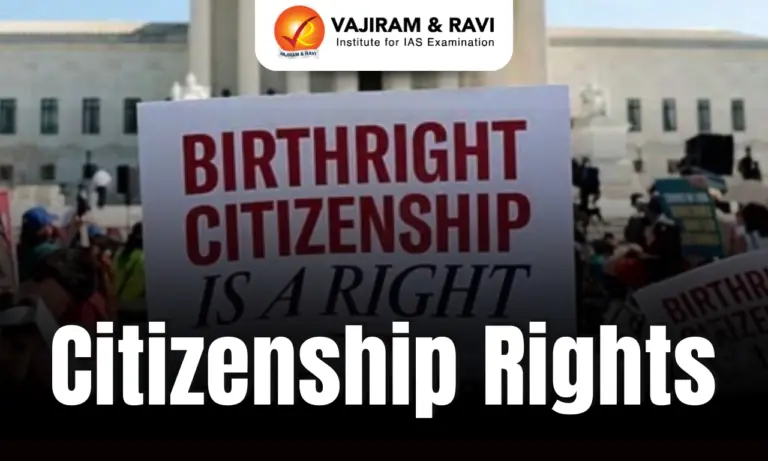
- Recently, the U.S. Supreme Court (SCOTUS), in a 6–3 majority ruling, struck down President Donald Trump’s Executive Order (EO) 14160, reaffirming that birthright citizenship under the Fourteenth Amendment remains a constitutional guarantee.
- The verdict is a major setback to the Trump administration’s immigration agenda and revives the debate over citizenship, immigration, and constitutional interpretation.
Constitutional Basis of Birthright Citizenship
- The Fourteenth Amendment (1868) states that all persons born or naturalised in the U.S. and subject to its jurisdiction are U.S. citizens.
- The Immigration and Nationality Act (INA), 1952 reinforces this principle by recognising citizenship “at birth.”
- Long-standing exceptions include – children of foreign diplomats, and children born during enemy military occupation.


Supreme Court’s Ruling
- Majority opinion:
- The Court held that the Executive Order violated the Citizenship Clause of the Constitution.
- The majority interpreted “subject to the jurisdiction” to mean anyone physically present in the U.S. and governed by its laws, irrespective of immigration status.
- The judgment relied on the jus soli (right of the soil) principle inherited from English common law.
- Dissenting opinions:
- The citizenship requires domicile and complete allegiance to the U.S., which temporary visitors and undocumented immigrants do not possess.
- They maintained that the Fourteenth Amendment was intended primarily to secure citizenship for formerly enslaved people, not to establish universal birthright citizenship.
- Concerns were also raised over illegal immigration and birth tourism.
Historical Evolution of Birthright Citizenship in the US
- The original U.S. Constitution did not define citizenship.
- The Naturalization Act, 1790 restricted citizenship to “free white persons.”
- The infamous Dred Scott (1857) judgment denied citizenship to Black Americans.
- Following the Civil War:
-
- The 13th Amendment (1865) abolished slavery.
- The Civil Rights Act, 1866 recognised all persons born in the U.S. as citizens.
- To permanently safeguard this principle, the Fourteenth Amendment (1868) constitutionalised birthright citizenship.
Political Debate Around Birthright Citizenship
- The issue became central to Donald Trump’s anti-immigration agenda and the Make America Great Again (MAGA) movement.
- Critics argue that:
- It encourages illegal immigration.
- It fuels birth tourism, where foreigners travel to the U.S. solely to secure citizenship for their children.
- The Supreme Court rejected these policy concerns, holding that changing political circumstances cannot alter the Constitution’s clear language.
- Changing demographic trends:
- Births to unauthorised immigrant mothers increased from about 1.2 lakh (~3% of total US births) in 1990 to nearly 3.8 lakh (9%) by 2006–07.
- After the 2008 financial crisis, the numbers declined to around 2.5 lakh (6%) by 2016.
- According to Pew Research Center, the share rose again to around 9% of U.S. births in 2023, reviving political controversy.
Case of India
- India’s Citizenship law:
- The acquisition and loss of Indian citizenship is primarily regulated by the Constitution of India (Part II, Articles 5-11) and the Citizenship Act of 1955.
- India does not allow dual citizenship, and citizenship is acquired through birth, descent, registration, naturalization, or incorporation of territory.
- No unconditional birthright citizenship:
- Article 5 of the Constitution initially recognised citizenship based on birth at the commencement of the Constitution.
- The Citizenship Act, 1955 granted citizenship by birth to nearly all persons born in India.
- 1986 Amendment to the 1955 Act: At least one parent had to be an Indian citizen.
- 2003 Amendment: Citizenship by birth was denied if either parent was an illegal migrant, further restricting the principle.
- The Citizenship (Amendment) Act (CAA) 2019:
- Modifying the rules for naturalization, it reduced the naturalization residency requirement from 12 to 6 years.
- It fast-tracked the path of citizenship of specific minority communities (Hindus, Sikhs, Buddhists, Jains, Parsis, and Christians) from Afghanistan, Bangladesh, and Pakistan who entered India on or before December 31, 2014.
Comparison Between Indian and US Citizenship Rights
- Dual citizenship:
- In the U.S., the individuals are citizens of both the United States and the specific state they reside in.
- India has single citizenship, meaning every individual is solely a citizen of the Union of India, with no separate state-level citizenship.
- Also, the U.S. allows its citizens to hold dual citizenship with other countries. However, in India, acquiring a foreign passport immediately nullifies Indian citizenship.
- Instead, India offers the Overseas Citizenship of India (OCI) – lifelong visa-free travel and economic rights (excluding voting or agricultural land ownership) to the Indian diaspora who have acquired foreign passports.
- Birthright citizenship (Jus Soli):
- The U.S. grants automatic citizenship to almost anyone born on its soil under the 14th Amendment.
- India previously followed absolute jus soli, but (through amendments) now requires at least one parent to be an Indian citizen, and the other must not be an illegal immigrant.
- Citizenship by descent: Both countries allow citizenship by descent if a child is born abroad to citizen parents, though the specific residency/retention requirements for the child differ based on local statutes.
Conclusion
- The U.S. birthright citizenship judgment offers an important lesson for constitutional governance and citizenship debates in India.
- It highlights the importance of constitutional supremacy, judicial review, and balancing citizenship policies with fundamental constitutional values and the rule of law.

 Last updated on Sep, 2026
→ UPSC Mains Question Paper 2026 is out now for Essay & GS Paper 1, 2, 3 & 4.
→ UPSC Mains GS Paper 1 2026 is out now.
→ UPSC Mains GS Paper 2 2026 is out now.
→ UPSC Mains GS Paper 3 2026 is out now.
→ UPSC Mains GS Paper 4 2026 is out now.
→ UPSC Mains Indian Language Paper & English Compulsory Paper are out now.
→ Check out the latest UPSC Syllabus 2026 here.
→ UPSC Mains Admit Card 2026 is now out.
→ Enroll in Vajiram & Ravi’s UPSC Mains Test Series 2027 for structured answer writing practice, expert evaluation, and exam-oriented feedback.
→ Join Vajiram & Ravi’s UPSC Mentorship Program 2027 for personalized guidance, strategy planning, and one-to-one support from experienced mentors.
→ Go through the UPSC Mains Previous Year Papers to enhance your preparation.
→ Download UPSC Mains Essay Paper 2025, UPSC Mains GS Paper-I 2025, UPSC Mains GS Paper-II 2025, UPSC Mains GS Paper-III 2025, UPSC Mains GS Paper-IV 2025, UPSC Mains English (Compulsory) Paper 2025, UPSC Mains Hindi (Qualifying) Paper 2025 here.
→ UPSC has released UPSC Toppers List 2025 with the Civil Services final result on its official website.
→ UPSC Calendar 2027 has been released.
→ Also check Best UPSC Coaching in India
Citizenship Rights FAQs
Q1. What is the U.S. Supreme Court's 2026 recent ruling on birthright citizenship? +
Q2. What is the historical evolution of birthright citizenship in the United States? +
Q3. How has India's approach to citizenship by birth evolved? +
Q4. What are the principles of citizenship by birth in the United States and India? +
Q5. What lessons does the U.S. birthright citizenship judgment offer for India? +
Tags: citizenship rights mains articles upsc current affairs upsc mains current affairs