Rutile Latest News
When a team at IIT-Delhi recently compared the members of a family of minerals called rutile oxides, they found a significant difference between metals and insulators that a well-known mathematical model could not explain.
About Rutile
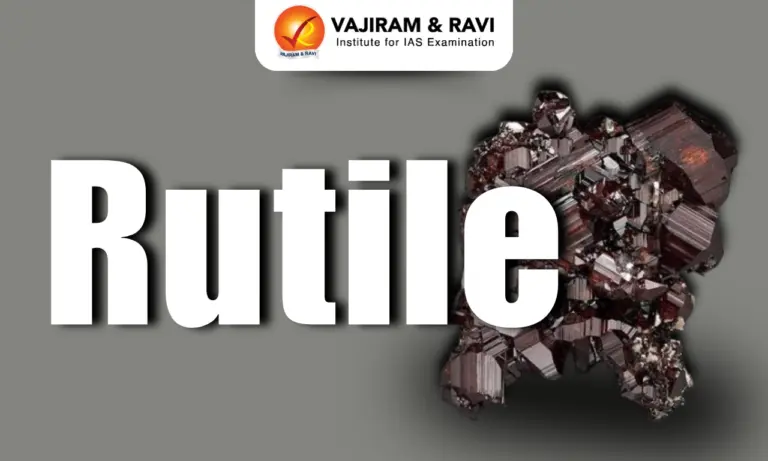
- It is a mineral composed primarily of titanium dioxide, TiO2.
- It is the most common and stable form of titanium dioxide found in nature.
- It is one of the three main minerals of titanium, along with ilmenite and leucoxene.
- It forms red to reddish brown, hard, brilliant metallic, slender crystals, often completely surrounded by other minerals.
- Natural Rutile can contain up to 10% iron and large amounts of niobium and tantalum.
- Rutile was first described in 1803 by Abraham Gottlob Werner.


Rutile Occurrence
- It is found in igneous, metamorphic, and sedimentary rocks throughout the world.
- Rutile has a high specific gravity and is often concentrated by stream and wave action in “heavy mineral sands” that exist today in both onshore and offshore deposits.
- Much of the world’s rutile production is mined from these sands.
- Rutile ore is largely available in countries like Australia, India, South Africa, Ukraine, and Sierra Leone.
- India has significant rutile deposits in the coastal sands of states such as Kerala, Tamil Nadu, Odisha, and Andhra Pradesh.
Rutile Uses
- Rutile has several important industrial applications due to its high refractive index and strong resistance to heat and chemical corrosion.
- One of its main uses is as a pigment in paints, plastics, ceramics, and other materials. It imparts a bright white color and excellent opacity to these products.
- Rutile has minor uses in porcelain and glass manufacture and in making some steels and copper alloys.
- Rutile is also used as a source of titanium metal, which has a wide range of applications in industries such as aerospace, automotive, electronics, and medical devices.
- In addition to its industrial uses, rutile is valued as a collector’s mineral and gemstone.
- Transparent rutile crystals are sometimes cut and polished for use as gemstones.
News: TH

 Last updated on Sep, 2026
→ UPSC 2027 Notification will be released on 13 January 2027 at upsconline.nic.in.
→ UPSC Mains Question Paper 2026 is out now for Essay & GS Paper 1, 2, 3 & 4.
→ UPSC Mains GS Paper 1 2026 is out now.
→ UPSC Mains GS Paper 2 2026 is out now.
→ UPSC Mains GS Paper 3 2026 is out now.
→ UPSC Mains GS Paper 4 2026 is out now.
→ UPSC Mains Indian Language Paper & English Compulsory Paper are out now.
→ Check out the latest UPSC Syllabus 2026 here.
→ UPSC Mains Admit Card 2026 is now out.
→ Enroll in Vajiram & Ravi’s UPSC Mains Test Series 2027 for structured answer writing practice, expert evaluation, and exam-oriented feedback.
→ Join Vajiram & Ravi’s UPSC Mentorship Program 2027 for personalized guidance, strategy planning, and one-to-one support from experienced mentors.
→ Go through the UPSC Mains Previous Year Papers to enhance your preparation.
→ Download UPSC Mains Essay Paper 2025, UPSC Mains GS Paper-I 2025, UPSC Mains GS Paper-II 2025, UPSC Mains GS Paper-III 2025, UPSC Mains GS Paper-IV 2025, UPSC Mains English (Compulsory) Paper 2025, UPSC Mains Hindi (Qualifying) Paper 2025 here.
→ UPSC has released UPSC Toppers List 2025 with the Civil Services final result on its official website.
→ UPSC Calendar 2027 has been released.
→ Also check Best UPSC Coaching in India
Rutile FAQs
Q1. What is rutile?+
Q2. What is the most common and stable natural form of titanium dioxide?+
Q3. What is the typical colour of rutile crystals?+
Q4. Which Indian states have significant rutile deposits?+
Q5. In which industries is rutile commonly used as a white pigment?+
Tags: prelims pointers rutile upsc current affairs upsc prelims current affairs