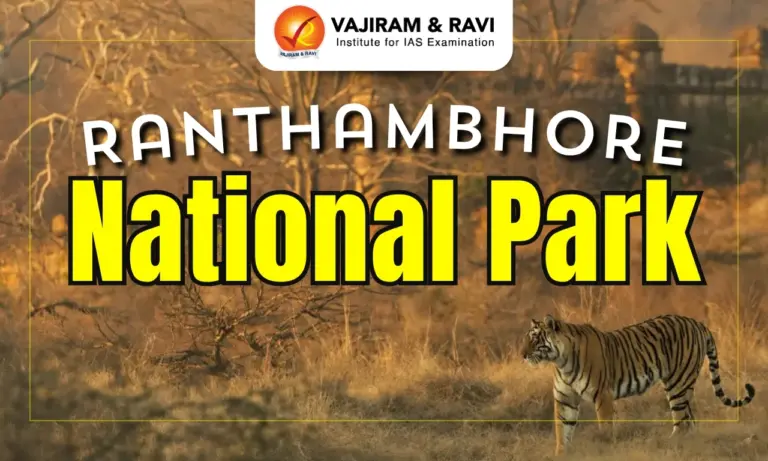
Ranthambhore National Park is one of India’s most important protected areas under Project Tiger (1973). It is famous for frequent daytime sightings of the Royal Bengal Tiger due to its open dry deciduous forest and low vegetation cover.
About Ranthambhore National Park
Ranthambhore National Park is part of the larger Ranthambhore Tiger Reserve, which spans about 1,300-1,400 square kilometres. The core National Park area covers approximately 274-275 square kilometres.The tiger reserve includes: Sawai Man Singh Wildlife Sanctuary and Kaila Devi Wildlife Sanctuary. Together, these areas form a connected conservation landscape that enables tiger movement, genetic exchange, and ecosystem stability.
Ranthambhore National Park Historical Background
The region was first declared the Sawai Madhopur Game Sanctuary in 1955. It became one of the original tiger reserves under Project Tiger in 1973 and was later declared a National Park in 1980.
In the early 1990s, the protected area was expanded by including nearby sanctuaries to strengthen conservation efforts. Historically, the forests were also used as royal hunting grounds by the rulers of Jaipur and Karauli.


Ranthambhore National Park Location and Geography
Ranthambhore National Park is located in the Sawai Madhopur district of eastern Rajasthan. It lies at the junction of the Aravalli and Vindhyan hill ranges.
- It is situated along the Great Boundary Fault, where ancient Aravalli rocks meet younger Vindhyan formations, giving the region geological significance.
- The landscape is characterised by rocky hills, eroded plateaus locally called “dangs”, ravines, and seasonal water bodies.
- The Chambal River system influences the southern and eastern boundaries, while the Banas River influences the northern region.
- Important lakes within the park include Padam Talao, Rajbagh Talao, and Malik Talao, which serve as crucial water sources for wildlife, particularly during dry seasons.
Ranthambhore National Park Flora
The vegetation of Ranthambhore belongs to the Northern Tropical Dry Deciduous forest type. The dominant species is Dhok (Anogeissus pendula), which forms extensive forest cover across the region.
Other species include Butea monosperma, Banyan, Babul, Acacia, Zizyphus, and Capparis. Low rainfall and semi-arid conditions result in open forests with limited undergrowth, which also improves wildlife visibility.
Ranthambhore National Park Fauna
The park is best known for the Royal Bengal Tiger, which is its flagship species. Other important mammals include leopards, sloth bears, striped hyenas, and jackals.
Herbivores include sambar deer, chital, nilgai, chinkara, and wild boar, which form the prey base for carnivores. The park also supports rich bird and reptile diversity, particularly around its lakes and wetlands.
It is important to note that the dhole (Indian wild dog) is no longer found in this region.
Ranthambhore National Park Cultural Importance
Ranthambhore National Park is not only important for its wildlife but also for its deep cultural and historical significance. The most prominent cultural feature within the park is the Ranthambhore Fort.
- Ranthambhore Fort is a UNESCO World Heritage Site under the Hill Forts of Rajasthan.
- It was built by the Chauhan dynasty around the 10th century and is associated with Raja Hammir Dev Chauhan, who is remembered for his resistance against the Delhi Sultanate.
- Owing to its strategic location on a hilltop, the fort served as an important military stronghold during medieval India.
- The fort contains several important temples, including the famous Trinetra (Three-Eyed) Ganesha Temple, along with temples dedicated to Lord Shiva, Ramlalaji, and several Jain shrines.

 Last updated on Sep, 2026
→ UPSC 2027 Notification will be released on 13 January 2027 at upsconline.nic.in.
→ UPSC Mains Question Paper 2026 is out now for Essay & GS Paper 1, 2, 3 & 4.
→ UPSC Mains GS Paper 1 2026 is out now.
→ UPSC Mains GS Paper 2 2026 is out now.
→ UPSC Mains GS Paper 3 2026 is out now.
→ UPSC Mains GS Paper 4 2026 is out now.
→ UPSC Mains Indian Language Paper & English Compulsory Paper are out now.
→ Check out the latest UPSC Syllabus 2026 here.
→ UPSC Mains Admit Card 2026 is now out.
→ Enroll in Vajiram & Ravi’s UPSC Mains Test Series 2027 for structured answer writing practice, expert evaluation, and exam-oriented feedback.
→ Join Vajiram & Ravi’s UPSC Mentorship Program 2027 for personalized guidance, strategy planning, and one-to-one support from experienced mentors.
→ Go through the UPSC Mains Previous Year Papers to enhance your preparation.
→ Download UPSC Mains Essay Paper 2025, UPSC Mains GS Paper-I 2025, UPSC Mains GS Paper-II 2025, UPSC Mains GS Paper-III 2025, UPSC Mains GS Paper-IV 2025, UPSC Mains English (Compulsory) Paper 2025, UPSC Mains Hindi (Qualifying) Paper 2025 here.
→ UPSC has released UPSC Toppers List 2025 with the Civil Services final result on its official website.
→ UPSC Calendar 2027 has been released.
→ Also check Best UPSC Coaching in India
Ranthambhore National Park FAQs
Q1. Where is Ranthambhore National Park located?+
Q2. Under which conservation programme was Ranthambhore included?+
Q3. What are the major geographical features of Ranthambhore National Park?+
Q4. Which UNESCO World Heritage Site is located inside Ranthambhore National Park?+
Q5. Which is the flagship species of Ranthambhore National Park?+
Q6. Which rivers and important lakes are associated with Ranthambhore National Park?+
Tags: ranthambhore national park