E20 Petrol Latest News
- India completed its transition to E20 petrol (20% ethanol blended with 80% petrol) last year. This target was achieved five years ahead of the original 2030 deadline.
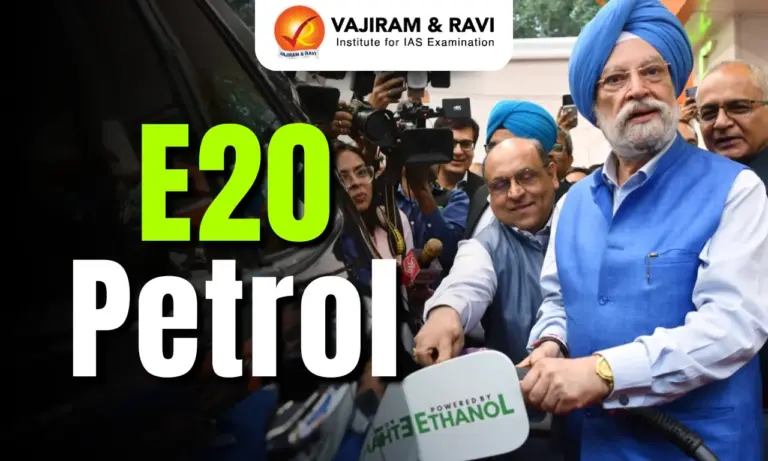
- In June 2026, Union Minister for Petroleum and Natural Gas Hardeep Singh Puri launched E85 fuel (85% ethanol, 15% petrol) in New Delhi.
- This rapid push toward higher ethanol blending has left many motorists worried about reduced mileage and possible engine damage, especially owners of older vehicles.
Background: India’s Ethanol Blending Journey
- The idea of ethanol blending in India isn’t new. The first National Policy on Biofuels in 2009 had set an indicative target of 20% ethanol blending by 2017. This target got delayed for various reasons over the years.
- More recently, the blending level jumped rapidly. Ethanol content in petrol doubled from 10% (E10) to 20% (E20) within just three years.
- This was originally planned to happen gradually over eight years. This fast transition, especially for older vehicles certified only for E10 fuel, came without adequate consumer warnings, leaving many motorists feeling short-changed.


Why Do Indians Care So Much About Mileage
- Fuel efficiency has always been central to Indian car buying decisions. Popular advertising taglines like “fill it, shut it, forget it” captured this obsession for decades.
- Even as India’s car market shifts toward premium vehicles, mileage remains a key consideration, especially since growth in disposable incomes remains uneven across the country.
Three Key Problems With Higher Ethanol Blends
- Drop in Fuel Economy: There is a genuine and measurable drop in mileage when using higher ethanol blends, particularly in vehicles not originally designed for them.
- This is rooted in basic chemistry — ethanol has a lower calorific value than petrol, causing roughly 30% less mileage in unadapted vehicles.
- The impact also isn’t linear; as blending levels increase, the drop in performance intensifies further.
- Risk of Vehicle Part Damage: Ethanol is hygroscopic — meaning it attracts and holds water molecules from its surroundings. This property raises concerns about corrosion in older vehicle parts.
- Ethanol also burns at a higher temperature than petrol, making cars harder to start on cold winter mornings.
- No Fuel Choice for Consumers: Unlike in Brazil, where consumers can choose between different ethanol blends at different price points, Indian motorists currently have no such choice at the pump.
- In Brazil, law mandates a price discount for higher ethanol blends. In India, motorists have had to accept the switch without any corresponding price benefit.
The Chemistry Behind Ethanol Blending
- Ethanol (C2H5OH) has a much simpler carbon chain compared to petrol (which ranges between C8 and C12).
- This means burning ethanol produces less carbon dioxide compared to burning an equivalent amount of petrol — making it more environment-friendly.
- Ethanol also has a very high-octane number (around 108 Research Octane Number, or RON), enabling a cleaner burn inside engines.
- This is why ethanol has traditionally been favoured in high-performance sports cars, thanks to its anti-knock properties, higher power potential, and better cooling effect from its high latent heat of vaporisation.
- Indian carmakers say this high RON value could eventually allow them to design engines with higher compression ratios, extracting better mileage from higher ethanol blends — but this remains a future possibility, not a current reality.
Also Read:- Ethanol Blending in India, Balancing Energy Security with Water Sustainability
The Road Ahead: E25 and E85
- The government now plans to move beyond E20, towards E25, alongside promoting E85 fuel for flex-fuel vehicles (vehicles designed to run on multiple fuel blends).
- Interestingly, even in flex-fuel vehicles, running standard E20 fuel currently works out cheaper than E85, since E85’s fuel efficiency loss (over 25%) isn’t sufficiently offset by its lower price.
- E85 is expected to cost around Rs 20 per litre less than E20. For comparison, in Brazil, a similar fuel switch only becomes economically viable when the higher ethanol blend is at least 30% cheaper.
- Auto industry insiders privately suggest that the jump from E20 to E25 could have a bigger impact than the E10 to E20 transition, especially for older engines and two-wheelers that don’t use high-grade aluminium or steel casts.
- This transition will require carmakers to undertake fresh engineering work around engine calibration, fuel-system durability, corrosion resistance, and material compatibility, along with fresh homologation — the official certification process confirming a vehicle meets safety, environmental, and roadworthiness standards.
Lessons From Brazil’s Ethanol Model
- Brazil offers a useful comparison. Its ethanol programme began in the 1970s in response to global oil market uncertainties. Over five decades, Brazil built a genuine alternative fuel ecosystem using sugarcane-based ethanol.
- Today, at almost every Brazilian fuel pump, consumers can choose between blended petrol (containing 27-35% ethanol) and E100 (pure hydrous ethanol).
- Brazil also successfully promoted flex-fuel cars, allowing consumers to fill up with whichever fuel option is cheaper on a given day. E100 is often 25-35% cheaper than lower blended petrol, thanks to strong government price support.
- This price incentive made flex-fuel cars hugely popular in Brazil. By the late 1980s, nine out of every ten new cars sold there could run entirely on ethanol. Ethanol’s ability to improve acceleration made it further attractive in a country where motorsport enjoys a passionate following.
- In India, by contrast, consumers currently have no such choice or price differential at the pump — a key structural difference that experts believe India could learn from as it moves toward higher ethanol blends.
Source: IE

 Last updated on Oct, 2026
→ UPSC 2027 Notification will be released on 13 January 2027 at upsconline.nic.in.
→ Asian Games 2026 are being held in Aichi-Nagoya, Japan, from 19 September to 4 October.
→ Check Nobel Prize 2026 Winners List here.
→ Download PIB PRiSM Monthly Magazine 2026 here.
→ Check UPSC Monthly Current Affairs Magazine The Recitals here.
→ Check out the latest UPSC Syllabus here.
→ Download UPSC Model Answers for Mains 2026
→ UPSC Mains Question Paper 2026 is out now for Essay & GS Paper 1, 2, 3 & 4.
→ UPSC Calendar 2027 has been released.
→ Enroll in Vajiram & Ravi’s UPSC Mains Test Series 2027 for structured answer writing practice, expert evaluation, and exam-oriented feedback.
→ Join Vajiram & Ravi’s UPSC Mentorship Program 2027 for personalized guidance, strategy planning, and one-to-one support from experienced mentors.
→ Go through the UPSC Mains Previous Year Papers to enhance your preparation.
→ UPSC has released UPSC Toppers List 2025 with the Civil Services final result on its official website.
→ Also check Best UPSC Coaching in India
E20 Petrol FAQs
Q1. Why does E20 Petrol reduce vehicle mileage?+
Q2. What challenges does E20 Petrol pose for older vehicles?+
Q3. How does E20 Petrol contribute to India's energy and environmental goals? +
Q4. How does Brazil's ethanol programme differ from India's E20 Petrol model?+
Q5. What factors should guide the future expansion of E20 Petrol to higher blends?+
Tags: E20 Petrol mains articles upsc current affairs upsc mains current affairs