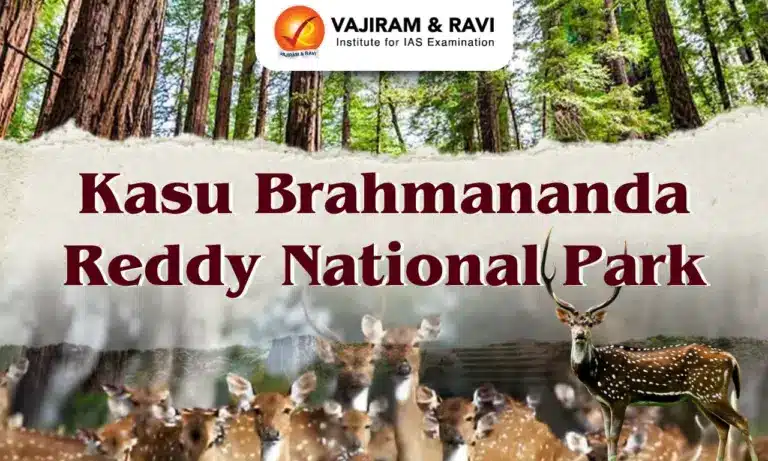
Kasu Brahmananda Reddy (KBR) National Park is one of India’s smallest national parks and a unique example of urban biodiversity conservation. Located in the heart of Hyderabad, Telangana, it is popularly known as the “Green Lung of Hyderabad” for its vital role in conserving biodiversity, improving air quality, and maintaining ecological balance within a rapidly expanding metropolitan city.
About Kasu Brahmananda Reddy National Park
Kasu Brahmananda Reddy National Park is located in the Jubilee Hills and Banjara Hills areas of Hyderabad, Telangana.
- The park covers an area of about 390 acres (approximately 1.6 sq. km), making it one of the smallest national parks in India.
- It was notified as a National Park in 1998 under the provisions of the Wildlife (Protection) Act, 1972.
- The park derives its name from Kasu Brahmananda Reddy, the former Chief Minister of the undivided Andhra Pradesh.
- It is widely regarded as one of India’s finest examples of an urban national park, protecting biodiversity within a densely populated metropolitan region.
- Owing to its rich ecological value, the Government of India declared an Eco-Sensitive Zone (ESZ) around the park on 27 October 2020 to regulate developmental activities in its surrounding landscape.
Kasu Brahmananda Reddy National Park Historical Background
Kasu Brahmananda Reddy National Park was developed from the historic Chiran Palace Estate, which was built in 1960 by the Nizam family of Hyderabad.
- In 1967, Prince Azam Jah gifted the palace estate to his son Prince Mukarram Jah on the occasion of his coronation as the titular Nizam.
- Following the declaration of the National Park in 1998, most of the palace estate came under the management of the Forest Department, while only a small portion remained under the ownership of the Nizam’s family.
- In 2010, an agreement between the Government and Prince Mukarram Jah resulted in the exchange of certain palace lands for approximately six acres situated outside the protected area.
- The palace complex, heritage buildings and old water structures continue to preserve the historical legacy of the former princely state.


Kasu Brahmananda Reddy National Park Physical Features
KBR National Park forms part of the Deccan Plateau and represents the characteristic dry deciduous ecosystem of the region.
- The terrain consists of rocky granite outcrops, undulating landscapes, scrub forests and open grasslands.
- Natural rock formations and seasonal water bodies create favourable habitats for a variety of wildlife.
- Despite its small size, the park functions as an important ecological island amid Hyderabad’s rapidly urbanising landscape.
Kasu Brahmananda Reddy National Park Flora
Kasu Brahmananda Reddy National Park supports remarkable floral diversity for an urban protected area.
- More than 600 species of flowering plants have been recorded, including numerous native trees, shrubs, climbers, herbs and grasses.
- The vegetation mainly represents the Southern Tropical Dry Deciduous Forest and Southern Tropical Thorn Forest ecosystems of the Deccan Plateau.
- Important tree species include Neem, Banyan, Peepal, Jamun, Tamarind, Palash, Flame of the Forest, Acacia and several indigenous shrubs.
- The rich vegetation provides food, nesting sites and shelter for numerous birds, insects, reptiles and mammals.
- The extensive tree cover also plays a significant role in carbon sequestration, temperature regulation and improvement of urban air quality.
Kasu Brahmananda Reddy National Park Faunal Diversity
Despite being surrounded by a densely populated city, KBR National Park supports considerable wildlife diversity.
- Mammals: The park is home to Spotted Deer (Chital), Jungle Cat, Small Indian Civet, Indian Grey Mongoose, Indian Hare, Indian Crested Porcupine and Indian Pangolin, along with several species of bats and rodents.
- Birds: More than 100 species of resident and migratory birds have been recorded from the park. Commonly sighted birds include Indian Peafowl, Parakeets, Kingfishers, Drongos, Sunbirds, Owls, Eagles and Woodpeckers, making the park a major destination for urban birdwatching.
- Reptiles: The park supports a variety of reptiles including the Indian Rock Python, Spectacled Cobra, Rat Snake, Monitor Lizard, Garden Lizard and several species of skinks and geckos.
- Butterflies and Insects: Numerous butterflies, bees, dragonflies and other pollinating insects contribute significantly to maintaining the ecological balance of the park.
Kasu Brahmananda Reddy National Park Ecological Significance
Kasu Brahmananda Reddy National Park plays a crucial role in conserving biodiversity within an urban environment.
- It is recognised as one of India’s finest examples of in-situ conservation of urban biodiversity, demonstrating that protected ecosystems can coexist successfully within large metropolitan cities.
- The park acts as the “green lung of Hyderabad”, helping regulate the city’s microclimate by reducing the urban heat island effect and improving air quality.
- It provides an important habitat for several protected species and supports ecological processes such as pollination, seed dispersal and nutrient cycling.
- The park serves as a natural carbon sink and contributes to climate change mitigation.
- The Eco-Sensitive Zone around the park helps regulate developmental activities and protects the ecological integrity of the protected area.

 Last updated on Sep, 2026
→ UPSC 2027 Notification will be released on 13 January 2027 at upsconline.nic.in.
→ UPSC Mains Question Paper 2026 is out now for Essay & GS Paper 1, 2, 3 & 4.
→ UPSC Mains GS Paper 1 2026 is out now.
→ UPSC Mains GS Paper 2 2026 is out now.
→ UPSC Mains GS Paper 3 2026 is out now.
→ UPSC Mains GS Paper 4 2026 is out now.
→ UPSC Mains Indian Language Paper & English Compulsory Paper are out now.
→ Check out the latest UPSC Syllabus 2026 here.
→ UPSC Mains Admit Card 2026 is now out.
→ Enroll in Vajiram & Ravi’s UPSC Mains Test Series 2027 for structured answer writing practice, expert evaluation, and exam-oriented feedback.
→ Join Vajiram & Ravi’s UPSC Mentorship Program 2027 for personalized guidance, strategy planning, and one-to-one support from experienced mentors.
→ Go through the UPSC Mains Previous Year Papers to enhance your preparation.
→ Download UPSC Mains Essay Paper 2025, UPSC Mains GS Paper-I 2025, UPSC Mains GS Paper-II 2025, UPSC Mains GS Paper-III 2025, UPSC Mains GS Paper-IV 2025, UPSC Mains English (Compulsory) Paper 2025, UPSC Mains Hindi (Qualifying) Paper 2025 here.
→ UPSC has released UPSC Toppers List 2025 with the Civil Services final result on its official website.
→ UPSC Calendar 2027 has been released.
→ Also check Best UPSC Coaching in India
Kasu Brahmananda Reddy National Park FAQs
Q1. Where is Kasu Brahmananda Reddy National Park located?+
Q2. When was Kasu Brahmananda Reddy National Park declared a National Park?+
Q3. From which historic estate was Kasu Brahmananda Reddy National Park developed?+
Q4. When was the Eco-Sensitive Zone around Kasu Brahmananda Reddy National Park notified?+
Q5. Why is Kasu Brahmananda Reddy National Park known as the “Green Lung of Hyderabad”?+
Tags: kasu brahmananda reddy national park