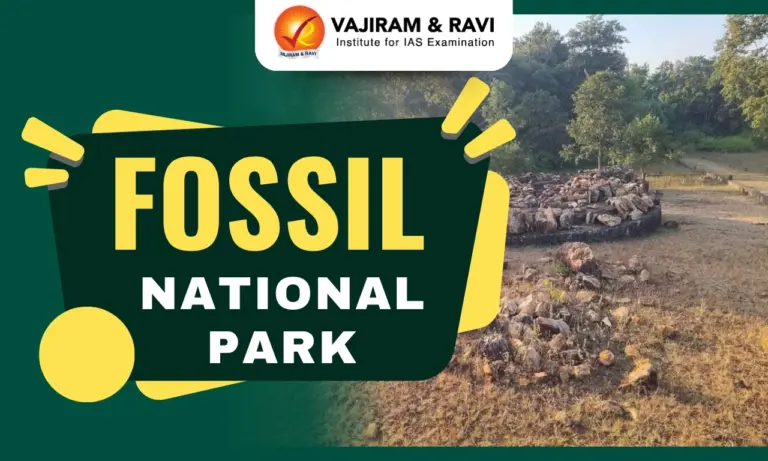
Fossil National Park is one of India’s most important palaeobotanical and geoheritage sites. It preserves plant fossils dating back nearly 65 million years, providing valuable evidence about ancient vegetation, geological evolution and environmental conditions of the Indian subcontinent.
About Fossil National Park
Fossil National Park, also known as Ghughua Fossil Park or Mandla Plant Fossils National Park, is located in Dindori district of Madhya Pradesh.
- The fossil site was discovered in 1970 by Dr. Dharmendra Prasad and was later recognised for its exceptional palaeobotanical importance.
- It was declared a National Park on 5 May 1983 for the conservation of fossilised plant remains.
- The park covers an area of around 75 acres and is among the largest plant fossil parks in Asia.
- It is managed by the Madhya Pradesh Forest Department with scientific support from the Birbal Sahni Institute of Palaeosciences, Lucknow.
- Unlike conventional national parks that protect wildlife, Fossil National Park protects fossilised remains of ancient plants.
Fossil National Park Geological Significance
Fossil National Park is located in the Deccan Traps region, one of the largest volcanic regions in the world. The park provides valuable evidence about the geological and biological history of the Indian subcontinent.
- The fossils are preserved in the Deccan Intertrappean Beds, which are layers of sedimentary rocks formed between successive lava flows of the Deccan volcanic eruptions.
- These fossil deposits date back to the Late Cretaceous to Early Paleogene period, around 65 million years ago, making them important records of ancient life.
- This period coincides with the Cretaceous–Paleogene (K–Pg) boundary, a major geological event associated with the mass extinction of dinosaurs and several other species.
- The plant fossils found here provide information about the ancient climate, vegetation patterns and ecosystems that existed millions of years ago.
- The fossils help scientists understand the evolution of plant life, including the spread of early flowering plants and palm-like vegetation.
- The park also provides insights into the geological evolution of Peninsular India and supports studies related to the ancient Gondwana landmass and continental changes.
Thus, Fossil National Park serves as an important natural archive that connects India’s geological past with the evolution of life on Earth.


Fossil National Park Palaeobotanical Significance
Fossil National Park preserves one of India’s richest collections of fossilised plants, representing ancient tropical forests that flourished around 65 million years ago.
- The park contains fossilised tree trunks, leaves, fruits, seeds, flowers and climbers belonging to 31 genera and 18 plant families, including palms, angiosperms, gymnosperms and bryophytes. These plant remains were preserved through petrification.
- Petrification is a process in which minerals dissolved in groundwater gradually replace the original organic material while retaining the plant’s external structure over millions of years. As a result, the fossils closely resemble the original plants and provide valuable evidence for reconstructing ancient vegetation, climatic conditions and the evolution of plant life.
- A fossil wood resembling Eucalyptus, considered among the oldest known records of the genus, has also been reported from the park, supporting theories regarding the ancient distribution of plant species across the Gondwana supercontinent.
Recent Development
In 2024, archaeologists from Ashoka University, led by Professor Nayanjot Lahiri, discovered prehistoric tools made from fossil wood in the park.
- The artefacts are estimated to be at least 10,000 years old.
- The discovery indicates that prehistoric communities used fossilised wood as a raw material for making tools.
- Such discoveries are extremely rare in India and add a new archaeological dimension to the importance of the park
Other Important Fossil Parks in India
India has several fossil parks that preserve ancient plant and animal fossils, providing important evidence about the country’s geological evolution and prehistoric life.
- Shivalik Fossil Park (Saketi), Himachal Pradesh: Preserves vertebrate fossils of the Siwalik Hills, including extinct mammals such as elephants and giant tortoises. It is maintained by the Geological Survey of India (GSI).
- National Fossil Wood Park, Tiruvakkarai, Tamil Nadu: Famous for its Miocene-age fossilised tree trunks (about 20 million years old), offering evidence of ancient tropical forests.
- National Fossil Wood Park, Sathanur, Tamil Nadu: Conserves well-preserved fossil wood deposits and is also managed by the Geological Survey of India.
- Dinosaur Fossils National Park, Dhar, Madhya Pradesh: Known for the discovery of Late Cretaceous dinosaur fossils and fossilised eggs.
- Indroda Dinosaur and Fossil Park, Gujarat: Located near Gandhinagar, it preserves dinosaur fossils and eggs and is popularly known as India’s Jurassic Park.
- Akal Wood Fossil Park, Rajasthan: Situated near Jaisalmer within the Desert National Park, it preserves about 180-million-year-old fossil wood, indicating that the present-day Thar Desert was once covered by forests.

 Last updated on Oct, 2026
→ UPSC 2027 Notification will be released on 13 January 2027 at upsconline.nic.in.
→ Check Nobel Prize 2026 Winners List here.
→ Download PIB PRiSM Monthly Magazine 2026 here.
→ Check UPSC Monthly Current Affairs Magazine The Recitals here.
→ Check out the latest UPSC Syllabus here.
→ Download UPSC Model Answers for Mains 2026
→ UPSC Mains Question Paper 2026 is out now for Essay & GS Paper 1, 2, 3 & 4.
→ UPSC Calendar 2027 has been released.
→ Enroll in Vajiram & Ravi’s UPSC Mains Test Series 2027 for structured answer writing practice, expert evaluation, and exam-oriented feedback.
→ Join Vajiram & Ravi’s UPSC Mentorship Program 2027 for personalized guidance, strategy planning, and one-to-one support from experienced mentors.
→ Go through the UPSC Mains Previous Year Papers to enhance your preparation.
→ UPSC has released UPSC Toppers List 2025 with the Civil Services final result on its official website.
→ Also check Best UPSC Coaching in India
Fossil National Park FAQs
Q1. Where is Fossil National Park located?+
Q2. In which geological formation are the fossils of Fossil National Park preserved?+
Q3. Why is Fossil National Park scientifically important?+
Q4. What is petrification?+
Q5. Which important archaeological discovery was made at Fossil National Park in 2024?+
Tags: fossil national park