


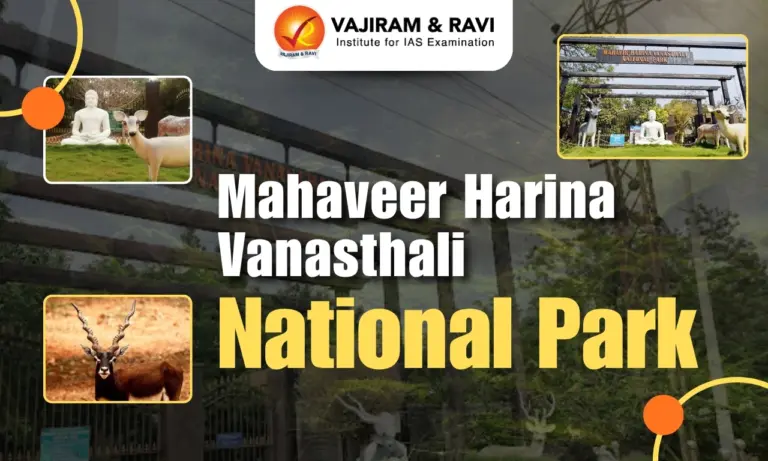
Mahaveer Harina Vanasthali National Park is a protected wildlife area located near Hyderabad in Telangana. It was established in 1975 and is best known for conserving the blackbuck, one of India’s most iconic antelope species. It features tropical dry deciduous forests, grasslands, and scrub vegetation that support a wide variety of plants and animals. Owing to its rich biodiversity and urban conservation efforts, the park is an important topic for UPSC Environment and Ecology preparation.
Mahaveer Harina Vanasthali National Park
Mahaveer Harina Vanasthali National Park is situated in Rangareddy district of Telangana, on the eastern outskirts of Hyderabad. The park is located near Vanasthalipuram and covers an area of around 14.59 square kilometres. Its proximity to the city makes it a unique protected area that conserves wildlife while serving as an important urban biodiversity hotspot.
Mahaveer Harina Vanasthali National Park Flora
The flora of Mahaveer Harina Vanasthali National Park is dominated by Tropical Dry Deciduous Forests, thorny scrub vegetation, and natural grasslands. This diverse vegetation provides food, shelter, and breeding habitats for blackbucks, birds, reptiles, and other wildlife species.
- Tropical Dry Deciduous Forests: The park is primarily covered with dry deciduous vegetation, where many trees shed their leaves during the dry season to conserve water.
- Thorny Scrub Forests: Large areas consist of thorny shrubs and bushes, which are well adapted to the region’s semi-arid climate and provide excellent cover for small mammals and birds.
- Grasslands: Extensive native grasslands serve as the primary grazing habitat for the park’s flagship species, the Blackbuck, along with spotted deer and other herbivores.
- Neem (Azadirachta indica): A common tree species known for its medicinal properties, shade, and ecological importance.
- Babul (Acacia nilotica): A drought-resistant tree that helps improve soil fertility and provides food and shelter for wildlife.
- Banyan (Ficus benghalensis): One of the largest native trees, offering nesting sites for birds and shade for animals.
- Peepal (Ficus religiosa): An ecologically significant tree that supports numerous insects, birds, and small mammals with its fruits.
- Tamarind (Tamarindus indica): A hardy tree species commonly found in the park, contributing to habitat diversity.
- Flame of the Forest (Butea monosperma): Known for its bright orange-red flowers, this tree attracts bees, butterflies, and birds, enhancing pollination.
- Native Shrubs and Herbs: Various indigenous shrubs, herbs, and flowering plants increase biodiversity and provide food sources for insects and pollinators.


Mahaveer Harina Vanasthali National Park Fauna
The fauna of Mahaveer Harina Vanasthali National Park is highly diverse, with a variety of mammals, birds, reptiles, and insects. Its grasslands and dry deciduous forests provide a suitable habitat for many wildlife species, making it one of Telangana’s important biodiversity hotspots.
- Blackbuck (Antilope cervicapra): The flagship species of the park, known for its spiral horns, exceptional speed, and graceful appearance. The park is one of the key conservation areas for this protected antelope.
- Mammals: Besides blackbucks, the park is home to Spotted Deer (Chital), Wild Boar, Indian Hare, Indian Porcupine, Jungle Cat, Small Indian Civet, Palm Squirrel, and Mongoose, all of which contribute to the park’s ecological balance.
- Bird Diversity: The park records over 100 species of resident and migratory birds, including Indian Peafowl, Indian Roller, White-throated Kingfisher, Grey Francolin, Rose-ringed Parakeet, Black Drongo, Eagles, Kites, Owls, Herons, and Egrets.
- Reptiles: Common reptiles found here include the Indian Cobra, Rat Snake, Monitor Lizard, Garden Lizard, Skinks, and Freshwater Turtles, which help maintain the food chain.
- Butterflies and Insects: Numerous butterflies, bees, dragonflies, and other pollinating insects thrive in the park, playing an essential role in pollination and ecosystem health.
- Grassland Ecosystem: The park’s grasslands, scrub forests, and dry deciduous vegetation provide ideal habitats for herbivores, birds, reptiles, and small carnivores, supporting rich biodiversity.
Blackbuck Conservation at Mahaveer Harina Vanasthali National Park
Mahaveer Harina Vanasthali National Park is one of the most important conservation sites for the Blackbuck (Antilope cervicapra) in Telangana. The park was established to protect this graceful antelope, whose population had declined due to habitat loss, hunting, and rapid urbanization. Through habitat management and strict wildlife protection measures, the park has become a safe refuge for blackbucks.
- Primary Conservation Objective: The park was established mainly to protect and conserve the Blackbuck, one of India’s most iconic antelope species.
- Protected Status: The Blackbuck is listed under Schedule I of the Wildlife (Protection) Act, 1972, providing it with the highest level of legal protection in India.
- Suitable Habitat: The park’s open grasslands, scrub forests, and dry deciduous vegetation provide ideal grazing grounds and shelter for blackbucks.
- Anti-Poaching Measures: Regular forest patrols, surveillance, and strict enforcement of wildlife laws help prevent illegal hunting and ensure the safety of wildlife.
- Habitat Management: The Telangana Forest Department carries out grassland improvement, water source maintenance, and vegetation management to support healthy blackbuck populations.
- Public Awareness: The park promotes wildlife conservation awareness, environmental education, and eco-tourism, encouraging people to protect blackbucks and their natural habitat.
Mahaveer Harina Vanasthali National Park Significance
Mahaveer Harina Vanasthali National Park plays a vital role in conserving wildlife and maintaining ecological balance in the rapidly urbanizing region of Hyderabad.
- Urban Biodiversity Hotspot: Located near Hyderabad, the park protects diverse flora and fauna, demonstrating how wildlife can be conserved within an urban landscape.
- Rich Ecosystem: Its tropical dry deciduous forests, scrublands, and grasslands support numerous mammals, birds, reptiles, butterflies, and pollinators.
- Ecological Balance: The park helps maintain food chains, pollination, seed dispersal, soil conservation, and groundwater recharge, contributing to a healthy ecosystem.
- Environmental Education and Research: It serves as a centre for wildlife research, biodiversity studies, conservation awareness, and nature education for students and visitors.
- Eco-Tourism Destination: The park promotes responsible tourism, birdwatching, wildlife photography, and nature-based recreation, while encouraging conservation awareness.

 Last updated on Oct, 2026
→ UPSC 2027 Notification will be released on 13 January 2027 at upsconline.nic.in.
→ Check Nobel Prize 2026 Winners List here.
→ Download PIB PRiSM Monthly Magazine 2026 here.
→ Check UPSC Monthly Current Affairs Magazine The Recitals here.
→ Check out the latest UPSC Syllabus here.
→ Download UPSC Model Answers for Mains 2026
→ UPSC Mains Question Paper 2026 is out now for Essay & GS Paper 1, 2, 3 & 4.
→ UPSC Calendar 2027 has been released.
→ Enroll in Vajiram & Ravi’s UPSC Mains Test Series 2027 for structured answer writing practice, expert evaluation, and exam-oriented feedback.
→ Join Vajiram & Ravi’s UPSC Mentorship Program 2027 for personalized guidance, strategy planning, and one-to-one support from experienced mentors.
→ Go through the UPSC Mains Previous Year Papers to enhance your preparation.
→ UPSC has released UPSC Toppers List 2025 with the Civil Services final result on its official website.
→ Also check Best UPSC Coaching in India
Mahaveer Harina Vanasthali National Park FAQs
Q1. Where is Mahaveer Harina Vanasthali National Park located?+
Q2. Why is Mahaveer Harina Vanasthali National Park famous?+
Q3. When was Mahaveer Harina Vanasthali National Park established?+
Q4. What is the area of Mahaveer Harina Vanasthali National Park?+
Q5. Which is the flagship species of the park?+
Q6. What type of vegetation is found in Mahaveer Harina Vanasthali National Park?+
Tags: mahaveer harina vanasthali national park











