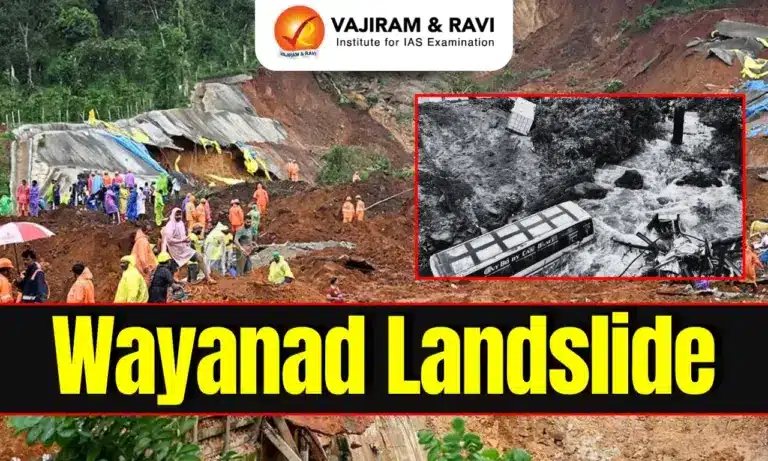
The Wayanad landslide is once again in the spotlight after a fresh landslide struck an under-construction tunnel road in Kerala’s Wayanad district on July 7, 2026. The Wayanad landslide claimed at least three lives, left several people missing, and prompted large-scale rescue operations, with nine people rescued.
Following the Wayanad landslide, the state government evacuated nearby residents, suspended traffic on the Meenakshi Bridge, and ordered a structural safety inspection to prevent further risks.
What Caused the Wayanad Landslide?
The Wayanad landslide was caused by a combination of natural factors and human activities that destabilized the fragile hill slopes of the Western Ghats.
- Extremely Heavy Rainfall: Continuous monsoon rains saturated the soil, triggering slope failure and debris flow.
- Fragile Geology: The Western Ghats consist of weathered rocks, steep slopes, and loose soil that are naturally prone to landslides.
- Steep Terrain: Wayanad’s rugged topography increases the risk of soil and rock movement during intense rainfall.
- Deforestation: Removal of forests weakened soil binding, making slopes more vulnerable to collapse.
- Unplanned Development: Road construction, quarrying, hill cutting, and expanding infrastructure disturbed the natural stability of slopes.
- Climate Change: Rising temperatures have increased the frequency of extreme rainfall events, leading to more frequent landslides.
- Poor Drainage: Inadequate drainage systems allowed rainwater to accumulate, increasing soil pressure and slope instability.
- Encroachment in Vulnerable Areas: Construction and settlements in landslide-prone zones exposed more people and infrastructure to disaster risks.
Major Impacts of the Wayanad Landslide
The Wayanad landslide caused widespread loss of life, severe environmental damage, and major disruptions to infrastructure and livelihoods across the affected region.
- Loss of Lives: The landslide resulted in significant casualties, with many people killed, injured, and reported missing.
- Displacement of Residents: Thousands of people were evacuated and shifted to relief camps after homes were destroyed or declared unsafe.
- Infrastructure Damage: Roads, bridges, houses, schools, electricity lines, and water supply systems suffered extensive damage.
- Agricultural Losses: Coffee, tea, pepper, cardamom, banana, and other plantations were buried under mud and debris, affecting farmers’ incomes.
- Environmental Degradation: The disaster caused soil erosion, destruction of forests, river siltation, and loss of biodiversity in the Western Ghats.
- Economic Impact: Tourism, agriculture, transport, and local businesses faced heavy financial losses due to the destruction.
- Disruption of Connectivity: Several villages were cut off as roads and bridges collapsed, delaying rescue and relief operations.
- Psychological and Social Impact: The disaster left survivors traumatized and disrupted the lives of affected families and communities.


Seismic Zone of Wayanad
Wayanad district falls under Seismic Zone III of the Bureau of Indian Standards (BIS) seismic zoning map, which is classified as a moderate earthquake risk zone. Although earthquakes are not the primary cause of landslides in the region, seismic activity combined with heavy rainfall and steep slopes can increase the risk of slope failure. Therefore, earthquake-resistant construction and proper land-use planning are important in Wayanad.
Gadgil Committee (Western Ghats Ecology Expert Panel)
The Gadgil Committee was constituted in 2010 to recommend measures for the conservation and sustainable development of the Western Ghats.
- Chairperson: Dr. Madhav Gadgil
- Constituted By: Ministry of Environment and Forests (MoEF)
- Report Submitted: 2011
- Objective: Protect the ecology and biodiversity of the Western Ghats.
- Recommended Three Ecologically Sensitive Zones (ESZ-I, ESZ-II, and ESZ-III) based on environmental sensitivity.
- Proposed Strict Restrictions on mining, quarrying, and large-scale construction in ecologically fragile areas.
- Discouraged New Dams and other major development projects in highly sensitive regions.
- Promoted Decentralized Governance by giving local bodies a greater role in environmental decision-making.
- Emphasized Sustainable Development while balancing ecological conservation with local livelihoods.
Kasturirangan Committee
The Kasturirangan Committee was constituted in 2012 to review the recommendations of the Gadgil Committee and suggest a balanced approach to conserving the Western Ghats while allowing sustainable development.
- Chairperson: Dr. K. Kasturirangan
- Constituted By: Ministry of Environment and Forests (MoEF)
- Report Submitted: 2013
- Recommended Declaring 37% of the Western Ghats (about 59,940 sq. km.) as Ecologically Sensitive Area (ESA).
- Used Satellite and Remote Sensing Data to identify ecologically sensitive regions.
- Prohibited Mining, Quarrying, and Sand Mining in Ecologically Sensitive Areas.
- Restricted Highly Polluting Industries such as Red Category industries and thermal power plants within ESAs.
- Allowed Sustainable Agriculture and Plantations, including tea, coffee, rubber, and spice plantations, to continue.
- Balanced Conservation and Development by permitting regulated economic activities in non-sensitive areas.
- Focused on Protecting Biodiversity while minimizing the impact on local livelihoods and development projects.
Lessons from the Wayanad Landslide
The Wayanad landslide highlights the urgent need to balance development with environmental conservation and strengthen disaster preparedness in ecologically fragile regions.
- Strengthen Early Warning Systems to provide timely alerts before landslides occur.
- Promote Scientific Land-Use Planning by avoiding construction in landslide-prone areas.
- Protect Forest Cover to improve slope stability and reduce soil erosion.
- Regulate Quarrying and Hill Cutting in ecologically sensitive regions.
- Implement Committee Recommendations such as those of the Gadgil and Kasturirangan Committees for sustainable development.
- Improve Drainage Infrastructure to prevent water accumulation on hill slopes.
- Adopt Disaster-Resilient Construction techniques for roads, bridges, and buildings in hilly areas.
- Strengthen Climate Adaptation Measures to address the growing risk of extreme rainfall events.
- Enhance Community Awareness and Preparedness through regular training, mock drills, and public education.
- Ensure Strict Environmental Impact Assessments (EIA) before approving major infrastructure projects in fragile ecosystems.

 Last updated on Oct, 2026
→ UPSC 2027 Notification will be released on 13 January 2027 at upsconline.nic.in.
→ Asian Games 2026 are being held in Aichi-Nagoya, Japan, from 19 September to 4 October.
→ Check Nobel Prize 2026 Winners List here.
→ Download PIB PRiSM Monthly Magazine 2026 here.
→ Check UPSC Monthly Current Affairs Magazine The Recitals here.
→ Check out the latest UPSC Syllabus here.
→ Download UPSC Model Answers for Mains 2026
→ UPSC Mains Question Paper 2026 is out now for Essay & GS Paper 1, 2, 3 & 4.
→ UPSC Calendar 2027 has been released.
→ Enroll in Vajiram & Ravi’s UPSC Mains Test Series 2027 for structured answer writing practice, expert evaluation, and exam-oriented feedback.
→ Join Vajiram & Ravi’s UPSC Mentorship Program 2027 for personalized guidance, strategy planning, and one-to-one support from experienced mentors.
→ Go through the UPSC Mains Previous Year Papers to enhance your preparation.
→ UPSC has released UPSC Toppers List 2025 with the Civil Services final result on its official website.
→ Also check Best UPSC Coaching in India
Wayanad Landslide FAQs
Q1. What is the Wayanad Landslide?+
Q2. What caused the Wayanad Landslide?+
Q3. Which areas were affected by the Wayanad Landslide?+
Q4. Which seismic zone does Wayanad fall under?+
Q5. What is the Kasturirangan Committee?+
Q6. What is the Gadgil Committee?+
Q7. Why is Wayanad prone to landslides?+
Tags: wayanad landslide