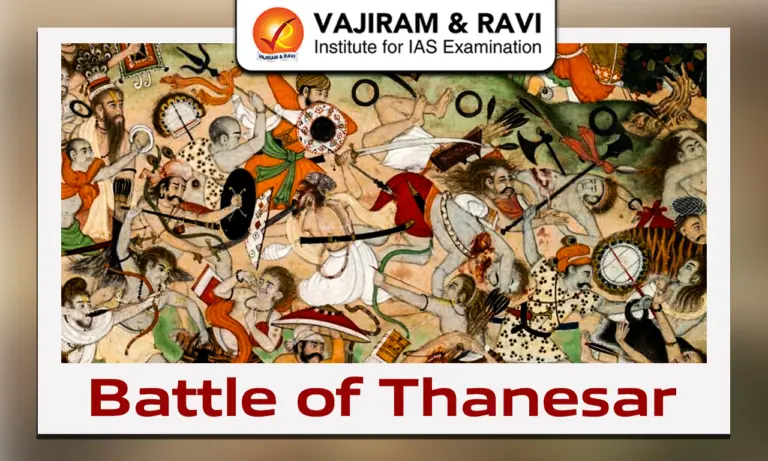
The Battle of Thanesar (1014 CE) was one of the most significant military campaigns undertaken by Mahmud of Ghazni during his invasions of India. It resulted in the capture and plunder of Thanesar (ancient Sthanesvara), an important religious centre in present-day Haryana. The campaign strengthened Ghaznavid authority in north-western India and exposed the political fragmentation of the contemporary Indian kingdoms.
Battle of Thanesar Sources
The Battle of Thanesar is known primarily through contemporary Persian chronicles and later historical studies.
- Tarikh-i-Yamini by Al-Utbi, Mahmud of Ghazni’s court chronicler, is the principal contemporary source describing the campaign.
- Kitab-ul-Hind (Tahqiq-i-Hind) by Al-Biruni explains the religious importance of Thanesar, although Al-Biruni was not an eyewitness to the battle.
Battle of Thanesar Background
By the beginning of the eleventh century, the decline of the Gurjara-Pratihara Empire had led to the emergence of several independent regional kingdoms in northern India, including the Tomaras, Chahamanas (Chauhans), Chandelas, Paramaras, and the Hindu Shahis. Mahmud of Ghazni had already defeated the Hindu Shahi ruler Anandapala at the Battle of Waihind (1008 CE) and established control over Punjab, which became the base for his subsequent invasions of India.
Among his major targets was Thanesar (Sthanesvara), one of the most sacred Hindu pilgrimage centres, famous for the Chakraswamin Temple dedicated to Lord Vishnu. The city had accumulated immense wealth through royal patronage and pilgrim donations, making it an attractive target for Mahmud.


Battle of Thanesar Causes
Mahmud of Ghazni invaded Thanesar due to a combination of political, economic and religious factors.
- Religious Importance: Thanesar was one of the holiest Hindu pilgrimage centres. Capturing such an important religious centre helped Mahmud project himself as a champion of Islam and enhanced his prestige.
- Economic Motive: The city’s temples possessed enormous wealth in the form of gold, silver, jewels and valuable offerings, making Thanesar an attractive target for plunder.
- Political Expansion: After establishing control over Punjab, Mahmud sought to expand and consolidate Ghaznavid authority further into northern India.
- Political Prestige: Successful military campaigns strengthened Mahmud’s authority within the Ghaznavid Empire and increased his reputation across the Islamic world.
- Political Disunity in Northern India: The absence of a united alliance among the Rajput kingdoms reduced organised resistance, encouraging Mahmud to launch the invasion.
Course of the Battle of Thanesar
Mahmud marched from Ghazni towards Thanesar in 1014 CE after securing Punjab. During his advance, Rama, the chief of Dera, attempted to stop the Ghaznavid army but was decisively defeated. Despite Mahmud’s repeated invasions, no broader Rajput coalition came forward to resist him.
The ruler of Thanesar abandoned the city before Mahmud’s arrival, leaving it without effective defence. Mahmud’s disciplined and highly mobile cavalry quickly occupied the city, overwhelming the local forces that relied largely on traditional elephant-based warfare. The famous Chakraswamin Temple was captured during the campaign.
Battle of Thanesar Outcome
Mahmud of Ghazni secured a decisive victory at the Battle of Thanesar, resulting in major political, economic and religious consequences.
- Thanesar was captured and extensively plundered, with large quantities of gold, silver, jewels and other valuables seized from the city and its temples.
- The famous bronze idol of Chakraswamin (Lord Vishnu) was carried to Ghazni and publicly displayed, according to contemporary Persian chronicles, as a symbol of Ghaznavid victory.
- The immense wealth acquired from the campaign substantially enriched the Ghaznavid treasury and financed Mahmud’s subsequent expeditions against Mathura and Kanauj (1018 CE) and Somnath (1025 CE).
Battle of Thanesar Significance
The Battle of Thanesar had far-reaching political, military and historical significance.
- Expanded Ghaznavid Influence: The victory strengthened Ghaznavid influence in north-western India and encouraged further military campaigns into the Indian subcontinent.
- Exposed Political Fragmentation: It revealed the inability of the Rajput kingdoms to form a united front against repeated foreign invasions.
- Demonstrated Military Advantage: The campaign highlighted the superiority of Mahmud’s fast-moving cavalry over the conventional warfare practised by many Indian kingdoms.
- Enhanced Mahmud’s Reputation: The conquest of a prominent religious centre increased Mahmud’s standing and prestige across the Islamic world.
- Established a Pattern of Temple Raids: The success of the campaign reinforced the strategy of targeting wealthy temple towns for both economic gain and political legitimacy.

 Last updated on Sep, 2026
→ UPSC 2027 Notification will be released on 13 January 2027 at upsconline.nic.in.
→ Check out the latest UPSC Syllabus here.
→ Download UPSC Model Answers for Mains 2026
→ UPSC Mains Question Paper 2026 is out now for Essay & GS Paper 1, 2, 3 & 4.
→ UPSC Calendar 2027 has been released.
→ Enroll in Vajiram & Ravi’s UPSC Mains Test Series 2027 for structured answer writing practice, expert evaluation, and exam-oriented feedback.
→ Join Vajiram & Ravi’s UPSC Mentorship Program 2027 for personalized guidance, strategy planning, and one-to-one support from experienced mentors.
→ Go through the UPSC Mains Previous Year Papers to enhance your preparation.
→ UPSC has released UPSC Toppers List 2025 with the Civil Services final result on its official website.
→ Also check Best UPSC Coaching in India
Battle of Thanesar FAQs
Q1. When was the Battle of Thanesar fought and between whom?+
Q2. Why did Mahmud of Ghazni invade Thanesar?+
Q3. Which important temple was captured during the Battle of Thanesar?+
Q4. Which source provides the principal contemporary account of the Battle of Thanesar?+
Q5. What was the historical significance of the Battle of Thanesar?+
Tags: battle of thanesar