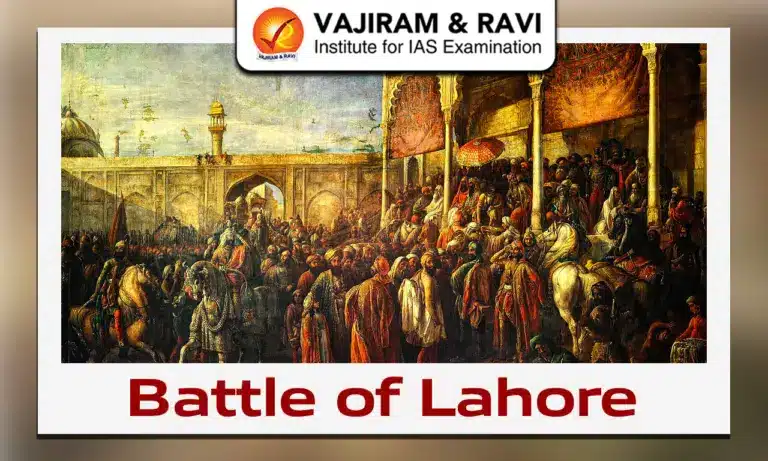
The Battle of Lahore (1021 CE) was one of the final and most decisive campaigns of Mahmud of Ghazni against the Hindu Shahi dynasty. The capture of Lahore ended the political power of the Hindu Shahis and led to the permanent annexation of Punjab into the Ghaznavid Empire. Unlike Mahmud’s earlier expeditions, which were primarily raids for wealth, this campaign marked a shift towards territorial expansion and long-term political control.
Battle of Lahore Background
The Hindu Shahi dynasty was one of the most powerful kingdoms of north-western India. At its height, it controlled a vast territory extending from Kabul in present-day Afghanistan to the Punjab region. For centuries, the Shahis acted as a frontier power, protecting northern India from invasions entering through the passes of Afghanistan and Central Asia.
However, from the beginning of the 11th century, the dynasty faced continuous attacks from Mahmud of Ghazni, the ambitious ruler of the Ghaznavid Empire. Over two decades of warfare gradually weakened Shahi authority and reduced their kingdom to a small territory.
Decline of the Hindu Shahis under Mahmud of Ghazni
- Battle of Peshawar (1001 CE): Mahmud of Ghazni defeated Jayapala, the Hindu Shahi ruler. This was the first major setback for the Shahis and demonstrated the military superiority of the Ghaznavids.
- Battle of Waihind (1008 CE): Jayapala’s successor Anandapala attempted to resist Mahmud’s expansion but was defeated. Since Waihind was an important Shahi centre, the defeat severely damaged Shahi prestige and territorial control.
- Fall of Nandana (1014 CE): Mahmud captured the strategic fort of Nandana, further reducing Shahi influence in the region.
- Kashmir Campaigns: Mahmud also launched repeated expeditions towards Kashmir. Although these campaigns did not result in complete conquest, they placed additional military and economic pressure on the Hindu Shahis.
By 1021 CE, the Shahi kingdom had been greatly weakened. Trilochanapala, the last effective ruler of the dynasty, had lost most of his ancestral territories and was forced to retreat eastwards. He attempted to resist Mahmud with support from neighbouring rulers, including Vidyadhara, the Chandela king, but his position remained fragile.
Meanwhile Lahore remained one of the last important centres under their control. As long as Lahore remained in Shahi hands, the dynasty retained political legitimacy and a base for resistance. Therefore, capturing Lahore became essential for Mahmud to establish complete control over Punjab.
Battle of Lahore Causes
Mahmud’s campaign against Lahore was driven by political, strategic and military considerations.
- Complete Conquest of Punjab: Mahmud wanted to end the long-standing conflict with the Hindu Shahis by bringing the entire Punjab under Ghaznavid rule.
- Continued Resistance by Trilochanapala: Despite repeated defeats, Trilochanapala continued to oppose Mahmud and sought support from other Indian rulers.
- Strategic Importance of Lahore: Lahore occupied a key position on the route between Central Asia and northern India. Controlling the city would secure the eastern frontier of the Ghaznavid Empire.
- Base for Future Campaigns: Mahmud intended to use Lahore as a permanent military and administrative centre for future expeditions into the Gangetic plains.


Battle of Lahore Course
In 1021 CE, Mahmud of Ghazni launched his campaign against the remaining territories of the Hindu Shahis. After consolidating his earlier victories in north-western India, his forces advanced towards Lahore.
Trilochanapala was unable to organise an effective defence against the well-trained Ghaznavid army, which possessed superior mobility and a strong cavalry force. Facing overwhelming pressure, he abandoned Lahore and retreated eastwards.
The Ghaznavid forces then captured Lahore after defeating local resistance. The fall of the city marked the final collapse of effective Hindu Shahi authority in Punjab.
Soon after the defeat, Trilochanapala was killed, reportedly by his own mutinous troops. His son Bhimapala succeeded him but controlled only a limited territory and continued minor resistance until around 1026 CE, after which the Hindu Shahi dynasty disappeared as an independent political power.
Battle of Lahore Outcome
Mahmud of Ghazni achieved a decisive victory that transformed the political landscape of north-western India.
- Capture of Lahore: Lahore was captured and became a major centre of Ghaznavid power in India.
- Annexation of Punjab: Punjab was incorporated into the Ghaznavid Empire and became the first Indian region to experience permanent Central Asian Muslim political control.
- Establishment of Ghaznavid Administration: Ghaznavid governors were appointed to administer the newly conquered territories.
- End of Hindu Shahi Power: The defeat ended the Hindu Shahis as an independent ruling dynasty after centuries of controlling the north-western frontier.
Battle of Lahore Significance
The Battle of Lahore marked an important turning point in the history of medieval India.
- Shift from Raids to Conquest: The campaign marked the transition from Mahmud’s earlier plundering expeditions to permanent territorial annexation.
- Permanent Ghaznavid Foothold: Punjab became the Ghaznavids’ principal base in India and remained under their control for more than a century.
- Gateway to Northern India: Control of Lahore established Punjab as the principal gateway for later Turkic invasions, including those of the Ghurids.
- Long-term Historical Impact: Lahore remained a major Ghaznavid centre until it was captured by Muhammad Ghori in 1186-87 CE, bringing the Ghaznavid dynasty to an end.

 Last updated on Sep, 2026
→ UPSC 2027 Notification will be released on 13 January 2027 at upsconline.nic.in.
→ Check out the latest UPSC Syllabus here.
→ Download UPSC Model Answers for Mains 2026
→ UPSC Mains Question Paper 2026 is out now for Essay & GS Paper 1, 2, 3 & 4.
→ UPSC Calendar 2027 has been released.
→ Enroll in Vajiram & Ravi’s UPSC Mains Test Series 2027 for structured answer writing practice, expert evaluation, and exam-oriented feedback.
→ Join Vajiram & Ravi’s UPSC Mentorship Program 2027 for personalized guidance, strategy planning, and one-to-one support from experienced mentors.
→ Go through the UPSC Mains Previous Year Papers to enhance your preparation.
→ UPSC has released UPSC Toppers List 2025 with the Civil Services final result on its official website.
→ Also check Best UPSC Coaching in India
Battle of Lahore FAQs
Q1. When was the Battle of Lahore fought?+
Q2. Who fought the Battle of Lahore?+
Q3. What were the main causes of the Battle of Lahore?+
Q4. What was the outcome of the Battle of Lahore?+
Q5. Why is the Battle of Lahore considered a turning point in medieval Indian history?+
Tags: battle of lahore