Video Assistant Referee (VAR) Latest News
- The Video Assistant Referee (VAR) system came under intense scrutiny during the FIFA World Cup clash between Egypt and Argentina in Atlanta. A well-crafted Egyptian goal was disallowed after VAR intervention flagged a foul in the build-up, sparking outrage from the Egyptian camp.
- Egypt, which surrendered a two-goal lead to lose 2-3, argued that certain fouls by Argentina were ignored in the same passage of play.
- The episode has reignited debate over VAR’s consistency and transparency.
What is VAR and How Does It Work?
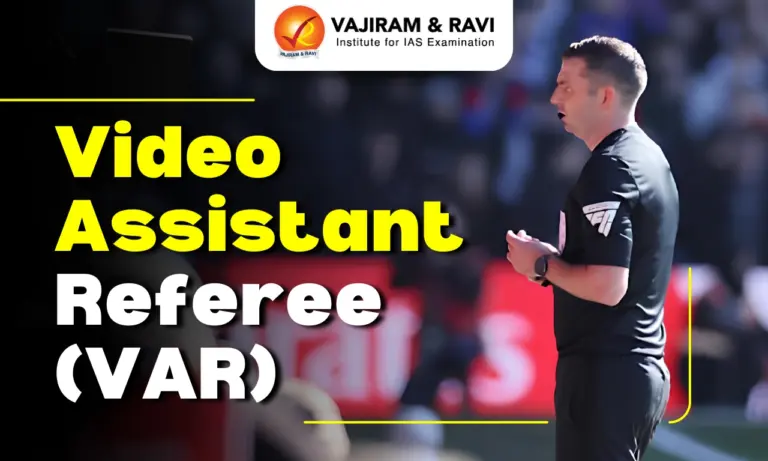
- VAR refers to both the video review system and the chief referee who monitors play, typically from a central hub.
- The system was proposed in the early 2010s and approved by the International Football Association Board (IFAB) in 2016, with the primary objective of avoiding “clear and obvious errors” during key match incidents.
- The setup includes multiple high-quality cameras positioned around the venue and a pitch-side monitor near the dugouts.
- The VAR official recommends that the on-field referee review certain incidents, but the final call rests with the on-field referee, who can accept or reject the recommendation even after review.


When Can VAR Intervene?
- VAR is primarily used to review four categories of decisions: goal or no goal, penalty or no penalty, direct red cards (including reversals), and cases of mistaken identity.
- At this World Cup, its third consecutive edition since introduction in 2018, VAR has taken on additional responsibilities, including reviewing wrongly awarded corner kicks and correcting incorrectly issued second yellow cards.
The Egypt-Argentina Controversy
- Egyptian player Mostafa Zico scored following an impressive attacking move, but the goal was disallowed after VAR official Jerome Brisard flagged a possible foul by Egypt’s Marwan Attia on Argentina’s Lisandro Martinez elsewhere on the pitch.
- On-field referee Francois Letexier reviewed the footage and ruled that Attia had unfairly won the ball in the build-up, disallowing the goal.
- Egypt contested this decision on two grounds:
- that the foul occurred away from where the goal-scoring move began, and
- that no similar review was granted for alleged fouls on Egyptian players inside Argentina’s box just before Argentina’s winning goal.
- FIFA’s chief refereeing officer clarified that there is no defined limit on distance or time between a foul and a goal for VAR to intervene in the build-up.
FIFA’s Response
- Following the backlash, FIFA introduced a significant operational change: two in-house VAR officials will now be appointed for every match from the quarterfinals through the final.
- This is aimed at improving oversight and consistency in decision-making.
Key Criticisms of VAR
- Inconsistency: Similar incidents are often judged differently by different referees, creating confusion over what constitutes a penalty or red card.
- Over-officiating: Critics argue VAR is making football “soft” by flagging fouls barely visible to on-field officials, as seen in Germany’s disallowed goal against Paraguay in the round-of-32.
- Lack of transparency: Fans, players, and coaching staff are frequently left uninformed about the reasoning behind VAR’s recommendations to the on-field referee.
Conclusion
- The Egypt-Argentina episode has exposed persistent flaws in VAR’s application, particularly around consistency and communication.
- While FIFA’s move to add a second VAR official signals responsiveness, the deeper challenge remains balancing technological precision with football’s fast-paced, human character.

 Last updated on Sep, 2026
→ UPSC 2027 Notification will be released on 13 January 2027 at upsconline.nic.in.
→ Check out the latest UPSC Syllabus here.
→ Download UPSC Model Answers for Mains 2026
→ UPSC Mains Question Paper 2026 is out now for Essay & GS Paper 1, 2, 3 & 4.
→ UPSC Calendar 2027 has been released.
→ Enroll in Vajiram & Ravi’s UPSC Mains Test Series 2027 for structured answer writing practice, expert evaluation, and exam-oriented feedback.
→ Join Vajiram & Ravi’s UPSC Mentorship Program 2027 for personalized guidance, strategy planning, and one-to-one support from experienced mentors.
→ Go through the UPSC Mains Previous Year Papers to enhance your preparation.
→ UPSC has released UPSC Toppers List 2025 with the Civil Services final result on its official website.
→ Also check Best UPSC Coaching in India
Video Assistant Referee (VAR) FAQs
Q1. What is the purpose of the Video Assistant Referee (VAR) system?+
Q2. Why has the Video Assistant Referee (VAR) system become controversial?+
Q3. In which situations can the Video Assistant Referee (VAR) intervene?+
Q4. What changes has FIFA introduced following recent Video Assistant Referee (VAR) controversies?+
Q5. What are the main criticisms of the Video Assistant Referee (VAR) system?+
Tags: mains articles upsc current affairs upsc mains current affairs Video Assistant Referee (VAR)