ECINET Form 6 Latest News
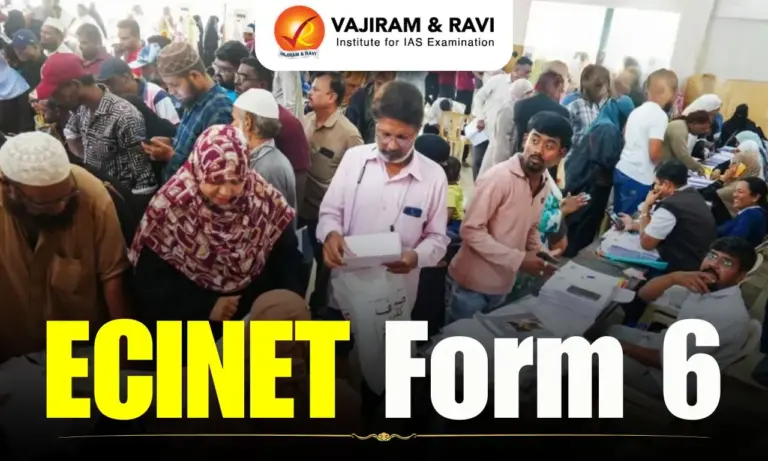
- The Election Commission of India’s (ECI) online voter registration portal, ECINET, now requires new applicants to furnish details of their parents’ status in the last Special Intensive Revision (SIR) of electoral rolls, down to the polling booth number and serial number.
- This change has been introduced even though Form 6, the statutory enrolment form, has not been formally amended through the procedure established by law, raising questions about due process.
What Is the New Procedure?
- The ECINET portal allows users to submit forms for new electoral registrations, changes to existing rolls, and deletions.
- Form 6, the electors’ enrolment form under the Representation of the People Act, 1950, and the Registration of Electors Rules, 1960, now includes a new section online called the “declaration form.”
- Applicants must state whether their parents were included in the last SIR:
- If yes: They must provide the Assembly constituency number, polling booth (part) number, and the serial number at which their father or mother was registered.
- If no: They must select that option and provide their parents’ names and Electors Photo Identity Card (EPIC) numbers, if available.
- This requirement applies in all states where the SIR has been completed or is underway, except Bihar.


Status of the SIR Exercise
- The EC has completed the SIR in 13 states/UTs since June 2025, using the early 2000s intensive revision as the reference point (“last SIR”).
- The exercise is currently underway in 19 other states/UTs.
- The EC has yet to announce the SIR for Himachal Pradesh, Ladakh, and Jammu and Kashmir.
- In Assam, the SIR has been deferred until the National Register of Citizens (NRC) exercise is completed.
- So far, the SIR has led to the deletion of 5.58 crore names nationally, mostly due to electors being found deceased, shifted, absent, or enrolled at multiple places.
- In West Bengal alone, 27 lakh electors who had submitted documents were deleted through a judicial adjudication process, with appeals now pending before appellate tribunals.
The Legal Question: Was Due Process Followed?
- Article 326 of the Constitution guarantees the right to enrol as an elector to all adult citizens ordinarily resident in a constituency, unless disqualified by law.
- The Representation of the People Act, 1950 empowers the Union government to frame election and registration rules.
- Section 28 (RPA) requires the Central Government, after consulting the EC, to notify rules in the Official Gazette, which must then be laid before Parliament.
- Since Form 6 is part of the Registration of Electors Rules, 1960, any change to it requires formal amendment and gazette notification by the Law and Justice Ministry.
- However, no such amendment has been notified. E-Gazette records from June 2025 (when the SIR was announced) show no change to Form 6.
- Notably, the downloadable/printable version of Form 6 on ECINET does not even contain the new SIR declaration section, confirming that the form has not been formally amended.
Implications for New Electors
- New applicants, largely those who have recently turned 18, must now trace themselves or their parents to the last SIR record.
- Since the EC has not clarified this change, it remains unclear whether applicants unable to provide such details will face additional scrutiny.
- This assumes greater significance because the ongoing SIR is unprecedented: rolls are being prepared afresh rather than revised annually, and for the first time, electors must submit documents to prove eligibility, including citizenship.
- The impact of this declaration requirement on the enrolment of children of those already deleted from rolls (as in West Bengal) remains unknown.
Conclusion
- The ECINET’s new declaration requirement highlights a troubling gap between administrative practice and legal procedure.
- Without formal gazette notification, the change lacks statutory backing, raising concerns about transparency, accountability, and the potential exclusion of genuine electors from India’s democratic process.
Source: IE

 Last updated on Sep, 2026
→ UPSC 2027 Notification will be released on 13 January 2027 at upsconline.nic.in.
→ Check out the latest UPSC Syllabus here.
→ Download UPSC Model Answers for Mains 2026
→ UPSC Mains Question Paper 2026 is out now for Essay & GS Paper 1, 2, 3 & 4.
→ UPSC Calendar 2027 has been released.
→ Enroll in Vajiram & Ravi’s UPSC Mains Test Series 2027 for structured answer writing practice, expert evaluation, and exam-oriented feedback.
→ Join Vajiram & Ravi’s UPSC Mentorship Program 2027 for personalized guidance, strategy planning, and one-to-one support from experienced mentors.
→ Go through the UPSC Mains Previous Year Papers to enhance your preparation.
→ UPSC has released UPSC Toppers List 2025 with the Civil Services final result on its official website.
→ Also check Best UPSC Coaching in India
ECINET Form 6 FAQs
Q1. What is the new requirement introduced in ECINET Form 6?+
Q2. Why has the ECINET Form 6 requirement generated legal concerns?+
Q3. How does the ECINET Form 6 requirement relate to Article 326?+
Q4. Who could be affected by the ECINET Form 6 requirement?+
Q5. Why is the ECINET Form 6 issue significant for electoral governance?+
Tags: ECINET Form 6 mains articles upsc current affairs upsc mains current affairs