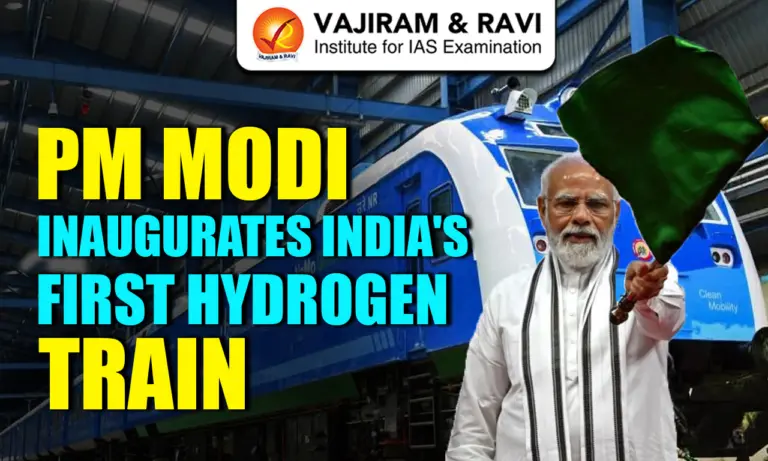
India has taken a major step towards green and sustainable transportation with the launch of its first hydrogen-powered train on the Jind-Sonipat route in Haryana. The project reflects India’s commitment to reducing carbon emissions, promoting clean energy, and modernizing its railway network. Hydrogen-powered trains are expected to play an important role in achieving the country’s long-term climate and net-zero goals.
What is a Hydrogen Train?
A hydrogen train is a train that runs using hydrogen fuel cells instead of diesel. The fuel cells generate electricity by combining hydrogen with oxygen, which powers the train’s electric motors. Unlike diesel trains, hydrogen trains emit only water vapour and heat, making them an eco-friendly mode of transport. They are an important step towards cleaner and more sustainable rail transportation.
How Does a Hydrogen Train Work?
A hydrogen train generates electricity through hydrogen fuel cells instead of using a diesel engine. This electricity powers the train’s electric motors, making it a clean and energy-efficient mode of rail transport.
- Hydrogen Storage: Compressed hydrogen gas is stored in specially designed high-pressure tanks mounted on the train.
- Supply to Fuel Cell: The stored hydrogen is supplied to the fuel cell stack through a controlled fuel delivery system.
- Oxygen Intake: Oxygen from the surrounding air enters the fuel cell through the air intake system.
- Electrochemical Reaction: Inside the fuel cell, hydrogen reacts with oxygen in an electrochemical process without combustion.
- Electricity Generation: The reaction produces electricity, which is used to operate the train’s electric traction motors.
- Battery Support: Excess electricity generated by the fuel cells is stored in onboard lithium-ion batteries and used during acceleration or when additional power is required.
- Train Propulsion: The electric motors convert electrical energy into mechanical energy, driving the wheels and moving the train.
- Zero Harmful Emissions: The only by-products of the fuel cell reaction are water vapour and heat, with no carbon dioxide or harmful pollutants released.
- Energy Efficiency: Fuel cells are more energy-efficient than conventional diesel engines and help reduce fuel consumption.
- Regenerative Braking: During braking, the train recovers some of the energy and stores it in the batteries, improving overall efficiency.


Hydrogen Train Features
India’s first hydrogen train marks a significant advancement in sustainable railway transportation. It combines clean energy technology with modern rail infrastructure to reduce pollution and improve energy efficiency. The key features of Hydrogen Train are:
- Powered by hydrogen fuel cell technology instead of diesel engines.
- Operates on the Jind–Sonipat route in Haryana.
- Generates electricity through an electrochemical reaction between hydrogen and oxygen.
- Emits only water vapour and heat, making it a zero tailpipe emission train.
- Equipped with high-pressure hydrogen storage tanks and fuel cell systems.
- Uses electric traction motors for smooth and efficient operation.
- Includes onboard batteries to store excess electricity and support acceleration.
- Designed to operate efficiently on non-electrified railway routes.
- Produces significantly lower noise compared to conventional diesel trains.
- Supports Indian Railways’ vision of adopting clean and sustainable technologies.
Hydrogen Train Benefits
- Environment-Friendly: Eliminates carbon dioxide and other harmful emissions during operation.
- Reduces Air Pollution: Helps improve air quality by replacing diesel-powered trains.
- Supports Climate Goals: Contributes to India’s Net Zero emissions target by 2070 and clean energy commitments.
- Lower Noise Pollution: Operates more quietly, improving passenger comfort and reducing noise in nearby communities.
- Energy Efficient: Hydrogen fuel cells convert energy more efficiently than diesel engines.
- Reduced Dependence on Fossil Fuels: Promotes the use of alternative and renewable energy sources.
- Suitable for Remote Routes: Offers a clean transport solution for railway lines that are not fully electrified.
- Boosts Green Hydrogen Economy: Encourages domestic production, storage, and use of green hydrogen.
- Promotes Technological Innovation: Strengthens India’s capabilities in advanced railway and clean energy technologies.
- Sustainable Public Transport: Supports the transition towards cleaner, greener, and more sustainable rail transportation.
How Does India’s First Hydrogen Train Support the National Green Hydrogen Mission?
India’s first hydrogen train is an important initiative under the country’s clean energy transition. It aligns with the objectives of the National Green Hydrogen Mission, which seeks to promote the production, use, and export of green hydrogen while reducing carbon emissions.
- Promotes Green Hydrogen Adoption: Demonstrates the use of hydrogen as a clean fuel in the railway sector, one of India’s largest transport networks.
- Supports Mission Objectives: Advances the National Green Hydrogen Mission’s goal of making India a global hub for the production, utilization, and export of green hydrogen.
- Decarbonises Rail Transport: Helps reduce dependence on diesel locomotives, particularly on non-electrified railway routes, lowering greenhouse gas emissions.
- Encourages Domestic Manufacturing: Boosts indigenous development of hydrogen fuel cells, storage systems, and related railway technologies under the Make in India initiative.
- Develops Hydrogen Infrastructure: Creates demand for hydrogen production, storage, transportation, and refuelling facilities, strengthening the hydrogen value chain.
- Promotes Energy Security: Reduces reliance on imported fossil fuels by encouraging the use of domestically produced green hydrogen.
- Supports Climate Commitments: Contributes to India’s pledge of achieving Net Zero emissions by 2070 and meeting its Nationally Determined Contributions (NDCs) under the Paris Agreement.
Advantages of Hydrogen Trains Over Diesel Trains
Hydrogen trains provide a cleaner, quieter, and more sustainable alternative to diesel-powered trains. They help reduce environmental pollution while improving energy efficiency and supporting India’s transition to green transportation.
- Clean Fuel: Hydrogen trains use hydrogen fuel cells, while diesel trains run on fossil fuels.
- Zero Tailpipe Emissions: Hydrogen trains emit only water vapour and heat, whereas diesel trains release carbon dioxide, nitrogen oxides, and particulate matter.
- Environment-Friendly: Hydrogen-powered trains have a much lower environmental impact and help reduce air pollution.
- Higher Energy Efficiency: Fuel cell technology converts energy more efficiently than conventional diesel engines.
- Lower Noise Levels: Electric motors used in hydrogen trains produce significantly less noise than diesel engines.
- Reduced Dependence on Fossil Fuels: Hydrogen trains decrease reliance on imported petroleum products and promote cleaner energy sources.
- Improved Air Quality: Since they do not emit harmful exhaust gases, hydrogen trains contribute to better public health and cleaner surroundings.
- Suitable for Non-Electrified Routes: They offer a sustainable alternative to diesel trains on railway lines where electrification is not feasible.
- Supports Climate Goals: Hydrogen trains contribute to India’s Net Zero emissions target by 2070 and the decarbonisation of the transport sector.
- Promotes Green Hydrogen Ecosystem: Their adoption encourages investment in hydrogen production, storage, refuelling infrastructure, and fuel cell technology.
Challenges in Adopting Hydrogen-Powered Trains in India
While hydrogen-powered trains offer significant environmental benefits, their large-scale adoption in India faces several technological, financial, and infrastructure-related challenges.
- High Initial Cost: Hydrogen fuel cell trains and related equipment are more expensive than conventional diesel trains.
- Cost of Green Hydrogen: Producing green hydrogen through renewable energy is currently costlier than using fossil fuels.
- Limited Refuelling Infrastructure: India has very few hydrogen production, storage, and refuelling facilities for railway operations.
- Hydrogen Storage Challenges: Hydrogen requires high-pressure tanks and advanced storage systems to ensure safe transportation and usage.
- Safety Concerns: Hydrogen is highly flammable and requires strict safety standards for storage, handling, and refuelling.
- Technology Development: Hydrogen fuel cell technology is still evolving and requires further research and testing for widespread railway use.
- Skilled Workforce: Operating and maintaining hydrogen-powered trains requires trained personnel with expertise in hydrogen technologies.
- Maintenance and Spare Parts: Fuel cell systems require specialised maintenance facilities and components, which are currently limited in India.
- Reliable Green Hydrogen Supply: A continuous and affordable supply of green hydrogen is essential for large-scale deployment.
- Infrastructure Investment: Significant investment is needed to develop hydrogen production plants, pipelines, storage facilities, and refuelling stations.
Future of Hydrogen Trains in India
Hydrogen-powered trains are expected to play an important role in India’s transition towards clean and sustainable rail transport. As hydrogen technology advances and supporting infrastructure develops, these trains could become a viable alternative to diesel locomotives on non-electrified routes.
- Indian Railways plans to gradually expand the use of hydrogen-powered trains on suitable routes.
- Hydrogen trains can help replace diesel locomotives on non-electrified railway lines, reducing carbon emissions.
- The success of pilot projects will guide the large-scale deployment of hydrogen trains across the country.
- Increased investment in green hydrogen production will improve the availability and affordability of hydrogen fuel.
- Development of hydrogen refuelling stations and storage infrastructure will support wider adoption.
- Advancements in fuel cell technology are expected to improve the efficiency, range, and reliability of hydrogen trains.
- The growth of the hydrogen ecosystem will encourage domestic manufacturing of fuel cells, storage tanks, and related railway components under the Make in India initiative.

 Last updated on Oct, 2026
→ UPSC 2027 Notification will be released on 13 January 2027 at upsconline.nic.in.
→ Check Nobel Prize 2026 Winners List here.
→ Download PIB PRiSM Monthly Magazine 2026 here.
→ Check UPSC Monthly Current Affairs Magazine The Recitals here.
→ Check out the latest UPSC Syllabus here.
→ Download UPSC Model Answers for Mains 2026
→ UPSC Mains Question Paper 2026 is out now for Essay & GS Paper 1, 2, 3 & 4.
→ UPSC Calendar 2027 has been released.
→ Enroll in Vajiram & Ravi’s UPSC Mains Test Series 2027 for structured answer writing practice, expert evaluation, and exam-oriented feedback.
→ Join Vajiram & Ravi’s UPSC Mentorship Program 2027 for personalized guidance, strategy planning, and one-to-one support from experienced mentors.
→ Go through the UPSC Mains Previous Year Papers to enhance your preparation.
→ UPSC has released UPSC Toppers List 2025 with the Civil Services final result on its official website.
→ Also check Best UPSC Coaching in India
Hydrogen Train FAQs
Q1. What is a hydrogen train?+
Q2. Which is India's first hydrogen train route?+
Q3. How does a hydrogen train work?+
Q4. What are the main advantages of hydrogen trains?+
Q5. What is the National Green Hydrogen Mission?+
Tags: 2026 current affairs jind pm modi pm modi inaugurates india's first hydrogen train sonipat train