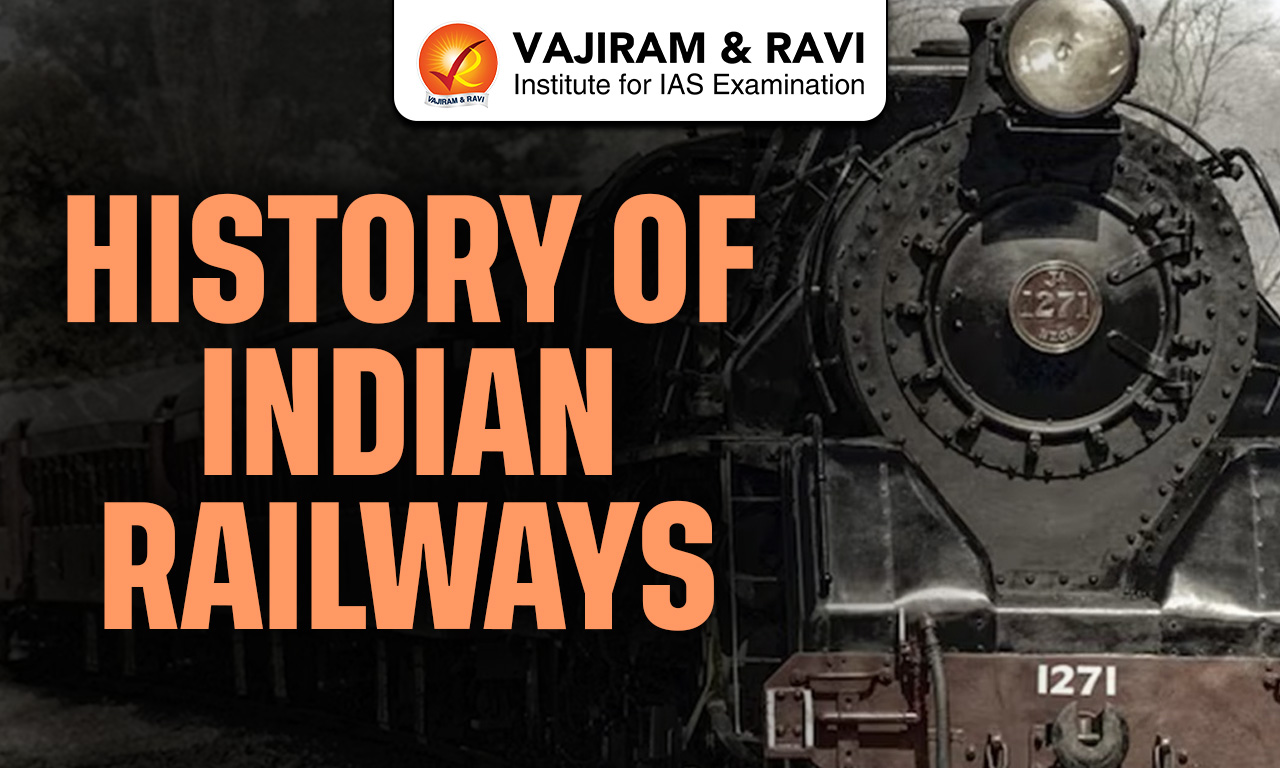
Indian Railways is one of the largest railway networks in the world and plays a crucial role in India’s economy and daily life. It is the fourth-largest railway system globally by route length and is owned and operated by the Government of India. With a history of more than 150 years, Indian Railways has evolved from a small colonial transport system into a modern and advanced network. In this article, we have discussed in brief about the History of Indian Railways from the British Era to the present-day modern era.
With a history of over 150+ years, Indian Railways carries more than 6 billion passengers annually and transports around 750 million tonnes of freight. It is also one of the largest employers in the world, with over 1.6 million employees.
History of Indian Railways
The journey of Indian Railways began during the British period and gradually expanded across the country. Below is a simplified timeline:
Early Developments (1832-1853)
- The idea of railways in India was first proposed in 1832 in Madras (Chennai).
- Red Hill Railway (1836-37), built by Arthur Cotton, was used for transporting granite.
- In 1843, George Clark proposed a railway connecting Bombay with nearby regions.
- On 16 April 1853, India’s first passenger train ran from Bombay to Thane, covering 34 km.
Rapid Expansion (1854-1900)
- 1854: First eastern railway line from Howrah to Hooghly.
- 1856: First southern railway line opened.
- 1859: Northern line from Allahabad to Kanpur.
- 1862: First railway workshop at Jamalpur.
- 1864: Delhi Junction became a major railway hub.
- By 1880, railway network expanded to 9000 miles.
- 1895: First steam locomotive manufactured in Ajmer.
Mountain & Heritage Railways
- Darjeeling Himalayan Railway (1881) – UNESCO World Heritage Site.
- Nilgiri Mountain Railway (1899) – Engineering marvel.
- Kalka Shimla Railway (1903) – Scenic hill route.
Colonial Impact & Independence (1900-1951)
- Railways were used heavily during World Wars, leading to damage and neglect.
- After Independence in 1947, railways were divided between India and Pakistan.
- In 1951, Indian Railways was nationalized and divided into zones.
Railway Infrastructure in India
Indian Railways has one of the most extensive and complex infrastructure networks in the world, connecting remote villages to major metropolitan cities. Its infrastructure includes tracks, stations, bridges, signaling systems, and modern digital facilities that ensure smooth and efficient operations.
- Extensive Rail Network: Indian Railways operates over 120,000 km of track, making it the fourth-largest railway network globally. It connects almost every region of India, including rural, urban, and industrial areas.
- Types of Railway Gauges: The network primarily uses Broad Gauge (1676 mm), which is the most widely used. Older Meter Gauge and Narrow Gauge lines are being converted into Broad Gauge under Project Unigauge.
- Railway Zones & Divisions: Indian Railways is divided into multiple zones (such as Northern, Southern, Western, etc.) for better administration. Each zone is further divided into divisions for efficient management.
- Major Railway Stations: India has thousands of railway stations, including major junctions like Delhi Junction, Mumbai, Chennai, and Kolkata, which handle heavy passenger and freight traffic.
- Bridges and Tunnels: Indian Railways has built several engineering marvels like the Pamban Bridge (India’s first sea bridge) and the Chenab Rail Bridge (world’s highest railway bridge). Numerous tunnels have also been constructed in hilly regions.
- Railway Tracks & Electrification: A large portion of the railway network is electrified to improve efficiency and reduce pollution. Continuous efforts are being made to achieve 100% electrification.
- Signaling and Safety Systems: Modern signaling systems like automatic signals, centralized traffic control, and anti-collision devices ensure safe train operations and reduce accidents.
- Workshops & Production Units: Indian Railways has major workshops and production units in places like Jamalpur and Ajmer, where locomotives, coaches, and wagons are manufactured and maintained.
- Rolling Stock (Trains & Engines): Includes diesel and electric locomotives, passenger coaches, freight wagons, and modern trains like semi-high-speed trains.
- Digital Infrastructure: Services like online ticket booking through IRCTC Rail Connect, real-time train tracking, and e-catering have improved passenger convenience.
- Freight Infrastructure: Dedicated Freight Corridors are being developed to improve the speed and efficiency of goods transport across the country.


Important Bridges of Indian Railways
Indian Railways has constructed several iconic bridges across rivers, seas, and valleys, showcasing remarkable engineering skills. These bridges play a crucial role in connectivity, trade, and strategic movement across different regions of India.
- Chenab Rail Bridge
- Located in Jammu & Kashmir over the Chenab River
- World’s highest railway bridge (about 359 meters above riverbed)
- Part of the Udhampur-Srinagar-Baramulla Rail Link (USBRL) project
- Symbol of modern engineering and strategic importance
- Pamban Bridge
- Connects mainland India to Rameswaram Island (Tamil Nadu)
- India’s first sea bridge (opened in 1914)
- Features a double-leaf bascule section that opens for ships
- Bandra Worli Sea Link (railway relevance indirect)
- Though primarily a road bridge, it reflects India’s advanced bridge engineering influencing rail projects
- Vembanad Rail Bridge
- India’s longest railway bridge (about 4.62 km)
- Built across Vembanad Lake in Kerala
- Connects Edappally to Vallarpadam
- Godavari Rail Bridge
- Built over the Godavari River in Andhra Pradesh
- One of the longest and oldest railway bridges in India
- Important for South India connectivity
- Mahatma Gandhi Setu (primarily road, but regionally significant)
- Highlights large-scale bridge construction over Ganga
- Bogibeel Bridge
- India’s longest rail-cum-road bridge
- Built over the Brahmaputra River in Assam
- Strategically important for Northeast India and defense
- Saraighat Bridge
- First rail-cum-road bridge over the Brahmaputra River
- Connects North and South Assam
- Howrah Bridge (mainly road but historically linked to rail hub)
- Located near Howrah Railway Station, one of the busiest rail terminals
- Narmada Bridge
- Important railway bridge over the Narmada River
- Supports freight and passenger movement in western India
Future of Indian Railways
The future of Indian Railways is focused on speed, safety, sustainability, and smart technology. With rapid modernization and large-scale investments, Indian Railways aims to become a world-class transport system that is efficient, eco-friendly, and passenger-friendly.
- High-Speed Rail (Bullet Trains): India is working on its first bullet train project, the Mumbai Ahmedabad High Speed Rail. This will significantly reduce travel time and introduce world-class rail technology.
- 100% Electrification: Indian Railways is moving towards complete electrification of its network to reduce fuel costs and pollution. This will also improve speed and efficiency.
- Green Energy & Sustainability: Railways aim to meet a large portion of their energy needs through solar and wind power. The goal is to reduce carbon emissions and become an environmentally sustainable transport system.
- Dedicated Freight Corridors (DFC): Special freight corridors are being developed to allow faster and smoother transportation of goods, reducing congestion on passenger routes.
- Modern Trains (Vande Bharat): Introduction of semi-high-speed trains like Vande Bharat Express with better speed, comfort, and modern facilities.
- Station Modernization: Major railway stations are being redeveloped into world-class hubs with better waiting areas, cleanliness, food courts, and digital services.
- Advanced Safety Systems: Implementation of modern safety technologies like automatic train protection systems (e.g., Kavach) to reduce accidents and improve passenger safety.
- Digital Transformation: Services like online booking via IRCTC Rail Connect, real-time train tracking, AI-based scheduling, and paperless tickets are improving passenger experience.
- Smart Infrastructure: Use of modern signaling systems, GPS tracking, and centralized traffic control for better management of trains and routes.
- Expansion to Remote Areas: New railway lines are being built to connect remote and border regions, improving connectivity and boosting economic development.
- Make in India & Indigenous Production: Focus on manufacturing trains, coaches, and railway equipment within India to reduce imports and boost local industries.

 Last updated on Oct, 2026
→ UPSC 2027 Notification will be released on 13 January 2027 at upsconline.nic.in.
→ Check Nobel Prize 2026 Winners List here.
→ Download PIB PRiSM Monthly Magazine 2026 here.
→ Check UPSC Monthly Current Affairs Magazine The Recitals here.
→ Check out the latest UPSC Syllabus here.
→ Download UPSC Model Answers for Mains 2026
→ UPSC Mains Question Paper 2026 is out now for Essay & GS Paper 1, 2, 3 & 4.
→ UPSC Calendar 2027 has been released.
→ Enroll in Vajiram & Ravi’s UPSC Mains Test Series 2027 for structured answer writing practice, expert evaluation, and exam-oriented feedback.
→ Join Vajiram & Ravi’s UPSC Mentorship Program 2027 for personalized guidance, strategy planning, and one-to-one support from experienced mentors.
→ Go through the UPSC Mains Previous Year Papers to enhance your preparation.
→ UPSC has released UPSC Toppers List 2025 with the Civil Services final result on its official website.
→ Also check Best UPSC Coaching in India
History of Indian Railways FAQs
Q1. When did Indian Railways start?+
Q2. What was the first railway line in India?+
Q3. Who introduced railways in India?+
Q4. When was the first railway workshop established?+
Q5. When were railway zones introduced in India?+
Tags: history history notes history of indian railways indian history