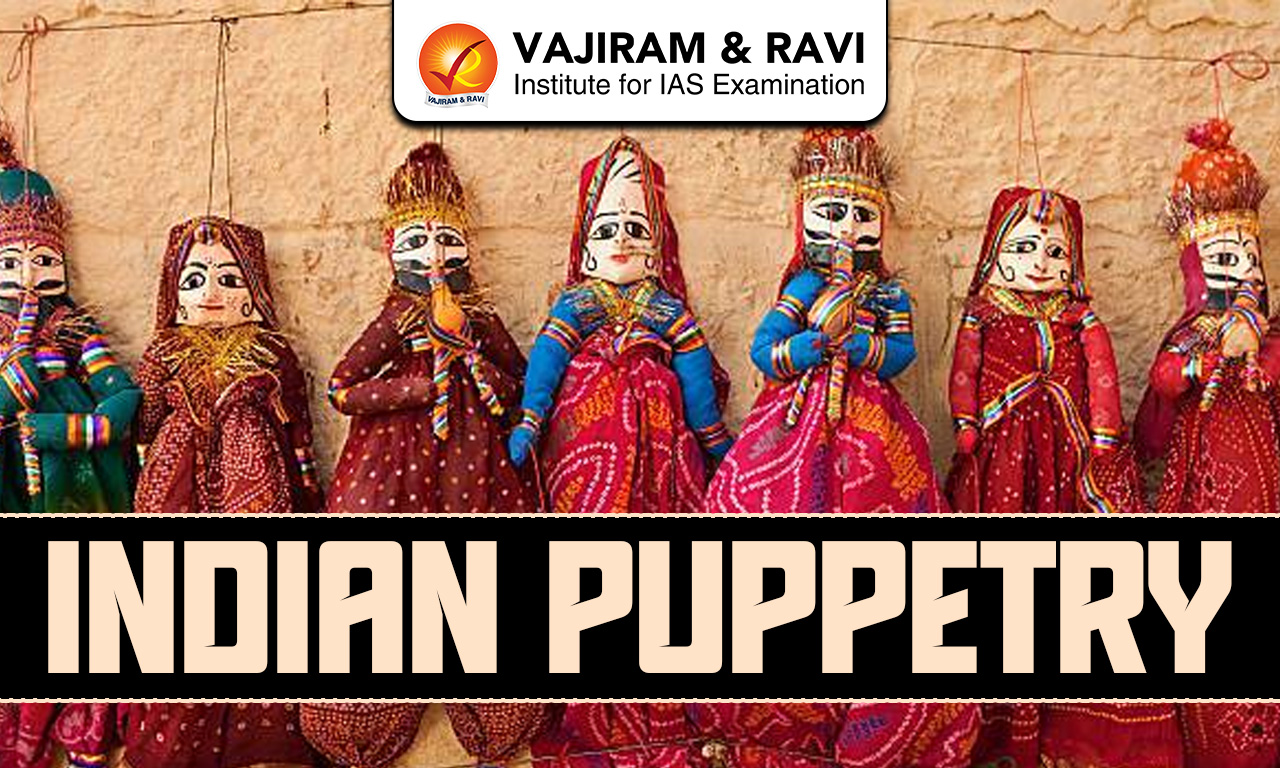
Indian Puppetry is one of the oldest and most creative art forms in India. It combines storytelling with acting, music, dance, and visual art. Puppets are used to tell stories from mythology, folklore, and everyday life. This art form is not only entertaining but also helps in spreading culture, traditions, and social messages.
Indian Puppetry Origin
- Ancient Origin of Puppetry: The history of puppetry in India dates back to very ancient times. It is considered one of the earliest forms of storytelling and entertainment in Indian culture.
- Evidence from Indus Valley Civilization: Archaeological discoveries from the Indus Valley Civilization, especially from sites like Harappa and Mohenjo-Daro, have revealed puppets with movable parts. This proves that puppetry was already practiced thousands of years ago.
- Early References in History: There are references to puppet theatre dating back to around 500 BC. These early mentions show that puppetry was not only a form of entertainment but also a well-known cultural activity in ancient India.
- Mention in Ancient Texts: Important Indian texts like the Mahabharata and Silappadikaram include references to puppetry. This indicates that puppetry was widely recognized and valued in literature and society.
- Philosophical Significance: Puppetry in India is not just an art form but also has deep philosophical meaning. In the Bhagavad Gita, God is compared to a puppeteer who controls human life and the universe through three qualities – Sattva (purity), Rajas (activity), and Tamas (inertia).
- Role of Sutradhar: In traditional Indian theatre, the narrator or storyteller is called a Sutradhar, which means “the one who holds the strings.” This term reflects the idea that the storyteller guides and controls the flow of the story, similar to how a puppeteer controls puppets.
Indian Puppetry Development
- Regional Development of Puppetry: Over time, puppetry spread across different regions of India, and each area developed its own unique style, techniques, and forms of puppets based on local culture and traditions.
- Use of Mythology and Folklore: The stories performed in puppetry are mostly taken from mythology, folklore, epics, and local legends. These stories help in preserving cultural traditions and passing them from one generation to another.
- Combination of Various Art Forms: Puppetry is a combined art form that includes elements of painting, sculpture, music, dance, and drama. This makes it a rich and complete form of artistic expression.
- Medium of Education and Entertainment: Puppetry has been widely used as a tool to educate people and spread social and moral messages, while also entertaining audiences in an engaging and simple way.
- Decline in Modern Times: In recent years, puppetry has been gradually declining due to a lack of audience interest, competition from modern entertainment, and financial difficulties faced by puppeteers.


Types of Indian Puppetry
Indian puppetry is broadly divided into four main types, each with its own unique style, technique, and regional importance.
- String Puppets (Marionettes): String puppets are controlled by strings tied to different parts of the puppet’s body such as the head, hands, and legs.
- Features
- Usually made of wood and painted with bright colours
- Have movable joints for flexible movement
- Controlled from above using strings
- Known for lifelike and expressive actions
- Major Regions: Rajasthan, Odisha, Karnataka, Tamil Nadu
- Important Examples
- Kathputli (Rajasthan): The most popular form, with colourful costumes and stories of kings, heroes, and folklore.
- Kundhei (Odisha): Light wooden puppets influenced by dance and music traditions.
- Gombeyatta (Karnataka): Inspired by Yakshagana theatre and often requires skilled control.
- Bommalattam (Tamil Nadu): A mix of rod and string puppetry, with large and heavy puppets.
- Shadow Puppets: Shadow puppets are flat figures placed behind a screen, and light is used to create moving shadows that tell a story.
- Features
- Made from processed leather
- Flat and often decorated with colours
- Shadows are shown on a white screen
- Mostly used for mythological and epic stories
- Major Regions: Odisha, Kerala, Andhra Pradesh, Karnataka, Tamil Nadu
- Important Examples
- Ravanachhaya (Odisha): Simple puppets without joints, mainly based on Ramayana stories.
- Togalu Gombeyatta (Karnataka): Puppets vary in size based on the importance of characters.
- Tholu Bommalata (Andhra Pradesh): Large, colourful puppets used to narrate epics like Ramayana and Mahabharata.
- Rod Puppets: Rod puppets are bigger puppets that are controlled using rods attached to their body.
- Features
- Larger in size compared to glove puppets
- Controlled from below using rods
- Have fewer movements but strong visual impact
- Major Regions: West Bengal, Odisha, Bihar
- Important Examples
- Putul Nach (West Bengal): Puppets are about 3-4 feet tall and perform folk stories.
- Yampuri (Bihar): Simple wooden puppets, often without joints and easy to handle.
- Glove Puppets: Glove puppets are worn on the hand like a glove and operated using fingers.
- Features
- Small and light in size
- Made of cloth, wood, or papier-mâché
- Easy to control and perform
- Appear like small dolls
- Major Regions: Kerala, Uttar Pradesh, Odisha, West Bengal
- Important Example
- Pavakoothu (Kerala): Influenced by Kathakali, with colourful costumes and expressive designs.
Indian Puppetry Cultural Significance
- Preservation of Traditions: Puppetry helps in preserving ancient stories, folklore, and cultural traditions, passing them from one generation to another.
- Connection with Religion and Mythology: Many puppet shows are based on epics like the Ramayana and Mahabharata, keeping religious beliefs and values alive.
- Medium of Social Awareness: Puppetry has been used to spread messages about social issues, morality, and education in a simple and engaging way.
- Reflection of Regional Diversity: Different regions of India have their own styles of puppetry, showing the country’s rich cultural diversity.
- Integration of Arts: It combines various art forms such as music, dance, drama, painting, and sculpture, making it a complete cultural expression.
- Community Bonding and Entertainment: Puppet shows were traditionally performed during festivals and gatherings, bringing people together and providing entertainment.
- Symbolic and Philosophical Meaning: Puppetry represents deeper ideas about life and control, as seen in texts like the Bhagavad Gita, where life is compared to a puppet controlled by higher forces.
Challenges Faced by Indian Puppetry
- Declining Audience Interest: Modern entertainment like TV, cinema, and mobile content has reduced people’s interest in traditional puppet shows.
- Lack of Financial Support: Puppeteers often earn very little, making it difficult to continue this art form as a full-time profession.
- Loss of Traditional Skills: Younger generations are less interested in learning puppetry, leading to a gradual loss of skills and knowledge.
- Limited Government Support: Although some efforts exist, overall support in terms of funding, promotion, and training is still inadequate.
- Competition from Modern Media: Digital platforms and advanced visual effects attract more attention compared to simple traditional performances.
- Irregular Performance Opportunities: Puppet shows are mostly limited to festivals or special events, reducing regular income for artists.
- Lack of Awareness and Promotion: Many people, especially in urban areas, are not aware of the richness and importance of puppetry traditions.
Government Schemes to Promote Indian Puppetry
- Sangeet Natak Akademi (SNA) Support Programs
- It is the national academy for music, dance, and drama under the Ministry of Culture.
- Provides grants, awards, and financial assistance to artists and institutions involved in puppetry and other performing arts.
- Kala Sanskriti Vikas Yojana (KSVY)
- A central government scheme that offers financial support to artists and cultural organizations.
- Covers traditional art forms like puppetry, helping artists sustain their livelihood.
- Cultural Function and Production Grant (CFPG)
- Supports organization of cultural programs, festivals, and performances.
- Helps puppeteers showcase their art and increase public awareness.
- Scheme for Safeguarding Intangible Cultural Heritage
- Focuses on preserving traditional art forms like puppetry as part of India’s cultural heritage.
- Encourages documentation, training, and promotion of such arts.
- Global Engagement Scheme (Festival of India)
- Provides opportunities for Indian artists, including puppeteers, to perform internationally.
- Promotes Indian puppetry on a global platform.
- Financial Assistance for Cultural Activities (Building Grants)
- Supports creation of theatres, training centres, and performance spaces.
- Helps in developing proper infrastructure for puppetry and other arts.
- Ministry of Culture Initiatives
- The Ministry of Culture runs various programs to preserve and promote traditional arts.
- It focuses on protecting intangible heritage like puppetry and supporting artists across India.

 Last updated on Oct, 2026
→ UPSC 2027 Notification will be released on 13 January 2027 at upsconline.nic.in.
→ Check Nobel Prize 2026 Winners List here.
→ Download PIB PRiSM Monthly Magazine 2026 here.
→ Check UPSC Monthly Current Affairs Magazine The Recitals here.
→ Check out the latest UPSC Syllabus here.
→ Download UPSC Model Answers for Mains 2026
→ UPSC Mains Question Paper 2026 is out now for Essay & GS Paper 1, 2, 3 & 4.
→ UPSC Calendar 2027 has been released.
→ Enroll in Vajiram & Ravi’s UPSC Mains Test Series 2027 for structured answer writing practice, expert evaluation, and exam-oriented feedback.
→ Join Vajiram & Ravi’s UPSC Mentorship Program 2027 for personalized guidance, strategy planning, and one-to-one support from experienced mentors.
→ Go through the UPSC Mains Previous Year Papers to enhance your preparation.
→ UPSC has released UPSC Toppers List 2025 with the Civil Services final result on its official website.
→ Also check Best UPSC Coaching in India
Indian Puppetry FAQs
Q1. What is Indian puppetry?+
Q2. What is the origin of Indian puppetry?+
Q3. What are the main types of Indian puppetry?+
Q4. What kind of stories are shown in puppetry?+
Q5. Why is Indian puppetry culturally important?+
Tags: art and culture art and culture notes indian puppetry