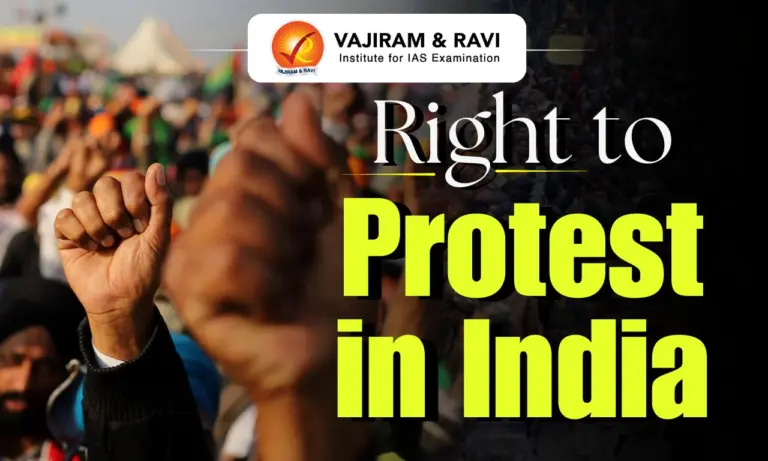
The Right to Protest in India is a vital democratic principle that allows citizens to peacefully express opinions, oppose government decisions and seek policy changes. It is derived from Article 19 of the Constitution through the freedoms of speech, peaceful assembly and association. However, this right is subject to reasonable restrictions to protect public order, national security and the rights of other citizens, ensuring a balance between democratic dissent and public interest.
Why is the Right to Protest in News?
The Right to Protest in India is in focus following the proposed Cockroach Janta Party (CJP) march from Jantar Mantar to Parliament in New Delhi on July 20. The Delhi Police stated that the organisation had neither obtained permission to continue its protest at Jantar Mantar nor applied for approval for the planned march. The CJP has been protesting since June 20, demanding the removal of Union Education Minister Dharmendra Pradhan over educational reforms. The incident has renewed discussions on whether peaceful protests require prior police permission, the limits of constitutional freedoms and the legal framework governing public demonstrations in India.
Right to Protest in India 2026
The Constitution does not recognise the Right to Protest as an independent Fundamental Right. It exists through Article 19 and remains subject to reasonable constitutional restrictions. These constitutional freedoms create the legal basis for peaceful protests, enabling citizens to question government action or inaction through democratic means.
Peaceful protests allow citizens to act as public watchdogs by highlighting governance concerns, encouraging public debate and providing governments with opportunities to review and improve policies.


Right to Protest in Indian Constitution
The Right to Protest in India is derived from multiple constitutional freedoms that collectively protect peaceful democratic participation. These constitutional articles have been highlighted below:
- Article 19(1)(a): Guarantees freedom of speech and expression, allowing citizens to publicly express opinions, criticise government policies and peacefully communicate their views through lawful protests.
- Article 19(1)(b): Gives citizens the right to assemble peacefully and without arms, forming the constitutional foundation for demonstrations, public meetings, rallies and peaceful gatherings.
- Article 19(1)(c): Protects the freedom to form associations and organisations, enabling citizens, political groups, unions and civil society organisations to collectively raise public issues.
Also Read:- Monsoon Session of Parliament 2026
Restrictions on Right to Protest in India
The Constitution permits reasonable restrictions to ensure protests remain peaceful and do not adversely affect public safety or constitutional values.
- Article 19(2) restrictions: Freedom of speech may be restricted in the interests of sovereignty and integrity of India, State security, friendly relations with foreign States, public order, decency, morality, contempt of court, defamation and incitement to an offence.
- Public Assembly Restrictions: Peaceful assemblies may also be regulated when necessary to maintain public order, prevent violence and safeguard the rights and freedoms of other citizens.
- Violence Prohibited: Constitutional protection extends only to peaceful protests. Violence, destruction of public property, or unlawful activities fall outside constitutional protection.
- Fundamental Duty under Article 51A: Every citizen has a constitutional duty to safeguard public property and renounce violence during public demonstrations and collective movements.
- Police Permission: Authorities may refuse permission if a proposed protest is likely to threaten public order, national security, decency, morality, or other constitutional grounds recognised under Article 19.
- Section 163 of Bharatiya Nagarik Suraksha Sanhita: Authorities may impose prohibitory orders and even revoke permission for ongoing protests when necessary to maintain law and order. This provision replaced the earlier Section 144 of the Code of Criminal Procedure 1973.
- Reasoned Decision Required: If permission is denied or withdrawn, the police or District Magistrate should communicate specific reasons, including the nature of the perceived threat and public safety concerns.
Right to Protest in India Case Laws
The Supreme Court has consistently recognised peaceful protest as an essential democratic freedom while emphasising that it must coexist with public order.
- Ramlila Maidan Incident v. Home Secretary, Union of India (2012): The Supreme Court held that peaceful assembly and protest are Fundamental Rights that cannot be curtailed through arbitrary executive or legislative action.
- Mazdoor Kisan Shakti Sangathan vs Union of India (2018): The Court recognised the right to demonstrate at Jantar Mantar while directing authorities to establish a balanced mechanism protecting both protesters and nearby residents.
- Shaheen Bagh Judgment (2019): The Court upheld peaceful protest but ruled that public roads and public spaces cannot be occupied indefinitely, stressing a balance between protesters’ rights and commuters’ rights.
Process of Legal Protest in India
Organising a lawful protest requires compliance with local laws, police permissions and administrative procedures that vary across States.
- State specific procedures: Since law and order is a State subject, every State may prescribe its own rules governing public protests, rallies, demonstrations and assemblies.
- No Objection Certificate (NOC): Organisers generally need an NOC from the local police station. Where multiple police jurisdictions are involved, approval is usually granted by the Commissionerate or Deputy Commissioner of Police (DCP).
- Application details: The application should include organisers’ names, addresses, contact details, purpose of protest, expected participants, venue, duration and proposed rally route wherever applicable.
- Equipment declaration: Organisers must mention arrangements for loudspeakers, tents, pandals, public address systems and other equipment proposed for use during the event.
- Supporting documents: Applications are generally accompanied by identity proof, residence proof, photographs and any additional documents required by the concerned police authority.
- Crowd management plan: Police may seek details regarding drinking water, sanitation facilities, crowd control measures, emergency arrangements, coordination with officials, or affidavits from organisers before granting permission.
- Permission not automatic: Authorities evaluate applications by considering public order, local conditions, security concerns and the rights of nearby residents before granting or refusing approval.
Examples of Peaceful Protests in India
Several peaceful movements have significantly influenced public policy, environmental protection, governance reforms and social justice in India.
- Chipko Movement (1973): Villagers, particularly women, peacefully embraced trees to oppose deforestation, making the movement a landmark example of Gandhian environmental conservation through non violent resistance.
- Narmada Bachao Andolan (1985): Farmers, Adivasis, environmentalists and human rights activists united against large dam projects on the Narmada River, influencing debates on rehabilitation, displacement and sustainable development.
- Jan Lokpal Movement (2011): Anna Hazare’s hunger strike at Jantar Mantar generated nationwide public support for stronger anti corruption institutions and accelerated discussions on the Lokpal legislation.
- Nirbhaya Movement (2012): Nationwide peaceful protests after the Delhi gang rape led to important legal reforms on crimes against women and the establishment of the Nirbhaya Fund for women’s safety.
- Farmers’ Protest (2020): Year long peaceful demonstrations against the three farm laws ultimately resulted in the repeal of the legislation and the formation of a committee to examine Minimum Support Price (MSP) related issues.

 Last updated on Sep, 2026
→ UPSC 2027 Notification will be released on 13 January 2027 at upsconline.nic.in.
→ Check out the latest UPSC Syllabus here.
→ Download UPSC Model Answers for Mains 2026
→ UPSC Mains Question Paper 2026 is out now for Essay & GS Paper 1, 2, 3 & 4.
→ UPSC Calendar 2027 has been released.
→ Enroll in Vajiram & Ravi’s UPSC Mains Test Series 2027 for structured answer writing practice, expert evaluation, and exam-oriented feedback.
→ Join Vajiram & Ravi’s UPSC Mentorship Program 2027 for personalized guidance, strategy planning, and one-to-one support from experienced mentors.
→ Go through the UPSC Mains Previous Year Papers to enhance your preparation.
→ UPSC has released UPSC Toppers List 2025 with the Civil Services final result on its official website.
→ Also check Best UPSC Coaching in India
Right to Protest in India 2026 FAQs
Q1. What is the Right to Protest in India?+
Q2. Can the Right to Protest be Restricted in India?+
Q3. Can we Protest without permission in India?+
Q4. Do we need permission to Protest in India?+
Q5. Is the Right to Protest a Fundamental Right in India?+
Tags: Article 19 of Indian Constitution constitution of india fundamental rights fundamental rights of indian constitution indian polity right to protest right to protest in india