Polymer Currency Latest News
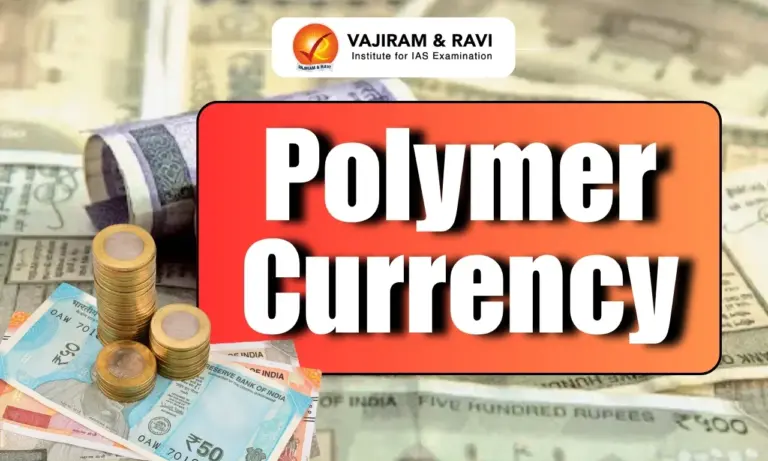
- The Reserve Bank of India (RBI), through its currency-printing arm Bharatiya Reserve Bank Note Mudran Pvt. Ltd. (BRBNMPL), has invited global Expressions of Interest (EOI) for supplying Biaxially Oriented Polypropylene (BOPP) polymer substrates with advanced security features.
- This marks India’s most significant move towards introducing polymer (plastic) banknotes since the proposal was first made in 2009.
Why is RBI Considering Polymer Currency?
- Greater durability:
- Polymer notes last 2.5–4 times longer than conventional cotton-paper notes.
- Lower denominations such as ₹10 and ₹20, which experience the highest circulation and physical wear, are likely to be introduced first.
- Longer lifespan reduces the frequency of replacement under the RBI’s Clean Note Policy.
- Better security against counterfeiting:
- Polymer banknotes can incorporate advanced security features such as –
- Transparent windows
- Metallic numerals
- Magnetic pseudo-threads
- Holograms
- Shadow images
- Iridescent patterns
- Durable tactile markings for visually impaired persons
- These features are significantly harder to replicate than those on paper currency.
- Polymer banknotes can incorporate advanced security features such as –
- Improved currency management: Although manufacturing costs are higher initially, fewer replacement cycles can reduce printing expenditure, transportation costs, storage and logistics costs, and destruction of soiled notes.


Economic Rationale
- Current cost of currency management:
- RBI spends roughly ₹5,000 crore annually on printing and maintaining currency.
- Security printing expenditure – ₹5,101 crore (FY2023-24), ₹6,373 crore (FY2024-25), and ₹4,875 crore (FY2025-26).
- India destroys 20–24 billion soiled notes annually, largely lower denominations.
- Cost challenges:
- Polymer notes cost 30–60% more to manufacture than paper notes.
- In several countries, production cost for low-value polymer notes has reached 20–24% of their face value.
- Additional transition costs include recalibration of ATMs, currency sorting machines, vending machines, and cash-processing infrastructure.
Environmental Dimensions
- Potential benefits: A TERI study commissioned by RBI found that –
- Longer circulation life reduces manufacturing and transportation requirements.
- Over the complete lifecycle, polymer notes may have a lower overall carbon footprint than paper notes.
- End-of-life polymer notes can be recycled into plastic products.
- Concerns:
- Polymer is produced from polypropylene, a petroleum–based product.
- Higher initial carbon footprint.
- Need for specialised recycling facilities.
- Dependence on fossil fuel-derived raw materials raises sustainability concerns.
Unanswered Questions
- Dependence on petrochemical imports:
- Polymer substrate is made from BOPP (Biaxially Oriented Polypropylene).
- India imports around one-fifth of its polypropylene requirement.
- Volatility in crude oil prices, aggravated by geopolitical tensions (especially West Asia), could increase manufacturing costs.
- This is despite planned domestic capacity expansion by companies such as Reliance Industries and Indian Oil Corporation.
- Relevance in an increasingly digital economy:
- India’s payment ecosystem presents a paradox – UPI processes over 24,000 crore transactions annually, accounting for nearly 85% of retail digital payments.
- Yet, currency in circulation has exceeded ₹41 lakh crore (2025–26), compared to around ₹16–17 lakh crore a decade earlier.
- The Currency-to-GDP ratio remains above 11%, indicating sustained demand for cash despite rapid digitalisation.
- Reasons for continued cash demand: Large informal economy, limited digital infrastructure in rural areas, and cash remains essential for financial inclusion and small-value transactions.
Historical Evolution and Global Experience
- Evolution:
- 2009: RBI first proposed polymer ₹10 notes.
- 2012:
- Pilot planned in Kochi, Mysuru, Jaipur, Bhubaneswar and Shimla to test diverse climatic conditions.
- The project was later shelved due to technological challenges and the disruption caused by 2016 demonetisation and subsequent currency redesign.
- 2026: BRBNMPL’s global EOI revives the proposal, with field trials expected to begin for ₹10 and ₹20 notes.
- Global experience:
- Australia pioneered polymer currency and has fully transitioned to it.
- Around 60 countries now use polymer banknotes in some form, including Canada, United Kingdom, New Zealand, Mexico, Brazil, Saudi Arabia, Romania, and Barbados.
- Their experience indicates improved durability, enhanced security and lower lifecycle costs despite higher initial production expenses.
Way Forward
- Begin with limited pilot projects in lower denominations before nationwide adoption.
- Encourage domestic production of polymer substrates to reduce import dependence.
- Conduct comprehensive cost-benefit and environmental impact assessments (EIAs).
- Upgrade ATM and cash-handling infrastructure in a phased manner.
- Ensure coexistence of paper and polymer notes during transition without demonetisation.
- Align currency reforms with India’s broader objectives of Digital India, financial inclusion, and efficient cash management.
Conclusion
- India’s move towards polymer currency represents an attempt to modernise its cash ecosystem by improving durability, security and lifecycle efficiency. However, concerns warrant a cautious, evidence-based rollout.
- The objective should not be merely replacing paper with plastic, but creating a cost-effective, secure and sustainable currency system suited to India’s evolving payment landscape.

 Last updated on Sep, 2026
→ UPSC 2027 Notification will be released on 13 January 2027 at upsconline.nic.in.
→ Asian Games 2026 are being held in Aichi-Nagoya, Japan, from 19 September to 4 October.
→ Check out the latest UPSC Syllabus here.
→ Download UPSC Model Answers for Mains 2026
→ UPSC Mains Question Paper 2026 is out now for Essay & GS Paper 1, 2, 3 & 4.
→ UPSC Calendar 2027 has been released.
→ Enroll in Vajiram & Ravi’s UPSC Mains Test Series 2027 for structured answer writing practice, expert evaluation, and exam-oriented feedback.
→ Join Vajiram & Ravi’s UPSC Mentorship Program 2027 for personalized guidance, strategy planning, and one-to-one support from experienced mentors.
→ Go through the UPSC Mains Previous Year Papers to enhance your preparation.
→ UPSC has released UPSC Toppers List 2025 with the Civil Services final result on its official website.
→ Also check Best UPSC Coaching in India
Polymer Currency FAQs
Q1. Why is the RBI considering the introduction of polymer banknotes in India?+
Q2. What is the 'currency demand paradox' highlighted by the RBI?+
Q3. What are the major challenges associated with adopting polymer currency in India?+
Q4. Why are ₹10 and ₹20 notes likely to be prioritised for polymer conversion?+
Q5. How can polymer banknotes contribute to environmental sustainability?+
Tags: indias shift towards polymer currency mains article upsc mains current affairs