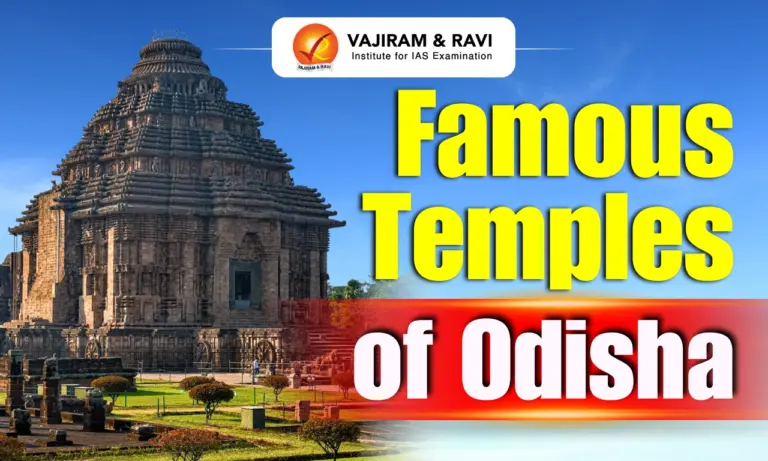
Odisha is known as the “Land of Temples” because of its rich cultural and religious heritage. The state is home to many ancient and beautiful temples that reflect its deep spiritual traditions and unique architecture. These temples are not only places of worship but also important symbols of history, art, and devotion. From the famous Jagannath Temple, Puri to the stunning Sun Temple, Konark, Odisha’s temples attract devotees and tourists from all over the world, making the state an important center of faith and culture in India. Some of the Famous Temples of Odisha are discussed in detail in this article.
Some of the Famous Temples of Odisha
The temples discussed below are some of the important and well-known temples of Odisha. They reflect the state’s rich religious, cultural, and architectural heritage. Each temple is unique in its history, design, and significance, showing the diversity of Odisha’s temple traditions.
Jagannath Temple (Puri)
- The Jagannath Temple is one of the most famous and sacred temples of India, located in Puri, Odisha, and is known by many names like Puri Dham, Srikshetra, Sri Mandira, Bada Deula, Nilachala Dham, Purusottama Kshetra, and Sankha Kshetra, showing its deep religious importance.
- It is dedicated to Lord Jagannath (a form of Lord Vishnu) and is worshipped along with Balabhadra and Subhadra, making it a unique example of family worship in Hindu tradition.
- The present temple was built in the 12th century AD during the reign of King Anantavarman Chodaganga Deva of the Eastern Ganga Dynasty, and was completed around 1230 AD under Anangbheema Deva III, who installed the deities.
- The temple is about 214 feet high, making it one of the tallest monuments in India and an important symbol of Odisha’s cultural and architectural heritage.
- It is one of the Char Dham pilgrimage sites, which are the four most sacred religious destinations for Hindus, giving it great spiritual significance.
- The temple is closely associated with the famous Ratha Yatra (Chariot Festival), which attracts millions of devotees every year.
- It is a fine example of Kalinga architecture, known for curved towers, detailed carvings, and beautiful sculptures, reflecting the artistic excellence of ancient Odisha.
- The temple is surrounded by two walls – the outer Meghanada Prachira and the inner Kurma Prachira, adding to its structural strength and uniqueness.
- The complex includes many smaller shrines, sacred tanks, and gardens, creating a calm and spiritual atmosphere for devotees.
- The main temple stands on a raised platform, and it is believed that no shadow of the temple falls on the ground, adding a sense of mystery and belief.
- At the top is a 20-foot-high Sudarshan Chakra, which is visible from all parts of the city, symbolizing divine presence.
- The carvings mainly show gods and goddesses, highlighting its strong religious focus.
- The temple is also called the “White Pagoda” and is part of Odisha’s Golden Triangle along with Bhubaneswar (City of Temples) and Sun Temple, Konark (Black Pagoda), which are major tourist and pilgrimage centers.
- It has four main gates in the four cardinal directions, each named after different animals, representing traditional beliefs and protection.
Konark Sun Temple (Konark)
- The Konark Sun Temple is located on the coastline of Odisha in the Puri district, near the sacred city of Puri, and is one of the most important heritage monuments in India.
- It is also known as Surya Devalaya because it is dedicated to the Sun God (Surya), who held great importance in ancient Indian worship.
- The temple was built in the 13th century (around 1250 CE) by King Narasimhadeva I of the Eastern Ganga Dynasty, showing the power and prosperity of that time.
- The Eastern Ganga Dynasty (also called Rudhi Gangas or Prachya Gangas) ruled the Kalinga region for many centuries and played a major role in promoting art and architecture.
- It was declared a UNESCO World Heritage Site in 1984, which highlights its global cultural significance.
- The temple is a fine example of Kalinga (Odisha) style of architecture, known for its grand structure, detailed carvings, and artistic beauty.
- The entire temple is designed like a huge stone chariot of the Sun God, with 24 carved wheels and seven horses, making it unique and symbolic.
- The 24 wheels are believed to represent the 24 hours of a day or the 12 months of a year, while the seven horses symbolize the seven days of the week.
- These wheels also function as sundials, which can be used to measure time accurately, showing advanced scientific knowledge.
- The temple faces the east, so that the first rays of the sunrise fall on the entrance, connecting it directly with the Sun God.
- Its original height was about 227 feet, making it one of the tallest temples built in India.
- The temple was constructed using different stones like laterite (for base and walls), khondalite (main structure), and chlorite (for door frames and carvings).
- Iron strips were used to hold the heavy stones together, and some of these can still be seen in the ruins.
- The walls of the temple are covered with detailed carvings of gods, animals, warriors, plants, and scenes from daily life and mythology, showing the richness of Indian culture.
- European sailors called it the “Black Pagoda” because of its dark appearance, and it was used as a navigation landmark.
- There is also a popular belief that the temple had magnetic powers that could attract ships, though this is mostly a legend.
- The temple represents the highest achievement of Kalinga architecture, combining art, science, and spirituality in a remarkable way.
- The Konark Sun Temple stands as a symbol of India’s rich heritage, architectural brilliance, and deep spiritual tradition.
Lingaraja Temple
- The Lingaraj Temple is one of the oldest and largest temples in the city of Bhubaneswar, often called the heart of Odisha’s temple culture.
- The temple we see today was mainly built in the 11th century AD, though its origins go back earlier, and it is believed to have been constructed by King Yayati I of the Somvanshi dynasty.
- Standing at around 180 feet tall, the temple is massive and creates a strong sense of awe and respect among visitors.
- It is dedicated to Lord Shiva, but what makes it special is that the deity here is worshipped as Hari-Hara, a combined form of Shiva (Hara) and Vishnu (Hari). This shows a beautiful unity between Shaivism and Vaishnavism traditions.
- The main Shivling in the temple is considered “Swayambhu” (self-originated), meaning it is believed to have appeared naturally rather than being man-made.
- Architecturally, the temple is a classic example of Kalinga style, known for its strong structure, detailed carvings, and precise design. It represents the peak development of temple architecture in Bhubaneswar.
- The temple complex is very large and includes around 150 smaller shrines, each dedicated to different deities, making it a complete religious center.
- The temple walls are beautifully decorated with carvings of daily life, cultural scenes, and divine figures, showing that it was not just a place of worship but also a center of social and cultural life, similar to a modern community space.
Mukteswara Temple
- The Mukteshwar Temple was built in the 10th century (around 950 CE) during the rule of the Somavanshi dynasty, and is often linked to King Yayati I.
- It is dedicated to Lord Shiva and is one of the most beautiful and artistically refined temples in Odisha.
- The temple is popularly known as the “Gem of Odishan Architecture” because of its elegant design and detailed carvings.
- It represents the transition phase of Kalinga architecture, acting as a bridge between early temples and later grand structures like the Lingaraj Temple.
- Built in the Kalinga style (a form of Nagara architecture), it shows important innovations in temple construction.
- One major feature is the Jagamohana (assembly hall), which has a pyramidal (tiered) roof, unlike earlier temples that had flat roofs.
- The most striking element is its beautifully carved arched gateway (Torana), which stands separately at the entrance. This design shows influence from Buddhist art styles.
- The Shikhara (tower) has five levels and is richly decorated with motifs like Chaitya windows, kirtimukha (face motifs), and dwarf figures.
- The design of the temple shows uniform ornamentation, where both the sanctum and hall follow a similar decorative style.
- Unlike many other temples, it is compact and complete, with no later additions, which helps us clearly understand its original design.
Rajarani Temple
- The Rajarani Temple was built in the 11th century AD during the later period of the Somavamsi dynasty.
- The temple is named after the reddish and yellow sandstone (Rajarani stone) used in its construction, which over time gives the structure a warm golden-amber appearance.
- It is popularly known as the “Love Temple” because of the beautiful and expressive carvings of couples and women on its walls.
- Even though there is no idol inside the temple today, historians believe it was originally dedicated to Lord Shiva, and was possibly called Indresvara Temple.
- This belief is supported by architectural clues like the figure of sage Lakulisa, which is closely associated with Shaivism.
- The temple is admired for its balanced design, symmetry, and detailed craftsmanship, making it a masterpiece of Odisha temple architecture.
- Its architectural style shows similarity with the Kandariya Mahadeva Temple, indicating cultural connections with Central India.
- The temple has a contrast in design, where the sanctum is richly decorated while the entrance hall remains comparatively plain, possibly because the structure was left incomplete.
- One of its most unique features is the tower (Shikhara), which rises like a beehive with many small clustered towers, giving it the look of a mountain-like structure.
- This design is often seen as a symbol of spiritual ascent, representing the soul’s journey towards the divine.
- The temple is located in a peaceful and scenic environment, enhancing its beauty and appeal as a tourist site.
Sri Lokanath Mandir
- The Sri Lokanath Temple is one of the most important Shiva temples in Odisha, located close to the Jagannath Temple.
- The temple is believed to have been built between the 11th-12th century, though its religious importance is greater than its architectural value.
- It is dedicated to Lord Shiva, worshipped here as Lokanath, meaning Lord of the World.
- According to legend, Lord Rama established this shrine during his journey to Lanka in search of Sita, after a local tribal (Sabara) offered him a pumpkin-shaped object resembling a Shivling.
- The original name is believed to be “Laukanath”, derived from lauka (pumpkin), which later evolved into Lokanath.
- The most unique feature of the temple is that the Shivling remains submerged in water throughout the year, due to a natural underground spring connected to the Parvati tank.
- Devotees can see the Shivling clearly only once a year during Pankoddhar Ekadashi, just before Mahashivaratri, when the water is temporarily removed.
- The temple follows the typical Kalinga style layout, consisting of the sanctum (Vimana), assembly hall (Jagamohana), dance hall (Natamandapa), and offering hall (Bhogamandapa).
- The temple has an important cultural role as the festival idol (Bhandar Lokanath) is kept inside the Jagannath Temple and is considered the guardian of its treasury and valuables.
- It holds a special place in the religious life of Puri and attracts many devotees, especially during Mahashivaratri.
Alarnath Temple
- The Alarnath Temple is a famous Vaishnavite shrine located in Brahmagiri, near Puri.
- It is dedicated to Lord Vishnu, who is worshipped here as Alarnath (or Alwarnath).
- The present temple was built in the 14th century and is believed to have been constructed by Rajputs from Alwar, who settled in Odisha during that time.
- The name Alarnath is derived from Alwarnath, showing its connection to the settlers from Alwar.
- The main idol of the temple is made of black stone and represents a form of Lord Vishnu, believed to have been created as per divine instruction to Brahma.
- The temple holds special importance for devotees of the Jagannath Temple. During the period when Lord Jagannath is believed to be unwell (Anasara period), devotees cannot see him.
- At that time, people visit Alarnath Temple and worship Lord Vishnu here as a substitute, believing they receive the same blessings.
- This belief became popular due to Chaitanya Mahaprabhu, who is said to have seen Lord Jagannath in the form of Alarnath and spent time worshipping here.
Chausathi Yogini Temples
- The Chausathi Yogini Temple at Hirapur (near Bhubaneswar, Odisha) is believed to be the earliest 64 Yogini temples in India, from where this tradition spread to other regions. It is also the smallest among the four surviving Yogini temples.
- Out of the four temples, two are in Odisha (Hirapur and Ranipur-Jharial, Bolangir) and two in Madhya Pradesh (Khajuraho – 9th century, Jabalpur – 10th century).
- The Ranipur-Jharial temple (c. 900 AD) was built using coarse sandstone, now partially eroded, and its dating is supported by the nearby Somesvara shrine.
- The Hirapur temple (9th century AD), located about 15 km from Bhubaneswar, is attributed to Queen Hiradevi of the Bhaumakar dynasty.
- These temples have a circular, open-roof design, different from typical Odisha temples, reflecting the practices of the Yogini cult (8th-13th century AD).
- The cult combined yoga and tantra, worshipping a chakra with 64 spokes. The main deity is Goddess Kali, and Yoginis are forms of Shakti, linked to the Saptamatrikas.
- The Yoginis represent divine feminine power and are shown as lively figures carved in black slate stone, riding their vahanas.
- The open structure may relate to worship of the five elements – air, water, fire, earth, and sky.
- Unlike other temples of that time, these do not have erotic carvings, possibly due to the cult’s emphasis on celibacy.
- The Hirapur temple was rediscovered in 1953 by Kedarnath Mohapatra and is now the best-preserved Yogini temple, protected by the ASI.
Harishankar Temple, Balangir
- Sri Harishankar Devasthana is a well-known temple situated on the southern slopes of the Gandhamardhan Hills in Odisha. It is famous for its natural beauty and its rare connection to both Lord Vishnu and Lord Shiva, which makes it spiritually significant.
- The temple has a strong historical background. It was built in the 14th century under the guidance of Queen Durlabha Devi during the rule of Maharaja Vaijjal Dev Chauhan. However, its religious importance goes back earlier, when the deity was discovered by the Chauhan rulers.
- Archaeological evidence adds to its importance. A dancing Ganesha idol from the 12th century has been found here, showing the rich cultural and artistic heritage of the site.
- The nearby plateau area has remains of ancient Buddhist structures, believed to be part of the famous Parimalgiri University, which adds another layer of historical importance.
- There is also a deer park near the Gandhamardhan Hills, which is an important attraction for tourists and nature lovers.
Significance of Famous Temples of Odisha
- Religious and Spiritual Importance – Temples of Odisha are major centers of Hindu worship, dedicated to deities like Shiva, Vishnu, Durga. They play a key role in preserving spiritual traditions and ritual practices.
- Architectural Excellence – These temples showcase the unique Kalinga Architecture, including forms like Rekha Deula, Pidha Deula, Khakara Deula, known for their intricate carvings and advanced design.
- Historical Value – Built mainly between the 7th-13th centuries, these temples provide insights into ancient dynasties like Somavamsis and Eastern Gangas, reflecting Odisha’s rich past.
- Cultural and Artistic Heritage – Temple sculptures depict mythology, dance, music, and daily life, helping preserve art forms like Odissi Dance and traditional craftsmanship.
- Tourism and Economy – These temples attract pilgrims and tourists, supporting local economy, handicrafts, and the hospitality sector.
- Festivals and Traditions – Temples are centers of major festivals like Rath Yatra, Durga Puja, Shivaratri, strengthening community bonding and cultural continuity.
- Syncretism and Diversity – Odisha temples reflect a blend of traditions like Shaivism, Vaishnavism, Tantrism, showing religious harmony and diversity.


 Last updated on Sep, 2026
→ UPSC 2027 Notification will be released on 13 January 2027 at upsconline.nic.in.
→ Asian Games 2026 are being held in Aichi-Nagoya, Japan, from 19 September to 4 October.
→ Check out the latest UPSC Syllabus here.
→ Download UPSC Model Answers for Mains 2026
→ UPSC Mains Question Paper 2026 is out now for Essay & GS Paper 1, 2, 3 & 4.
→ UPSC Calendar 2027 has been released.
→ Enroll in Vajiram & Ravi’s UPSC Mains Test Series 2027 for structured answer writing practice, expert evaluation, and exam-oriented feedback.
→ Join Vajiram & Ravi’s UPSC Mentorship Program 2027 for personalized guidance, strategy planning, and one-to-one support from experienced mentors.
→ Go through the UPSC Mains Previous Year Papers to enhance your preparation.
→ UPSC has released UPSC Toppers List 2025 with the Civil Services final result on its official website.
→ Also check Best UPSC Coaching in India
Famous Temples of Odisha FAQs
Q1. Why is Odisha called the “Land of Temples”?+
Q2. Which is the most famous temple in Odisha?+
Q3. What is special about the Konark Sun Temple?+
Q4. Which temple represents the best of Kalinga architecture?+
Q5. What makes Mukteshwar Temple unique?+
Tags: art and culture art and culture notes famous temples of odisha