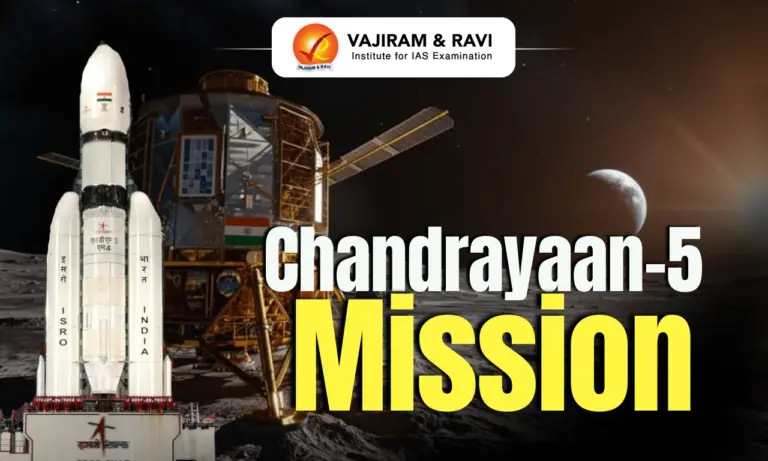
Chandrayaan 5 Mission is also called the Lunar Polar Exploration Mission (LUPEX). It is a joint lunar exploration mission of the Indian Space Research Organisation (ISRO) and the Japan Aerospace Exploration Agency (JAXA). The mission is planned for launch in 2028 and will focus on studying water and water-ice in the Moon’s south polar region. It represents India’s fifth lunar mission and is expected to strengthen international cooperation in advanced lunar exploration through contributions from NASA and the European Space Agency (ESA).
Chandrayaan 5 Mission Latest News 2026
ISRO and JAXA have reviewed the progress of Chandrayaan 5 Mission during technical meetings held in Bengaluru, including discussions on spacecraft communication, payload integration and launch planning. The mission remains targeted for 2028, while both agencies continue work on lander, rover and scientific payload development.
ISRO has also confirmed that Gaganyaan 1 Mission hardware is nearing completion and Chandrayaan 4 Mission is India’s immediate next lunar mission before Chandrayaan 5.
Chandrayaan 5 (LUPEX) Mission Features
A joint lunar mission planned for 2028 to explore water and water-ice near the Moon’s south pole. The key features of the Chandrayaan 5 Mission (LUPEX) has been listed below:
- Mission name: Chandrayaan 5 is officially known as the Lunar Polar Exploration Mission (LUPEX). It is the fifth mission in India’s Chandrayaan programme and is being jointly developed by ISRO and JAXA for advanced lunar surface exploration.
- Launch schedule: The mission is targeted for 2028, with ISRO and JAXA reviewing the possible launch window through regular technical meetings. It received Government of India approval with financial sanction on 10 March 2025.
- Launch vehicle: Chandrayaan 5 will be launched by Japan’s H3 rocket, specifically the H3-24L launch vehicle, making it one of the major international launches involving Indian lunar hardware.
- Lander: The lunar lander is being developed by ISRO. It will carry scientific instruments, safely land near the lunar south pole and deploy the rover for detailed surface exploration.
- Rover: The rover is being developed by JAXA, with Mitsubishi Heavy Industries (MHI), Japan, contributing to its development. After landing, it will travel across the lunar surface to collect scientific observations.
- Scientific instruments: The mission will carry seven scientific instruments across the lander and rover. Scientific payloads are being contributed by ISRO, JAXA, NASA and ESA, demonstrating large scale international cooperation.
- International payloads: NASA will provide neutron spectrometers for detecting hydrogen rich regions, while ESA will contribute a mass spectrometer to analyse the composition of lunar materials and volatile substances.
- Mission duration: Chandrayaan 5 is designed to operate on the Moon for around 100 days or nearly three and a half months, with some mission planning considering the possibility of a longer operational life if conditions permit.


Chandrayaan 5 Mission Objectives
The Chandrayaan 5 Mission is designed to improve scientific understanding of lunar water resources and support future long duration lunar exploration.
- Study lunar water: The primary objective is to detect and analyse water and water-ice present on both the lunar surface and beneath the surface, particularly in the Moon’s south polar region.
- Explore Permanently Shadowed Regions: Chandrayaan 5 will investigate Permanently Shadowed Regions (PSRs) near the lunar south pole, where water-ice is expected to remain preserved because sunlight rarely reaches these areas.
- Analyse lunar volatiles: The mission will conduct in situ analysis of lunar volatile materials using advanced scientific instruments to understand their distribution, composition and long term stability.
- Drill lunar soil: The rover will study the lunar regolith by examining water content, quality and composition, helping scientists understand the availability of resources beneath the Moon’s surface.
Chandrayaan 5 Mission Significance
The significance and advantages of the Chandrayaan 5 Mission (LUPEX) is listed below:
- Support future lunar missions: Information collected during Chandrayaan 5 will help assess the feasibility of using lunar water resources for future robotic missions and long duration human exploration activities.
- Advance lunar science: Observations from spectrometers and onboard sensors will improve knowledge of lunar geology, surface processes and the evolution of the Moon’s south polar environment.
- Strengthen international collaboration: The mission combines the expertise of ISRO, JAXA, NASA and ESA, making it one of India’s most significant multinational scientific missions in deep space exploration.
- Continue India’s lunar programme: Chandrayaan 5 builds upon Chandrayaan 1, which confirmed water molecules on the Moon, Chandrayaan 2 with its operational orbiter, Chandrayaan 3, which achieved the first soft landing near the lunar south pole in 2023 and the planned Chandrayaan 4 lunar sample return mission.
Gaganyaan Mission
Gaganyaan remains India’s first human spaceflight programme, with the uncrewed Gaganyaan 1 mission serving as an important technology demonstration before sending astronauts into space.
- Current Progress: ISRO has informed Parliament that the Crew Module and Service Module for Gaganyaan 1 are in the final stages of assembly, integration and testing.
- Mission Objectives: Gaganyaan 1 is an uncrewed precursor mission designed to validate the Crew Module, Service Module, Crew Escape System and life support technologies before future crewed flights.
- Launch Status: The mission was earlier shifted from late 2025 to the first quarter of 2026. However, ISRO has not yet announced a revised launch schedule.
- Significance: Technologies demonstrated during Gaganyaan are expected to strengthen India’s future human spaceflight capability and support the country’s long term space exploration goals.
Chandrayaan 5 Mission Challenges
The success of Chandrayaan 5 Mission depends on technical coordination, international cooperation and timely completion of multiple complex mission components.
- Joint system integration: Integrating the ISRO developed lander with the JAXA developed rover requires extensive testing, interface compatibility and continuous technical coordination between both agencies.
- Communication systems: Scientists are working on Inter Spacecraft Communication, ensuring reliable data exchange between mission components during landing, rover operations and scientific observations.
- Multi agency coordination: Scientific payloads from ISRO, JAXA, NASA and ESA must be integrated efficiently while maintaining compatibility with mission objectives and operational requirements.
- Dependence on H3 launch vehicle: The mission relies on Japan’s H3 launch vehicle, making launch readiness dependent on successful coordination between Indian and Japanese mission timelines.
- Managing multiple flagship missions: ISRO is simultaneously progressing with Chandrayaan 4, Gaganyaan, Earth observation missions and other national space programmes, requiring careful allocation of financial resources, technical manpower and infrastructure.
- Mission timeline: Maintaining the planned 2028 launch requires timely completion of lander, rover, payload development, ground systems, landing site selection and all joint technical milestones agreed upon by ISRO and JAXA.

 Last updated on Sep, 2026
→ UPSC 2027 Notification will be released on 13 January 2027 at upsconline.nic.in.
→ Asian Games 2026 are being held in Aichi-Nagoya, Japan, from 19 September to 4 October.
→ Check out the latest UPSC Syllabus here.
→ Download UPSC Model Answers for Mains 2026
→ UPSC Mains Question Paper 2026 is out now for Essay & GS Paper 1, 2, 3 & 4.
→ UPSC Calendar 2027 has been released.
→ Enroll in Vajiram & Ravi’s UPSC Mains Test Series 2027 for structured answer writing practice, expert evaluation, and exam-oriented feedback.
→ Join Vajiram & Ravi’s UPSC Mentorship Program 2027 for personalized guidance, strategy planning, and one-to-one support from experienced mentors.
→ Go through the UPSC Mains Previous Year Papers to enhance your preparation.
→ UPSC has released UPSC Toppers List 2025 with the Civil Services final result on its official website.
→ Also check Best UPSC Coaching in India
Chandrayaan 5 Mission FAQs
Q1. What is Chandrayaan 5 Mission?+
Q2. When will Chandrayaan 5 be launched?+
Q3. What is the main objective of Chandrayaan 5 Mission?+
Q4. Which countries are participating in Chandrayaan 5 Mission?+
Q5. What makes Chandrayaan 5 Mission different from earlier Chandrayaan missions?+
Tags: chandrayaan chandrayaan 5 chandrayaan 5 mission