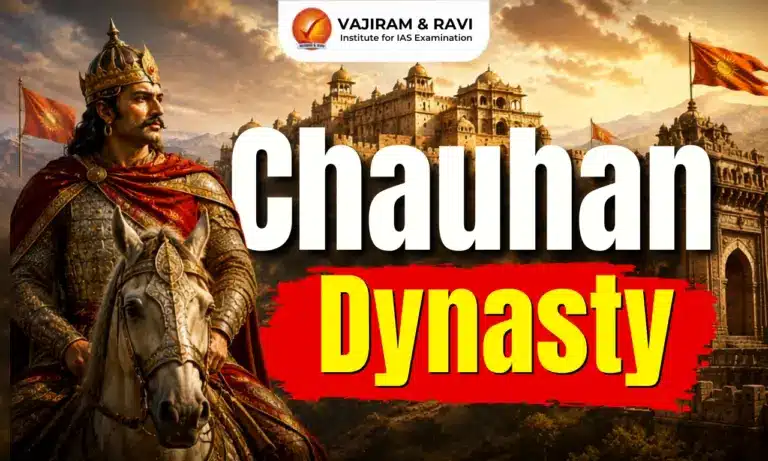
The Chauhan Dynasty, also known as the Chahamana dynasty, was one of the most influential Rajput dynasties of early medieval northern India. It ruled large parts of present day Rajasthan and neighbouring regions between the 7th and 12th centuries CE. The dynasty emerged from Shakambhari and later made Ajmer its political centre. It became famous for military strength, territorial expansion, temple patronage and the reign of Prithviraj III, whose battles against Muhammad Ghori marked a major turning point in the political history of northern India.
Chauhan Dynasty
The Chauhan Dynasty grew from a regional ruling house into one of the strongest powers of north-western India. Its rule extended across Rajasthan, Delhi, Haryana and nearby regions before the main Shakambhari branch declined after 1192 CE.
- Timeline: The dynasty flourished from the 7th century CE until the late 12th century. Later branches continued to rule several regional kingdoms until the modern period in Rajasthan and other parts of India.
- Founder: Vasudeva is regarded as the earliest known ruler and founder of the Shakambhari branch. According to Prabandha-Kosha, he ascended the throne around 551 CE, although this date remains historically disputed.
- Kingdom and Capital: The early capital was Shakambhari (modern Sambhar). Ajayaraja II later established Ajayameru (Ajmer) as the principal capital during the early 12th century, making it the dynasty’s political centre.
- Territorial Expansion: At its height under Vigraharaja IV and Prithviraj III, the kingdom included Ajmer, Sambhar, Delhi, Hansi, Nagaur, Ranthambore, parts of Haryana, eastern Rajasthan and areas along the Yamuna River.
- Major Ruling Branches: Important branches included the Chahamanas of Shakambhari, Naddula (Nadol), Jalor and Ranastambhapura (Ranthambore). These branches later gave rise to states such as Bundi, Kota, Sirohi and others.
- Major Battles: The dynasty is best remembered for the First Battle of Tarain (1191), where Prithviraj III defeated Muhammad Ghori and the Second Battle of Tarain (1192), where Ghori returned with improved cavalry tactics and defeated the Chauhan forces.
- Political Importance: Initially feudatories of the Gurjara-Pratiharas, the Chauhans gradually became independent after the decline of Pratihara authority and emerged as one of the leading Rajput powers of northern India.
Chauhan Dynasty Background
The Chauhans developed from regional chiefs into an important ruling dynasty by combining military strength, strategic location and political independence in early medieval Rajasthan.
- Early Homeland: Early inscriptions connect the dynasty with Ahichchhatrapura, identified with modern Nagaur. The rulers later shifted their political centre to Shakambhari and eventually to Ajmer.
- Association with Gurjara-Pratiharas: During their early history, the Chauhans served as feudatories of the Gurjara-Pratiharas and supported Nagabhata I in defending the north-western frontier against Arab attacks.
- Rise as Independent Power: Simharaja became one of the earliest rulers to assert independence after the decline of the Gurjara-Pratiharas and adopted the title Maharajadhiraja, marking the dynasty’s emergence as a sovereign power.


Chauhan Dynasty Historical Sources
Knowledge about the Chauhan Dynasty comes from inscriptions, literary works and later historical traditions that together provide information about its genealogy, administration and political achievements.
- Inscriptions: Important inscriptions include the Hansot copper plate, Sevadi inscription (1119 CE), Bijolia rock inscription (1170 CE), Sundha Hill inscription (1262 CE), Ajmer inscription and Mount Abu inscription.
- Court Literature: Prithviraja Vijaya, written by court poet Jayanaka, provides valuable contemporary information about Prithviraj III and presents the dynasty as descendants of the solar lineage.
- Jain Literature: Works such as Prabandha-Kosha by Rajashekhara Suri and Hammira Mahakavya by Nayachandra Suri preserve important traditions regarding Chauhan rulers and their genealogy.
- Bardic Traditions: Prithviraj Raso, attributed to Chand Bardai, became the most famous literary source associated with Prithviraj III, although many legendary additions appeared in later versions.
- Temple Records: Temple inscriptions from Pushkar, Ajmer, Harshanatha and other religious centres provide evidence regarding donations, temple construction and royal patronage.
Chauhan Dynasty Prominent Rulers
Several Chauhan rulers strengthened the kingdom through military victories, administrative reforms, territorial expansion and cultural patronage.
- Vasudeva: Considered the earliest known ruler, Vasudeva laid the foundation of the Shakambhari branch. Later traditions also associate him with Sambhar Salt Lake and the Sapadalaksha region.
- Ajayaraja II: He defeated the Paramaras, expanded Chauhan influence and established Ajayameru (Ajmer) as the new capital, transforming it into an important political and cultural centre.
- Arnoraja: Arnoraja fought repeated conflicts with the Chaulukyas of Gujarat. He also confronted Ghaznavid attacks and strengthened Chauhan authority despite facing military setbacks against Kumarapala.
- Vigraharaja IV: Widely regarded as the greatest Chauhan ruler, he captured Delhi from the Tomaras, extended authority towards eastern Punjab, defeated Muslim rulers and authored the Sanskrit drama Harikeli Nataka.
- Prithviraj III (Rai Pithora): He ruled from about 1177 to 1192 CE, defeated Muhammad Ghori in the First Battle of Tarain, fought the Chandelas, expanded the kingdom and became the dynasty’s most celebrated ruler.
- Hariraja: After Prithviraj’s defeat, Hariraja attempted to restore Chauhan authority by recovering Ajmer and resisting the Ghurid advance before being defeated by Qutb-ud-din Aibak.
- Hammiradeva: The Ranthambore branch reached prominence under Hammiradeva, who resisted the Delhi Sultanate until Alauddin Khalji captured Ranthambore in 1301 CE.
Chauhan Dynasty Administration
The Chauhan rulers maintained a hereditary monarchy supported by feudatories, military chiefs and provincial officers for effective governance across their expanding territories.
- Monarchical System: The king held supreme authority over administration, justice, military affairs and land grants, while members of the royal family often governed strategic regions.
- Provincial Administration: The kingdom was divided into administrative units managed by local nobles and feudatories who collected revenue and maintained law and order while remaining loyal to the ruler.
- Feudal Structure: Samantas and local chiefs formed the backbone of administration and military organisation. They supplied troops during campaigns and managed regional territories.
- Military Organisation: The army mainly consisted of cavalry, infantry, elephants and feudatory contingents. Strong forts such as Ajmer, Taragarh and Ranthambore strengthened frontier defence.
- Justice and Governance: Royal courts administered justice according to traditional customs, while inscriptions indicate grants to temples, Brahmins and religious institutions under royal supervision.
Chauhan Dynasty Economy
Agriculture, trade, land revenue and control over strategic commercial routes formed the economic foundation of the Chauhan kingdom.
- Agriculture: Farming remained the principal occupation. Revenue from cultivated land formed the largest source of royal income across the Sapadalaksha region.
- Salt Trade: Control over Sambhar Salt Lake gave the Chauhans an important economic advantage, as salt was one of the most valuable commercial commodities of medieval Rajasthan.
- Trade Routes: Ajmer’s location connected Rajasthan with Gujarat, Delhi, Malwa and northern India, encouraging long distance trade and commercial prosperity.
- Land Grants: Kings frequently donated villages and agricultural lands to temples, Brahmins and Jain institutions, promoting both religious activities and local economic development.
- Urban Growth: Centres such as Ajmer, Sambhar, Nagaur and Delhi developed as administrative, commercial and cultural towns under Chauhan rule.
Chauhan Dynasty Art and Architecture
The Chauhans promoted temple construction, forts and literary activities, leaving a lasting architectural and cultural legacy across Rajasthan.
- Ajmer Development: Ajayaraja II developed Ajmer into a fortified capital with important religious and administrative buildings, increasing its political importance.
- Temple Construction: Simharaja is associated with temple construction at Pushkar. Chamundaraja built a Vishnu temple at Narapura, while Someshvara commissioned five temples at Ajmer.
- Harshanatha Temple: Several Chauhan rulers contributed to the development of the Harshanatha temple, reflecting sustained royal patronage of religious architecture.
- Adhai Din Ka Jhonpra: Vigraharaja IV constructed an educational and religious structure at Ajmer, which was later converted into the Adhai Din Ka Jhonpra during the Delhi Sultanate period.
- Literary Patronage: Vigraharaja IV composed Harikeli Nataka, while the period also witnessed works such as Prithviraja Vijaya and the later celebrated Prithviraj Raso.
Chauhan Dynasty Culture and Religion
The Chauhan rulers encouraged religious tolerance, supported temple institutions and promoted Sanskrit and regional literary traditions.
- Religious Beliefs: Most Chauhan rulers followed Hindu traditions and patronised both Shaivism and Vaishnavism while extending support to Jain religious institutions.
- Jain Patronage: Ajayaraja II permitted Jain temple construction in Ajmer, while Prithviraja III presented a golden kalasha to a Parshvanatha temple, reflecting continued Jain patronage.
- Pilgrim Welfare: Prithviraj I established a food distribution centre for pilgrims travelling towards the Somnath temple, demonstrating organised royal support for religious activities.
- Literary Culture: Royal courts encouraged Sanskrit scholars, poets and dramatists, contributing significantly to medieval literary traditions of north-western India.
- Cultural Legacy: The dynasty became closely associated with ideals of bravery, honour and chivalry, themes that remained central to later Rajput literary traditions.
Chauhan Dynasty Decline
The decline of the Chauhan Dynasty resulted from military defeat, political divisions and the expansion of Ghurid power into northern India.
- Internal Divisions: Rivalries among Rajput kingdoms weakened collective resistance, preventing the formation of a united military front against external invasions.
- Second Battle of Tarain: In 1192 CE, Muhammad Ghori adopted flexible cavalry tactics and defeated Prithviraj III at Tarain, ending Chauhan control over Delhi and Ajmer.
- Ghurid Expansion: After the victory, Muhammad Ghori installed Govindaraja as a vassal before Qutb-ud-din Aibak consolidated Ghurid authority over Ajmer and surrounding regions.
- Regional Survival: Although the main Shakambhari branch declined, branches at Ranthambore, Jalor, Sirohi, Bundi and Kota continued ruling regional states for several centuries.
- End of Major Resistance: The capture of Ranthambore by Alauddin Khalji in 1301 CE ended the strongest remaining Chauhan resistance, though several descendant lineages survived into the princely state period.

 Last updated on Sep, 2026
→ UPSC 2027 Notification will be released on 13 January 2027 at upsconline.nic.in.
→ Asian Games 2026 are being held in Aichi-Nagoya, Japan, from 19 September to 4 October.
→ Check out the latest UPSC Syllabus here.
→ Download UPSC Model Answers for Mains 2026
→ UPSC Mains Question Paper 2026 is out now for Essay & GS Paper 1, 2, 3 & 4.
→ UPSC Calendar 2027 has been released.
→ Enroll in Vajiram & Ravi’s UPSC Mains Test Series 2027 for structured answer writing practice, expert evaluation, and exam-oriented feedback.
→ Join Vajiram & Ravi’s UPSC Mentorship Program 2027 for personalized guidance, strategy planning, and one-to-one support from experienced mentors.
→ Go through the UPSC Mains Previous Year Papers to enhance your preparation.
→ UPSC has released UPSC Toppers List 2025 with the Civil Services final result on its official website.
→ Also check Best UPSC Coaching in India
Chauhan Dynasty FAQs
Q1. Who founded the Chauhan Dynasty?+
Q2. Who was the most famous ruler of the Chauhan Dynasty?+
Q3. What was the capital of the Chauhan Dynasty?+
Q4. Which regions were ruled by the Chauhan Dynasty?+
Q5. Why did the Chauhan Dynasty decline?+
Tags: chauhan dynasty dynasty