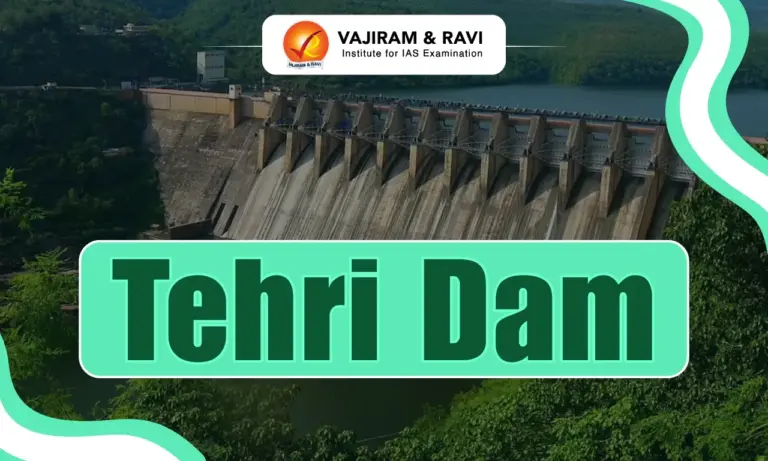
Tehri Dam is a multipurpose rock and earth fill embankment dam built on the Bhagirathi River in Tehri Garhwal district of Uttarakhand. It is the tallest dam in India with a height of 260.5 metres (855 feet) and among the highest dams in the world. It is managed by THDC India Limited, a subsidiary of NTPC Limited. The project supports hydroelectric power generation, irrigation, drinking water supply, flood moderation and regional development across northern India.
Tehri Dam Features
Tehri Dam is a strategic water resource project. It combines power generation, water storage and flood control through advanced engineering in a seismically active Himalayan region.
- Location: The dam is located in New Tehri, Tehri Garhwal district of Uttarakhand. It stands about 1.5 km downstream from the confluence of the Bhagirathi and Bhilangana rivers in a narrow S-shaped Himalayan valley.
- River: Tehri Dam is constructed across the Bhagirathi River, a major tributary of the Ganga. The stored monsoon water is released during the dry season for irrigation, drinking water supply and electricity generation.
- Height: The dam rises 260.5 metres (855 feet), making it the tallest dam in India and the 13th tallest dam in the world. Its length is 575 metres, crest width is 20 metres and base width is 1,128 metres.
- Reservoir: The reservoir has a storage capacity of about 4.0 cubic kilometres with a surface area of nearly 52 square kilometres. It has a sediment trap efficiency of around 95 percent and is designed for about 150 years of sedimentation.
- Seismic Design: The dam is located in a highly earthquake prone Himalayan region. It uses a flexible rock fill structure with a clay core that can absorb seismic energy and withstand strong earthquakes through controlled deformation.
- Water Supply and Irrigation: The project irrigates about 1.977 million acres of agricultural land. It also supplies drinking water to Uttarakhand, Uttar Pradesh and Delhi throughout the year.
- Power Distribution: Electricity generated from Tehri Dam is supplied to Uttarakhand, Uttar Pradesh, Rajasthan, Haryana, Punjab, Himachal Pradesh, Jammu and Kashmir and Chandigarh through the Northern Grid.
Tehri Dam Project
The Tehri Dam Project is a three stage hydroelectric and water management programme.
- It was conceived in 1949, investigated in 1961 and approved by the Planning Commission in 1972 with an initial capacity of 600 MW.
- Construction started in 1978 after feasibility studies. Delays occurred due to financial constraints, environmental concerns, rehabilitation issues and administrative challenges. The main dam was completed in 2006 after nearly three decades.
- THDC was established on 12 July 1988 to implement the project. In 1990, the project capacity was revised to 2,400 MW with three stages comprising Tehri HPP, Koteshwar HEP and Tehri Pumped Storage Plant.
- The project includes four headrace tunnels, an underground powerhouse, multiple spillways and an intermediate level outlet designed for flood control, reservoir regulation and emergency water release.
- The USSR provided technical and financial assistance in 1986. In 2019, the Government of India approved the takeover of THDC India Limited by NTPC Limited for long term management.


Tehri Dam Significance
Tehri Dam is one of India’s most important multipurpose river valley projects. It supports energy security, agriculture, drinking water supply, flood management and regional economic growth.
- Hydroelectric Generation: The project provides reliable peaking power through its hydroelectric stations. THDC generates around 3,000 GWh of electricity annually, strengthening the Northern Grid and improving energy availability.
- Agricultural Benefits: Stored water supports irrigation across more than 800,000 hectares of farmland. It also stabilises irrigation in additional command areas by ensuring water availability during non monsoon months.
- Drinking Water Supply: The reservoir supplies drinking water to major urban and rural areas in Uttarakhand, Uttar Pradesh and Delhi, reducing seasonal water shortages for millions of people.
- Flood Control: Controlled release of reservoir water helped reduce flood impacts during heavy rainfall events in 2010, 2011 and 2013, demonstrating the project’s role in flood moderation.
- Tourism Development: The reservoir has promoted tourism in New Tehri through boating, water sports, paragliding and the Tehri Lake Festival, creating new employment and income opportunities.
Tehri Dam Challenges
The project has remained one of India’s most debated infrastructure projects because of environmental, geological and rehabilitation concerns despite its significant developmental benefits.
- Displacement: Around 100,000 people lost their homes because of reservoir submergence. Rehabilitation and resettlement became major concerns and resulted in prolonged legal and administrative processes.
- Environmental Concerns: The project affected forests, wildlife habitats and river ecosystems. Environmental clearance required strict compliance with catchment treatment, water quality monitoring, flora and fauna conservation and disaster management plans.
- Seismic Risk: The dam is located in the Central Himalayan Seismic Gap. Although designed to withstand major earthquakes, experts and environmental groups have continuously raised concerns regarding long term geological safety.
- Public Opposition: The Tehri Bandh Virodhi Sangharsh Samiti led organised protests demanding environmental protection and proper rehabilitation. Environmental activist Sunderlal Bahuguna, a prominent leader of the earlier Chipko Movement, became the leading face of the campaign through peaceful protests and repeated fasts.
- Religious and River Flow Issues: Reduced flow of the Bhagirathi after reservoir filling raised concerns among several religious groups because the river forms an important source of the Ganga at Devprayag, leading to widespread public debate.

 Last updated on Oct, 2026
→ UPSC 2027 Notification will be released on 13 January 2027 at upsconline.nic.in.
→ Asian Games 2026 are being held in Aichi-Nagoya, Japan, from 19 September to 4 October.
→ Check Nobel Prize 2026 Winners List here.
→ Download PIB PRiSM Monthly Magazine 2026 here.
→ Check UPSC Monthly Current Affairs Magazine The Recitals here.
→ Check out the latest UPSC Syllabus here.
→ Download UPSC Model Answers for Mains 2026
→ UPSC Mains Question Paper 2026 is out now for Essay & GS Paper 1, 2, 3 & 4.
→ UPSC Calendar 2027 has been released.
→ Enroll in Vajiram & Ravi’s UPSC Mains Test Series 2027 for structured answer writing practice, expert evaluation, and exam-oriented feedback.
→ Join Vajiram & Ravi’s UPSC Mentorship Program 2027 for personalized guidance, strategy planning, and one-to-one support from experienced mentors.
→ Go through the UPSC Mains Previous Year Papers to enhance your preparation.
→ UPSC has released UPSC Toppers List 2025 with the Civil Services final result on its official website.
→ Also check Best UPSC Coaching in India
Tehri Dam FAQs
Q1. Why is Tehri Dam famous?+
Q2. Which river flows through Tehri Dam?+
Q3. Who manages Tehri Dam?+
Q4. What are the main uses of Tehri Dam?+
Q5. Why was Tehri Dam opposed?+
Q6. Which states receive benefits from Tehri Dam?+
Tags: dam dams in india list of dams in india tehri dam