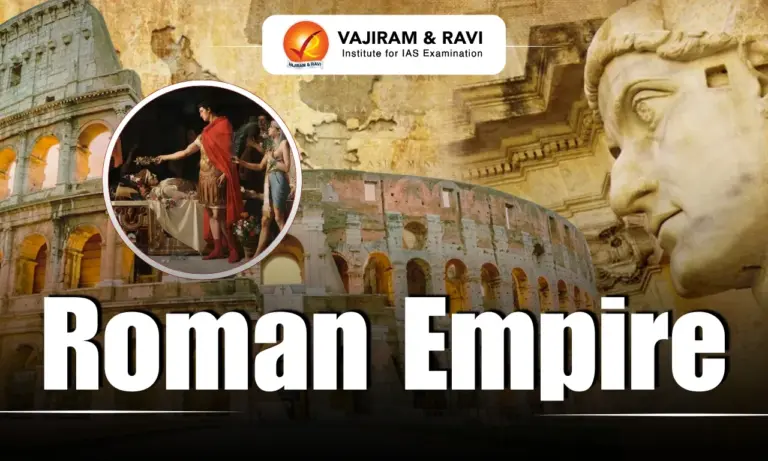
The Roman Empire was one of the most powerful and influential civilizations in history, emerging after the fall of the Roman Republic and expanding across Europe, North Africa, and the Middle East. It was known for its strong government, advanced architecture, well-developed infrastructure, and powerful military. The Romans built lasting structures like roads, aqueducts, and monuments, and spread their language (Latin), culture, and legal systems across their territories. Many modern ideas, such as citizenship, governance, and law, have roots in Roman practices, making the Roman Empire an important foundation of modern civilization.
Roman Empire
- The Roman Empire was one of the most influential and powerful civilizations of the ancient world, with its center in the city of Rome. It emerged after the decline of the Roman Republic and marked a shift from collective governance to rule under a single emperor.
- It officially began in 27 BCE, when Augustus became the first emperor, and continued until the fall of the Western Roman Empire in the 5th century CE.
- Over time, the empire expanded across vast regions, including Western Europe, North Africa, and parts of the Middle East, becoming the dominant power around the Mediterranean Sea.
- The Roman Empire is remembered not only for its territorial control but also for its administrative efficiency, cultural richness, and long-lasting influence on modern civilization.
Roman Empire Timeline
- The beginning of the empire is marked by the rise of Augustus (27 BCE – 14 CE), whose rule brought peace and stability after years of internal conflict.
- The early phase included rulers of the Julio-Claudian dynasty, such as Tiberius, Caligula, Claudius, and Nero, whose reigns showed both effective administration and misuse of power.
- The period of the Five Good Emperors (96-180 CE) is considered the peak or golden age, characterized by stability, expansion, and efficient governance.
- The 3rd century CE witnessed serious challenges, including political instability, economic decline, and military pressures.
- Emperor Diocletian (284-305 CE) introduced major reforms, including dividing authority among multiple rulers (Tetrarchy) to improve control.
- Constantine (312-337 CE) made important changes like accepting Christianity and shifting the capital to Constantinople, strengthening the eastern region.
- In 395 CE, the empire split into Eastern and Western halves, and eventually, the Western Roman Empire collapsed in 476 CE, while the East continued as the Byzantine Empire.


Rise and Expansion of the Roman Empire
- The rise of the Roman Empire was closely linked to a period of political instability and civil wars during the late Roman Republic in the 1st century BCE.
- Julius Caesar played a key role in concentrating power, but after his assassination in 44 BCE, a struggle for power began among leaders like Mark Antony, Lepidus, and Octavian.
- Octavian defeated Antony in the Battle of Actium (31 BCE) and later became Augustus, establishing a new system of imperial rule.
- The empire expanded rapidly due to its strong military organization, disciplined soldiers, and effective leadership.
- Roman territories grew to include large parts of Europe, North Africa, and Asia, making it one of the largest empires in history.
- Expansion was not only military but also administrative, as Rome established control systems and infrastructure in conquered regions.
Also Read:- Mughal Empire
Administration and Governance in the Roman Empire
- Augustus created a system called the Principate, which maintained the outward appearance of a republic while actually concentrating power in the hands of the emperor.
- Institutions like the Senate continued to function, but the emperor, known as the “first citizen” (Princeps), held the real authority.
- Over time, governance became more centralized, with emperors directly controlling taxation, law, and administration.
- Emperors like Claudius and Diocletian introduced administrative reforms, including strengthening bureaucracy and reorganizing governance structures.
- The introduction of the Tetrarchy by Diocletian divided power among four rulers, which helped maintain stability for a certain period.
- The Roman administrative system was highly organized and played a key role in managing a vast and diverse empire.
Key Emperors of the Roman Empire and Their Major Contributions
The Roman Empire was shaped by several important rulers whose leadership and reforms played a key role in its growth and stability. The emperors discussed below highlight the major contributions that helped strengthen Rome and influence future societies.
Augustus (27 BC-14 AD)
- Augustus, originally named Gaius Octavius, was the grand-nephew of Julius Caesar and became Rome’s first emperor after Caesar’s death. His rule marked the shift from the Roman Republic to a powerful empire that lasted for centuries.
- He ruled for over 40 years, making his reign one of the longest in Roman history. During this time, he brought much-needed peace and stability after years of civil wars.
- Augustus is best known for starting the Pax Romana, a long period of peace and stability that lasted about 200 years. This era became a model for later peaceful empires like Pax Britannica and Pax Americana.
- He focused heavily on improving Rome’s infrastructure by building roads, highways, aqueducts, and temples, which made daily life better for citizens and boosted trade and communication.
- Augustus reformed the administrative system by dividing Rome into 14 regions and many smaller neighborhoods, improving how the city was managed, especially in areas like water supply and public services.
- He also made taxation fairer, which increased government revenue and helped expand trade across the empire.
- One of his most lasting contributions was developing the idea of citizenship, giving Roman citizens specific rights and responsibilities, an idea still important in modern societies.
Claudius (41 AD-54 AD)
- Claudius became emperor later in life and overcame physical challenges from illness during his childhood, showing strong determination and capability.
- He is best remembered for expanding the Roman Empire by conquering Britain and turning it into a Roman province.
- Claudius had a strong interest in law and personally judged many legal cases during his rule, which made him deeply involved in justice and governance.
- He introduced important legal reforms, especially laws that offered protection to slaves, helping lay the foundation for future laws that protected weaker and minority groups.
Vespasian (69 AD-79 AD)
- Vespasian founded the Flavian dynasty, which ruled Rome for nearly three decades and helped restore stability after a chaotic period.
- He was a successful military leader, known for his campaigns in Britain and for suppressing revolts in Judea.
- Vespasian improved the empire’s finances by increasing taxes and introducing financial reforms that strengthened the economy.
- He used the money collected from taxes to fund large construction projects, most famously the Colosseum (then called the Flavian Amphitheater), which became one of Rome’s greatest architectural achievements.
Trajan (98 AD-117 AD)
- Trajan was one of the Five Good Emperors and ruled during Rome’s Golden Age, a time of great prosperity and expansion.
- He expanded the empire to its greatest size by conquering regions like Dacia (modern Romania) and pushing into the eastern territories.
- Trajan was also known for his public building projects, including Trajan’s Column, which celebrated his military victories and still stands today.
- He improved social welfare by expanding financial aid programs for citizens, creating early ideas similar to modern welfare systems.
Hadrian (117 AD-138 AD)
- Hadrian, who was adopted by Trajan, was more focused on maintaining and strengthening the empire rather than expanding it further.
- He worked to secure the empire’s borders and ensure long-term stability instead of engaging in constant warfare.
- His most famous project was Hadrian’s Wall in Britain, a massive structure built to protect Roman territory and show the empire’s engineering strength.
- He also rebuilt the Pantheon in Rome, using innovative architectural techniques like concrete domes, which influenced future building designs.
Marcus Aurelius (161 AD-180 AD)
- Marcus Aurelius is remembered as a wise and thoughtful ruler, known for his writings on Stoic philosophy, especially his work Meditations.
- He believed in applying philosophical ideas to everyday life, encouraging people to live with discipline, wisdom, and inner peace.
- Despite his peaceful nature, he successfully defended the empire against invasions from Germanic tribes like the Marcomanni and Quadi.
- His reign showed how a leader could balance intellectual thought with practical leadership during difficult times.
Roman Society, Economy, and Culture
- Roman society was structured in a clear hierarchy, with patricians (elite class), plebeians (common citizens), and slaves forming the main groups.
- The economy was largely based on agriculture, trade, and taxation, but over time it faced serious challenges like inflation, heavy taxation, and economic instability.
- Trade networks connected different parts of the empire, allowing the exchange of goods, ideas, and culture.
- Roman culture was deeply influenced by Greek traditions, especially in areas like art, philosophy, and education.
- The Romans made major contributions in law, literature, architecture, and engineering, which still influence the modern world.
- Latin became the official language and later evolved into many modern European languages, showing the lasting cultural impact of Rome.
Roman Military System and Strength
- The Roman army was one of the most important pillars of the empire, known for its discipline, organization, and advanced strategies.
- Soldiers were trained to fight in structured formations, making them highly effective in both defense and expansion.
- Emperors like Vespasian improved the army by making it more professional, loyal, and better organized.
- The army not only helped in conquering territories but also played a key role in maintaining internal order and protecting borders.
- However, over time, the increasing influence of the military in politics led to power struggles and instability, contributing to the empire’s decline.
Causes of the Decline of the Roman Empire
- One of the main reasons for decline was political instability, with frequent changes in leadership and weak emperors.
- Continuous civil wars and internal conflicts weakened the empire and drained its resources.
- Economic problems such as high taxes, inflation, and disruption in trade created long-term difficulties.
- External pressures from barbarian invasions, especially by Germanic tribes, further weakened the empire’s defenses.
- The division of the empire into Eastern and Western parts reduced unity and made the Western part more vulnerable.
- Finally, in 476 CE, the last Western Roman emperor was removed from power, marking the official end of the Western Roman Empire.
Legacy and Contributions of the Roman Empire
- The Roman Empire left behind a strong legacy in areas like law, governance, engineering, and urban planning, many of which influence modern societies.
- Roman law became a foundation for legal systems across the world, especially in Europe.
- The empire built advanced infrastructure such as roads, aqueducts, and cities, which improved communication and living conditions.
- Roman culture helped preserve and spread Greek knowledge, ensuring its survival for future generations.
- The use of Latin language and literature contributed greatly to Western intellectual traditions.
- Even after the fall of the Western Empire, the Eastern Roman (Byzantine) Empire continued to carry forward Roman traditions for many centuries.
Also Read : Ottoman Empire

 Last updated on Oct, 2026
→ UPSC 2027 Notification will be released on 13 January 2027 at upsconline.nic.in.
→ Asian Games 2026 are being held in Aichi-Nagoya, Japan, from 19 September to 4 October.
→ Check Nobel Prize 2026 Winners List here.
→ Download PIB PRiSM Monthly Magazine 2026 here.
→ Check UPSC Monthly Current Affairs Magazine The Recitals here.
→ Check out the latest UPSC Syllabus here.
→ Download UPSC Model Answers for Mains 2026
→ UPSC Mains Question Paper 2026 is out now for Essay & GS Paper 1, 2, 3 & 4.
→ UPSC Calendar 2027 has been released.
→ Enroll in Vajiram & Ravi’s UPSC Mains Test Series 2027 for structured answer writing practice, expert evaluation, and exam-oriented feedback.
→ Join Vajiram & Ravi’s UPSC Mentorship Program 2027 for personalized guidance, strategy planning, and one-to-one support from experienced mentors.
→ Go through the UPSC Mains Previous Year Papers to enhance your preparation.
→ UPSC has released UPSC Toppers List 2025 with the Civil Services final result on its official website.
→ Also check Best UPSC Coaching in India
Roman Empire FAQs
Q1. What was the Roman Empire?+
Q2. When did the Roman Empire begin and end?+
Q3. Who was the first emperor of the Roman Empire?+
Q4. What was the Pax Romana?+
Q5. What was the Principate system?+
Q6. Who were the Five Good Emperors?+
Q7. What were the major contributions of Augustus?+
Q8. How did Roman society function?+
Q9. What was the Roman economy based on?+
Q10. What were the key causes of the decline of the Roman Empire?+
Q11. Why was the Roman Empire divided?+
Q12. What happened after the fall of the Roman Empire?+
Tags: roman empire world history