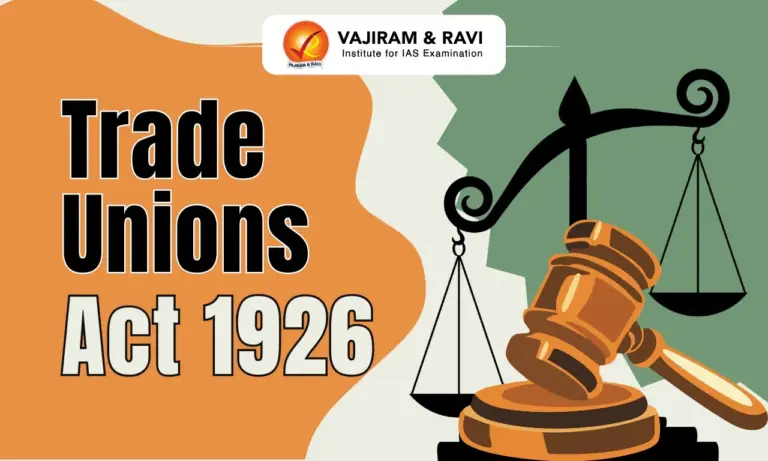
The Trade Unions Act 1926 is the principal legislation governing the registration, regulation and legal protection of trade unions in India. It was enacted to provide workers and employers with a statutory framework for forming associations and protecting their collective interests. Before this law, trade unions lacked legal recognition and their activities were often treated as unlawful. The Act granted registered trade unions a legal identity, defined their rights and liabilities and promoted collective bargaining, industrial peace and better employer-worker relations.
Trade Unions Act 1926 History and Evolution
The Trade Unions Act 1926 emerged in response to rapid industrialisation, increasing labour exploitation and the growing need for organised worker representation in India.
- Industrialisation and Labour Problems: Rapid industrialisation replaced traditional employer-worker relations with wage employment. Low wages, long working hours, poor working conditions and mechanisation increased the demand for organised worker representation.
- Early Labour Movement (1875): Shri Sorabji Shapurji Bengali and Shri N.M. Lokhandey first highlighted the need for organised labour in 1875, encouraging the formation of workers’ unions across different industries.
- Formation of Early Trade Unions: The Printers’ Union of Calcutta (1905) and Bombay Postal Union (1907) marked the beginning of organised trade unions, while the Bombay Mill Hands Association (1890) became India’s first labour association.
- Expansion of National Trade Unions: The Madras Labour Union (1918) became India’s first properly registered trade union. In 1920, the Ahmedabad Textile Labourers’ Association and the All India Trade Union Congress (AITUC) strengthened the national labour movement.
- Enactment of the Trade Unions Act 1926: Support from the International Labour Organization, nationalist leaders and later recommendations of the Royal Commission on Labour led to legal recognition of trade unions through the Trade Unions Act 1926.
Trade Unions Act 1926 Major Provisions
The Act provides a comprehensive legal framework for registration, administration, rights, governance and regulation of registered trade unions across India.
- Definition: After the Trade Unions (Amendment) Act, 1970, the Act extends to the whole of India. Section 2(h) defines a trade union as any temporary or permanent combination formed to regulate relations among workers, employers, or both, including federations of two or more trade unions.
- Registration of Trade Unions: Sections 3 to 14 govern registration. The appropriate government appoints a Registrar under Section 3. Under Section 4, at least seven members may apply, provided they satisfy the requirement of seven workers and at least 10 percent or 100 workers, whichever is less, in the concerned establishment.
- Application and Registration Requirements: Sections 5 to 9 require submission of union rules, objectives, office bearer details, registered office and membership information. Once satisfied, the Registrar registers the union and issues a certificate that serves as conclusive proof of registration.
- Rights, funds and legal protection: Sections 15 to 21 permit expenditure of union funds on administration, legal aid, education, welfare, insurance, medical treatment, unemployment benefits and worker compensation. Sections 17 and 18 grant immunity from specified criminal conspiracy and civil suits for lawful trade dispute activities, while Section 19 validates agreements made in restraint of trade among registered unions.
- Administration and penalties: Sections 21A to 33 regulate qualifications of office bearers, change of name, amalgamation, dissolution, annual returns, audits, government regulations, penalties for false information and judicial procedures. Section 31 prescribes penalties for failure to submit statutory returns, while Section 33 specifies the courts competent to try offences under the Act.


Trade Unions Act 1926 Significances
The Trade Unions Act 1926 established the legal foundation for organised labour in India and strengthened industrial relations through statutory recognition of registered trade unions.
- Legal Recognition of Trade Unions: The Act granted registered trade unions legal status with perpetual succession, a common seal, property ownership rights, contract making powers and the ability to sue or be sued.
- Strengthened Collective Bargaining: It enabled registered trade unions to negotiate with employers for fair wages, better working conditions, reasonable working hours, welfare measures and improved job security.
- Protection of Workers’ Rights: The Act provided civil and criminal immunity for lawful trade union activities and permitted spending on education, healthcare, insurance, legal aid, disability support and worker welfare.
- Improved Industrial Relations: It introduced a structured system for trade union registration, governance, accountability and dispute resolution, encouraging dialogue between employers and workers while reducing industrial disputes.
- Foundation of Labour Laws: The Act laid the base for modern labour legislation and influenced important laws including the Factories Act 1948, Minimum Wages Act 1948, EPF Act 1952, Apprentices Act 1961 and Contract Labour Act 1970.

 Last updated on Oct, 2026
→ UPSC 2027 Notification will be released on 13 January 2027 at upsconline.nic.in.
→ Asian Games 2026 are being held in Aichi-Nagoya, Japan, from 19 September to 4 October.
→ Check Nobel Prize 2026 Winners List here.
→ Download PIB PRiSM Monthly Magazine 2026 here.
→ Check UPSC Monthly Current Affairs Magazine The Recitals here.
→ Check out the latest UPSC Syllabus here.
→ Download UPSC Model Answers for Mains 2026
→ UPSC Mains Question Paper 2026 is out now for Essay & GS Paper 1, 2, 3 & 4.
→ UPSC Calendar 2027 has been released.
→ Enroll in Vajiram & Ravi’s UPSC Mains Test Series 2027 for structured answer writing practice, expert evaluation, and exam-oriented feedback.
→ Join Vajiram & Ravi’s UPSC Mentorship Program 2027 for personalized guidance, strategy planning, and one-to-one support from experienced mentors.
→ Go through the UPSC Mains Previous Year Papers to enhance your preparation.
→ UPSC has released UPSC Toppers List 2025 with the Civil Services final result on its official website.
→ Also check Best UPSC Coaching in India
Trade Unions Act 1926 FAQs
Q1. What is the Trade Unions Act 1926?+
Q2. What is the main objective of the Trade Unions Act 1926?+
Q3. What is the minimum membership required to register a trade union?+
Q4. Which section of the Trade Unions Act defines a trade union?+
Q5. Why is the Trade Unions Act 1926 important?+
Tags: trade unions trade unions act 1926