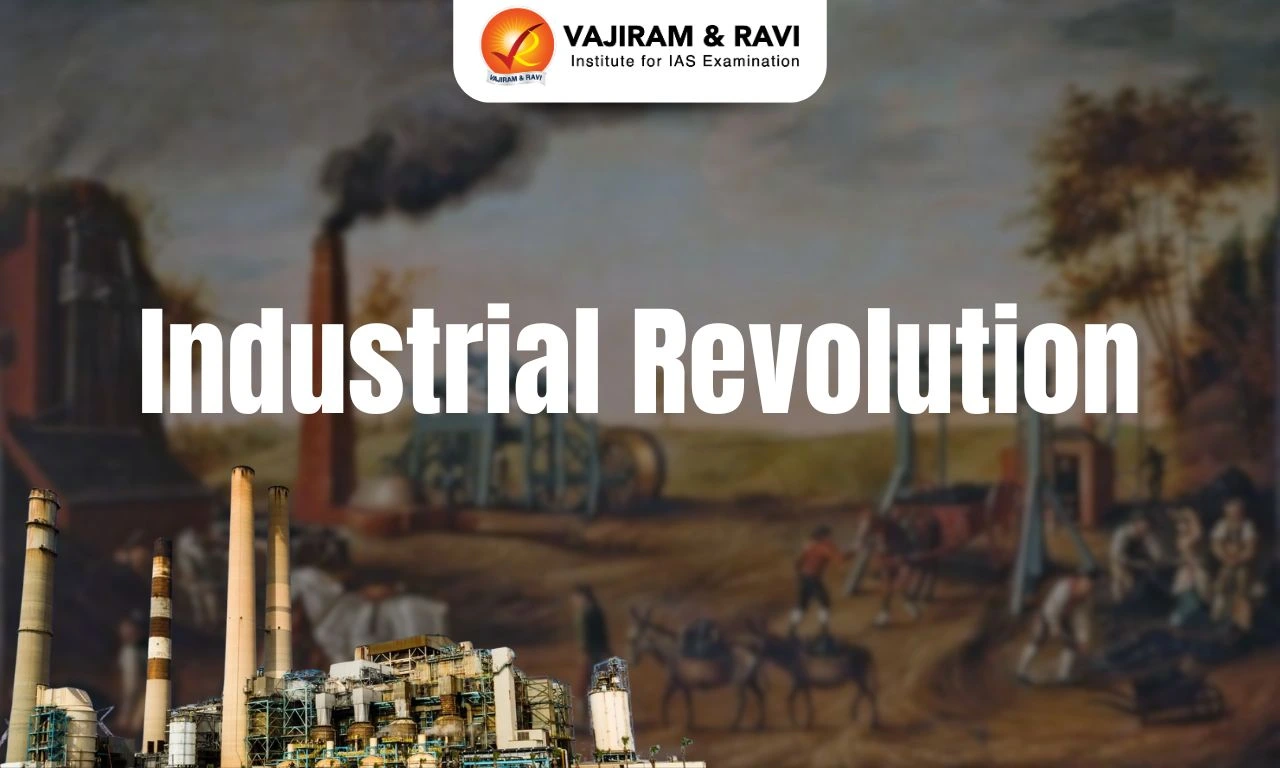
The Industrial Revolution marked a shift from an agrarian and craft-based economy to an industrial and factory-based economy. It stimulated mass production, expanded markets, increased productivity, and contributed to the growth of capitalism, trade, and modern transportation. It also accelerated urbanisation and created a new industrial working class.
However, industrialisation also created challenges such as poor working conditions, long working hours, child labour, overcrowded cities, and economic inequality. It increased pressure on natural resources and contributed to environmental degradation.
Industrial Revolution Background
The Industrial Revolution was a major transformation in production that began in Britain in the 18th century and gradually spread to Europe and other regions. It replaced many traditional hand-based methods with machines, factories and new sources of power, fundamentally changing the way goods were produced.
- The transformation was driven by innovations in steam power, mechanised textiles, iron production and transport.
- It also brought major changes in population patterns, labour relations and urban life, laying the foundations of the modern industrial economy.
Industrial Revolution in Britain
The Industrial Revolution was a period of rapid industrialisation that began in Britain in the late 18th century. It originated with the introduction of machinery, factories, and new manufacturing processes, ushering in profound economic and social changes.


Industrial Revolution Causes
The Industrial Revolution in England was a complex and multifaceted phenomenon, with several interrelated causes that contributed to its emergence.
- Surplus Wealth: The revolution in trade and commerce brought into existence a class of capitalists who were constantly seeking new opportunities to invest their surplus wealth.
- As a result, increasing amounts of money were made available for the growth of manufacturing.
- The financial resources required for industry investment came from the wealth that various colonies, particularly India, exported to England.
- Population growth: Rapid population growth met the growing industries' demand for more and cheaper labour.
- Political will: Britain's government was influenced by commercial and manufacturing interests, and as a result, it fought other countries tenaciously for markets and colonies.
- Demand: Inventions by Hargreaves, Crompton, Watt, Cartwright and others enabled technological advancements to meet Britain's growing industrial production demands.
- Infrastructure: All along the coast, the British had established ports, making it simple to conduct both internal and external trade.
- The banking system in Britain played a pivotal role as it provided the necessary capital and financial support for establishing factories, investing in new machinery, and funding technological innovations.
- State support: The state supported the Industrial Revolution through laissez-faire policies advocated by David Ricardo and Adam Smith to foster economic growth.
- Coined by the French businessman M. Le Gendre, it was against the earlier idea of mercantilist protectionism.
- Availability of Raw materials and easy market access: Britain's colonies supplied raw materials and offered markets for finished goods, facilitating the Industrial Revolution by ensuring the availability of resources and demand for products.
- Favourable climate: Finally, the temperate climate of the British Isles was favourable for the manufacturing of cotton clothes.
- Innovations and Technological advancements:
|
Innovations and Technological changes during the Industrial Revolution |
|
|
Cotton textile Industry |
- The invention of the flying shuttle accelerated the process of weaving on a loom. - This resulted in yarn shortages until 1768, when James Hargreaves' spinning jenny, perfected by Hargreaves, enabled spinners to produce yarn in greater quantities. - The water frame spinning machine of Richard Arkwright, which could be powered by either water or horses. - Samuel Crompton's mule, which combined elements of the water frame and spinning jenny, increased yarn production even further. - With the invention of the power loom by Edmund Cartwright in 1787, the weaving of fabric was able to keep up with the spinning of yarn. - The textile industry stimulated other industries, such as dyeing, bleaching, and printing. |
|
Steam Engine |
- In 1705, Thomas Newcomen built an engine for pumping water from coal mines. - James Watt significantly increased the design and effectiveness of Newcomen's engine in 1764 and added a chamber with a cold water jet to condense the steam and create a vacuum. - The steam engine quickly succeeded the earlier coal-powered locomotives. It boosted demand for railway lines. |
|
Coal and Iron |
- Tunnel ventilation, the use of safety lamps, coal transportation, and the use of gunpowder to blast away ridges all made significant advances in coal mining. - During this time, significant advancements were made in the iron industry. Abraham Darby invented pig iron smelted with coke in 1709.
|
|
Means of Transportation and Communication |
- Improvements in bridges and road construction were made early in the 1700s and helped to transport raw materials and factory-made products to their destinations. - In 1814, George Stephenson built the first steam locomotive engine to run on railway tracks. Electricity was now commercially available and used to power the factories. - The invention of the telegraph and telephone made it possible to communicate anywhere in the world instantly. |
Industrial Revolution in the United States of America
Soon after Britain, the Industrial Revolution also started in the USA for more than a century. This revolution involved major changes in manufacturing, transportation and communications, and transformed the daily lives of Americans.
Factors Responsible for the Industrialisation of America
America's industrialisation was driven by a powerful mix of abundant natural resources, rapid transportation networks, and a massive surge in the workforce.
- Embargo Act of 1807: It prohibited American merchant ships from leaving for foreign ports and prohibited foreign vessels from carrying American goods out of American ports.
- The Americans were forced to start producing more of their goods because they couldn't access foreign goods.
- Natural Resources: The United States' abundant natural resources like water, timber, metals, and coal fueled the manufacturing of various goods for the market.
- Railroads: Railroad networks in the U.S. promoted the growth of industries like coal and steel and sped up the transportation of goods to market, thus encouraging mass production, mass consumption, and economic specialisation.
- Abundant Labor Supply: A significant number of foreign workers were drawn to the United States by the railway industry, creating a plentiful labour pool for expanding businesses.
- Laissez-faire politics: Businesses were able to thrive and grow at a rapid pace due to a lack of government regulation.
Innovations and Technological Changes
Samuel Slater, an English mill operator, helped Moses Brown establish the first water-powered textile mill in the Americas in 1793. He was referred to by President Andrew Jackson as the "Father of the American Industrial Revolution."
- In 1793, Eli Whitney invented the cotton gin. The telegraph was invented by Samuel F.B. Morse, and the sewing machine was invented by Elias Howe.
- After the Civil War, industrialisation accelerated.
- The first transcontinental railway was finished in 1869 to transport people, raw materials, and manufactured goods.
- The invention of electricity by Thomas Alva Edison (1879) and the telephone by Alexander Graham Bell (1876) changed the whole world.
- The invention of electricity enabled the development of the electric motor, leading to electric trams and subway trains.
- The first roller coaster was patented by Edwin Prescott in 1898.
- The first aeroplane, Orville and Wilber Wright invented the first plane that was not powered by wind in 1903.
- The Ford Model T automobile was created by Henry Ford in 1908.
Industrial Revolution in France
The Industrial Revolution in France occurred later than in Britain and other European countries, starting in the late 18th century and gaining momentum in the 19th century. France's industrialisation progressed through textile mechanisation and heavy industry growth, such as iron, steel, and coal, culminating in rapid industrialisation under the Second Empire.
Factors Responsible for the Industrialisation of France
The French Revolution abolished feudalism and established a more unified market, facilitating industrialisation in the long run, despite initial disruptions.
- Resource Availability: Access to resources like coal, iron ore, and water power supported heavy industries, while textile centres like Lyon and Lille benefited from raw materials like wool and flax.
- Infrastructure Development: Construction of roads, canals, and railroads, particularly under the July Monarchy, improved transportation and movement of goods and resources.
- Technological Innovations: French inventors contributed innovations like the Jacquard loom and Leblanc process, driving productivity in textiles, chemicals, and metallurgy.
- Government Policies: The Second Empire under Napoleon III invested in infrastructure, provided financial support, and implemented protectionist tariffs to nurture domestic industries.
- Entrepreneurship and Investment: Influential industrialists like the Schneiders and Peugeots, along with private investment and joint-stock companies, propelled industrial growth
Industrial Revolution in Germany
Germany's industrialisation commenced in the early 1800s with the establishment of the Zollverein (a customs union) in 1834, enabling free trade among German states. This economic unity paved the way for industrial growth. The 1871 unification under Otto von Bismarck's leadership marked a pivotal shift, propelling Germany's industrial development through unified policies and initiatives.
Factors Responsible for the Industrialisation of Germany
Germany transformed from an agricultural society into an industrial powerhouse in the 19th century due to economic unification, rich natural resources, and rapid infrastructure development.
- Availability of Natural Resources: The industrial boom was fuelled by abundant natural resources, with coal deposits in the Ruhr Valley and iron ore in Lorraine and Silesia, propelling the steel and coal mining industries.
- Transportation Infrastructure: The construction of an extensive railway network was pivotal, streamlining the transport of raw materials and finished goods and bolstering trade and commerce.
- Contribution of Bismarck: Bismarck's policies facilitated economic unification, promoted heavy industries through subsidies and tariffs, encouraged infrastructure development, and supported technological advancements, providing a conducive environment for rapid industrialisation.
- Threat from France: The threat of military conflict with France motivated Germany to strengthen its industrial base, particularly in the production of steel, coal, and armaments, to enhance its military capabilities and assert its power.
- Adoption of New Technologies: Germany's industrial progress was fuelled by adopting new technologies like the Bessemer steel process and chemical/electrical engineering advancements.
- Entrepreneurial Spirit and Industrial Leadership: The emergence of influential industrialists and business leaders, such as those behind Krupp and Siemens, and a culture of risk-taking and innovation were key drivers of industrial growth.
Industrial Revolution in Japan
The Industrial Revolution in Japan took place in the late 19th and early 20th centuries. The Meiji Restoration in 1868 marked the beginning of Japan's industrialization. The new government initiated a series of reforms, known as the Bunmei Kaika (Civilization and Enlightenment), aimed at westernising and modernising Japan.
Factors Responsible for the Industrialisation of Japan
Japan's industrialization began rapidly after the Meiji Restoration in 1868, driven by intentional state policy, social reform, and the adoption of Western technology.
- Skilled Labor Force: Japan's emphasis on education resulted in a literate population, a disciplined workforce, and the availability of skilled artisans and craftsmen.
- Acquisition of Foreign Knowledge and Technology: Japan hired foreign experts, sent students and workers abroad for training, and imported machinery and equipment from Western nations to acquire foreign knowledge and technology.
- Infrastructure Development: The construction of railways, roads, ports, and expansion of transportation networks facilitated the movement of goods and resources, supporting industrial growth.
- Private Enterprise and Zaibatsu: The shift from government-led to private sector involvement, establishment of zaibatsu (large family-owned conglomerates), and promotion of entrepreneurship and innovation drove industrialization.
- Focus on Heavy Industries: Japan's emphasis on strategic heavy industries like shipbuilding, steel, and machinery development supported military modernization and the buildup of a robust industrial base.
- Protectionist Policies: The implementation of tariffs, trade barriers, nurturing of domestic industries, and promotion of import substitution fostered industrial growth.
Impact of the Industrial Revolution
The Industrial Revolution had far-reaching and profound effects on every aspect of society, economy, and technology, shaping the course of human history and transforming the world in various ways.
Political Impact
shifted political power from traditional landowners to factory owners and urban middle classes, while sparking widespread demands for workers' rights.
- The industrial and professional bourgeoisie section began to fight for a share in the government and succeeded with the passing of the historic First Reform Act in 1832.
- This gave the right to vote to the middle class.
- Emergence of Labour Unions: Workers were inspired to combine and organise themselves to fight for rights, and this gave rise to the trade union movement in Britain.
- Their right to strike and form a union for exacting demands from the management was recognized.
- A shift in power and influence: The Industrial Revolution brought about the rise of capitalism. As a result, a small number of industrialists came to possess vast wealth and power. At the same time, factory workers received pitiful wages, sparking discussions about economic inequality and social justice.
- Thus, it led to the rise of classes and class politics, ultimately leading to communism by Marx.
- Rise of nationalism: Industrialisation enabled countries leading to increased connectivity and a sense of national identity.
- Nationalism, which placed a strong emphasis on patriotism and pride in one's country, developed into a strong political force that was frequently connected to international rivalry in terms of trade and conflict over territorial interests.
- Growth of imperialism: As industrialised countries sought to expand their territories and secure resources for their growing economies, it led to imperialism and the colonisation of other regions of the world.
Social Impact
The Industrial Revolution immensely affected the society of Europe, particularly that of Britain. The society was divided into three new groups based on economic status and interests.
- The 'grande bourgeoisie' or industrial elite comprised wealthy bankers, capitalists and industrialists.
- The educated middle class or 'professional bourgeoisie' included engineers, technicians, doctors and lawyers.
- The working class consisted of labourers who migrated to urban areas for factory, mining and dock jobs.
- Conditions of the working class:
- Child labour increased
- Working class lived in poverty
- Long working hours and low pay
- Positive Effects of the Industrial Revolution included an increase in wealth, the production of goods, and the standard of living. People had access to more affordable goods, better housing, and healthier diets.
Economic Impact
The Industrial Revolution replaced farming economies with machine-driven manufacturing, creating major economic changes worldwide. There was a significant increase in output, which resulted in lower product costs.
- Rise of Capitalism: A new source of wealth rose from the ownership of factories and machinery. This new group of people became known as capitalists.
- Banking system: They also organised the banking system to distribute capital from surplus income areas to those areas where it was needed.
- In the early 1700s, the first private banks were opened by goldsmiths, merchants, and manufacturers.
- Trade: The discovery of trade routes encouraged competition amongst colonial and imperialist powers for expanding their empires to fulfil the need for raw materials, new markets, and cheap labour.
Industrial Revolution Impacts on India
The Industrial Revolution in Britain transformed India from a prosperous global manufacturing hub into a controlled supplier of raw materials and a consumer of cheap foreign goods.
- Economic Impact: The rise of British economic power and colonisation of India led to the destruction of traditional Indian industries like textiles and handicrafts.
- There was an influx of British manufactured goods, undermining local production.
- India was transformed into a supplier of raw materials and a consumer of British goods.
- Social Impact: The Industrial Revolution disrupted traditional social structures and occupations in India.
- It led to the rise of new social classes, such as industrialists and workers, and accelerated urbanisation and the growth of cities.
- Western education and ideas were introduced, influencing Indian society.
- Political Impact: The strengthening of British colonial rule and exploitation of resources in India was a direct consequence of the Industrial Revolution.
- It also sparked the rise of Indian nationalist movements and demands for self-governance.
- Exposure to Western political ideologies like liberalism and socialism influenced Indian political thought.
- Infrastructural Impact: The development of railways, roads, and communication networks facilitated the movement of goods and people in India.
- This infrastructure laid the groundwork for India's future industrialisation, though it primarily served British colonial interests initially.
Industrial Revolution Limitations
The Industrial Revolution increased production and economic growth, but its benefits were unevenly distributed. Rapid industrialisation also created social, economic and environmental problems, particularly for workers and urban populations.
- Poor working conditions: Factories often had unsafe workplaces, long hours and inadequate safety measures.
- Child labour: Children were employed in factories and mines, often for low wages and under harsh conditions.
- Urban overcrowding: Rapid migration to industrial cities resulted in slums, poor sanitation and housing shortages.
- Economic inequality: Industrial wealth was concentrated among factory owners and the emerging capitalist class, while many workers remained poorly paid.
- Worker exploitation: The absence of strong labour protections allowed low wages and excessive working hours.
- Environmental degradation: Extensive coal use caused air pollution, while industrial waste contaminated rivers and land.
Industrial Revolution Recent Developments
The Industrial Revolution has progressed from mechanisation and steam power to Industry 4.0 and Industry 5.0, with digital technologies increasingly transforming production. Industry 4.0 focuses on smart, connected and automated factories, while Industry 5.0 places greater emphasis on human–machine collaboration, sustainability and resilience.
- Industry 4.0: Integration of AI, Internet of Things (IoT), big data, cloud computing, robotics and cyber-physical systems into manufacturing.
- Smart factories: Real-time data and connected machines enable automated production, predictive maintenance and improved quality control.
- Industry 5.0: Shifts the focus towards human-centric, sustainable and resilient production, complementing Industry 4.0's emphasis on digitalisation and automation.
- Human–machine collaboration: Cobots and advanced robotics are increasingly designed to work alongside humans rather than simply replace them.
- Digital twins: Virtual replicas of machines and production systems help industries simulate operations, identify problems and optimise processes.
| Other Related Posts | |
| Industrial Revolution | French Revolution |
| American Revolution | Decolonisation |

 Last updated on Oct, 2026
→ UPSC 2027 Notification will be released on 13 January 2027 at upsconline.nic.in.
→ Check Nobel Prize 2026 Winners List here.
→ Download PIB PRiSM Monthly Magazine 2026 here.
→ Check UPSC Monthly Current Affairs Magazine The Recitals here.
→ Check out the latest UPSC Syllabus here.
→ Download UPSC Model Answers for Mains 2026
→ UPSC Mains Question Paper 2026 is out now for Essay & GS Paper 1, 2, 3 & 4.
→ UPSC Calendar 2027 has been released.
→ Enroll in Vajiram & Ravi’s UPSC Mains Test Series 2027 for structured answer writing practice, expert evaluation, and exam-oriented feedback.
→ Join Vajiram & Ravi’s UPSC Mentorship Program 2027 for personalized guidance, strategy planning, and one-to-one support from experienced mentors.
→ Go through the UPSC Mains Previous Year Papers to enhance your preparation.
→ UPSC has released UPSC Toppers List 2025 with the Civil Services final result on its official website.
→ Also check Best UPSC Coaching in India
Industrial Revolution FAQs
Q1. What is the Industrial Revolution?+
Q2. What are the 1st, 2nd, 3rd, and 4th industrial revolutions?+
Q3. When did the Industrial Revolution start?+
Q4. What is the 3 Industrial Revolution?+
Q5. What are the four stages of the Industrial Revolution?+
Tags: industrial revolution quest UPSC World History Notes