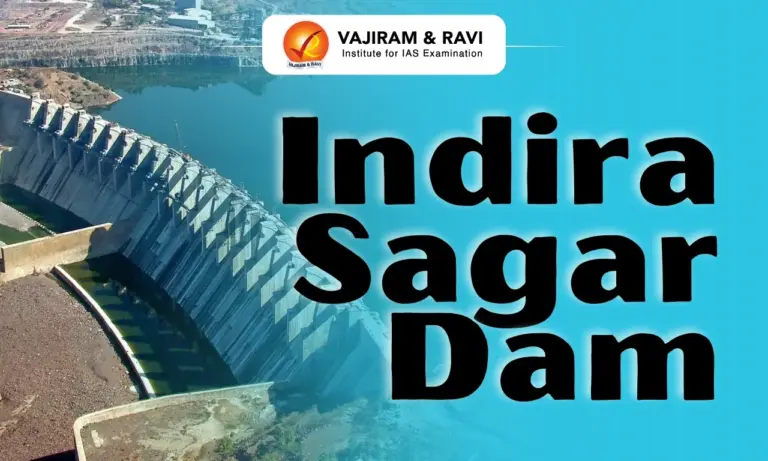
The Indira Sagar Dam is one of India’s most important multipurpose river valley projects. It is located at Narmada Nagar near Punasa in Khandwa district of Madhya Pradesh on the Narmada River. It is India’s largest reservoir by water storage volume commissioned in May 2005. The project supports hydropower generation, irrigation, flood management and downstream water regulation. It has become a major infrastructure asset for agriculture, energy security and regional development.
Indira Sagar Dam Features
The Indira Sagar Dam combines large scale water storage, power generation and irrigation facilities, making it one of India’s most significant multipurpose infrastructure projects.
- Location: The dam is situated at Narmada Nagar near Punasa in Khandwa district of Madhya Pradesh. Construction began on 23 October 1984. The project became operational on 31 May 2005 under the Government of Madhya Pradesh.
- Structure: It is a concrete gravity dam with a slightly curved alignment across the Narmada River. It includes 20 ogee spillway gates with a discharge capacity of 83,400 cubic metres per second.
- Height: The dam has a height of 92 metres and a length of 653 metres.
- Reservoir Capacity: The Indira Sagar Reservoir has a total storage capacity of 12.22 cubic kilometres. Its active water capacity is 9.75 cubic kilometres, inactive storage is 2.47 cubic kilometres and the reservoir spreads across about 913.48 square kilometres.
- Power Generation: The hydropower station has an installed capacity of 1,000 MW through eight Francis turbines of 125 MW each. It generates nearly 2,700 GWh of electricity annually and is among India’s largest surface powerhouses.
- Ownership and Operation: The project is owned by the Government of Madhya Pradesh and operated by the Narmada Hydroelectric Development Corporation (NHDC), a joint venture of NHPC and the Government of Madhya Pradesh.
Indira Sagar Project
The Indira Sagar Project is a multipurpose development programme that supplies electricity, irrigation, regulated river flow and downstream water management.
- Project Development: The foundation stone was laid by Prime Minister Indira Gandhi on 23 October 1984. Main dam construction started in 1992 and all eight generating units were commissioned ahead of schedule by March 2005.
- Hydropower Output: The project has a total installed generation of 1,000 MW. It was designed for dependable annual energy production of about 1,980 million units and currently generates around 2,700 GWh every year.
- Irrigation Benefits: The project irrigates nearly 2.65 lakh hectares annually with a culturable command area of about 1.23 lakh hectares. It strengthens agricultural production across Khandwa, Khargone and surrounding regions.
- Catchment and Downstream Role: The dam receives runoff from a catchment area of 61,642 square kilometres. Regulated releases support the Omkareshwar, Maheshwar and Sardar Sarovar projects under the Narmada Water Disputes Tribunal award.
- Investment: The Cabinet Committee on Economic Affairs approved the project at ₹4,355.57 crore. The capital expenditure up to the approved cut off period reached about ₹4,049.85 crore.


Indira Sagar Dam Significance
The Indira Sagar Dam has transformed water resource management in central India by supporting agriculture, energy production and regional economic growth.
- Largest Reservoir: The project is also known as India’s largest reservoir by stored water volume, with 12.22 cubic kilometres of storage, making it a strategic national water resource.
- Energy Security: The 1,000 MW hydropower station supplies renewable electricity to Madhya Pradesh. It reduces dependence on fossil fuels and strengthens the regional power supply throughout the year.
- Agricultural Development: Reliable irrigation has expanded cultivated land, improved crop productivity and ensured better water availability during dry seasons, directly supporting rural livelihoods and food production.
- Flood Regulation: Large reservoir storage helps moderate seasonal floods by regulating river discharge. It also ensures controlled water releases for downstream irrigation and hydropower projects.
- Regional Economy: The project has generated employment during construction and operation. It has also improved infrastructure, promoted tourism around the reservoir and supported long term economic development.
Indira Sagar Dam Challenges
Despite its developmental benefits, the Indira Sagar Dam project has faced several environmental, social and management challenges.
- Displacement: Construction of the reservoir led to the displacement of nearly 22,000 people and around 100 villages. Rehabilitation and resettlement remained major concerns during project implementation.
- Environmental Impact: The large reservoir submerged forests and agricultural land. It altered local ecosystems and affected biodiversity in parts of the Narmada basin.
- Sedimentation: Long term sediment accumulation can gradually reduce effective reservoir storage and affect future operational efficiency if proper catchment management is not maintained.
- Water Management: Balancing hydropower generation, irrigation demands, downstream releases and flood control requires continuous planning, especially during years of variable rainfall.
- Maintenance and Safety: Regular inspection of spillways, turbines, reservoir operations and dam safety systems remains essential to ensure efficient performance and long term structural reliability.

 Last updated on Oct, 2026
→ UPSC 2027 Notification will be released on 13 January 2027 at upsconline.nic.in.
→ Asian Games 2026 are being held in Aichi-Nagoya, Japan, from 19 September to 4 October.
→ Check Nobel Prize 2026 Winners List here.
→ Download PIB PRiSM Monthly Magazine 2026 here.
→ Check UPSC Monthly Current Affairs Magazine The Recitals here.
→ Check out the latest UPSC Syllabus here.
→ Download UPSC Model Answers for Mains 2026
→ UPSC Mains Question Paper 2026 is out now for Essay & GS Paper 1, 2, 3 & 4.
→ UPSC Calendar 2027 has been released.
→ Enroll in Vajiram & Ravi’s UPSC Mains Test Series 2027 for structured answer writing practice, expert evaluation, and exam-oriented feedback.
→ Join Vajiram & Ravi’s UPSC Mentorship Program 2027 for personalized guidance, strategy planning, and one-to-one support from experienced mentors.
→ Go through the UPSC Mains Previous Year Papers to enhance your preparation.
→ UPSC has released UPSC Toppers List 2025 with the Civil Services final result on its official website.
→ Also check Best UPSC Coaching in India
Indira Sagar Dam FAQs
Q1. Where is the Indira Sagar Dam located?+
Q2. What is the power generation capacity of the Indira Sagar Dam?+
Q3. Why is the Indira Sagar Dam important?+
Q4. What is the storage capacity of the Indira Sagar Reservoir?+
Q5. Which projects receive regulated water from the Indira Sagar Dam?+
Q6. Indira Sagar Dam is situated in which State?+
Tags: dams in india indira sagar dam sagar dam