Mecca Agreement Latest News
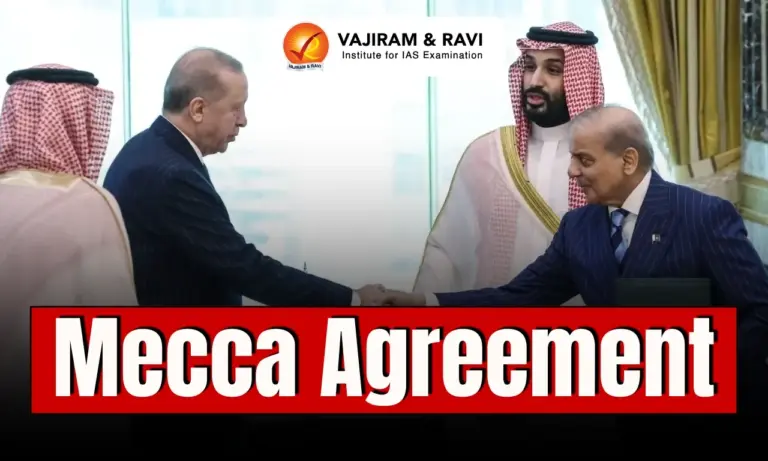
- Recently, Saudi Arabia, Turkey and Pakistan signed the Mecca (Makkah) Joint Defence Agreement in the presence of Crown Prince Mohammed bin Salman.
- The pact declares that an armed attack on any one of the three states will be treated as an attack on all three, marking a significant new trilateral security arrangement in West Asia with direct implications for India.
Background: From Bilateral Pact to Trilateral Compact
- The agreement builds on the September 2025 Saudi-Pakistan Strategic Mutual Defence Agreement (SMDA), now widened to include Turkey’s NATO-integrated military capabilities and defence-industrial base.
- Notably, as with the original Saudi-Pakistan pact, the full text of the Mecca Agreement has not been made public — only a joint press release describing its collective-deterrence intent has been issued.


What the Pact Actually Covers
- According to officials, the agreement rests on four pillars:
- a collective-deterrence clause modelled on Article 51 of the UN Charter,
- joint training and military exercises,
- intelligence-sharing mechanisms, and
- defence-industrial integration — particularly Turkish drone production feeding into Saudi capacity.
- Equally significant is what is missing: there is no integrated command headquarters, no standing joint force, no common budget, and crucially, no explicit nuclear-sharing clause.
- A reported exclusionary clause also denies protection to any member that initiates aggression or allows its territory to be used to attack another state, underlining the pact’s defensive character.
Why Now: Three Converging Pressures
- The timing reflects three factors.
- First, the widening US-Israel-Iran confrontation since late February 2026 exposed the limits of relying solely on US security guarantees, especially after Saudi Arabia reportedly depleted a large share of its Patriot missile interceptor stockpile defending against Iranian and Houthi strikes.
- Second, post-October 7 regional recalibration pushed Riyadh to diversify its security partners.
- Third, the three states bring complementary strengths:
- Saudi financial depth and geography astride the Hormuz and Bab el-Mandeb chokepoints,
- Turkish NATO-standard doctrine and drone/naval industry (Baykar’s Akinci drones, the KAAN fighter programme), and
- Pakistan’s manpower and status as the only nuclear-armed Muslim-majority state.
Not Quite a “NATO of the East”
- Comparisons with NATO’s Article 5 are analytically weak. NATO’s guarantee rests on a standing treaty organisation, integrated command, and decades of tested doctrine.
- The Mecca pact instead relies on Article 51 self-defence logic, leaves geographic scope and response triggers undefined, and gives each signatory full discretion over whether to respond at all.
- Historically, mutual defence pacts are rarely invoked militarily — Pakistan did not act when Saudi Arabia came under missile and drone attack during the SMDA’s first year, choosing mediation over military response.
Who Is It Really Aimed At?
- While the pact is framed as deterrence against Iran, its deeper subtext may be directed at Israel.
- Turkey views Israel as a greater long-term security threat than Iran, especially given clashing interests in post-Assad Syria.
- Israeli figures, including former PM Naftali Bennett, have already labelled Turkey “the new Iran” and accused it of building a “hostile Sunni axis” with nuclear-armed Pakistan.
Global Reactions
- China has responded with calculated silence, seeing benefit in a stabilised Pakistan-Gulf security architecture that protects its Belt and Road investments without cost.
- Russia is watching with pragmatic neutrality, balancing its Iran partnership against interest in reduced US centrality in the Gulf.
- India has adopted a non-committal closely following” posture.
Implications for India
- For India, the pact signals deeper strategic integration between Saudi Arabia and the Pakistan-Turkey-China axis.
- Turkey has historically been diplomatically hostile to India and has already demonstrated military cooperation with Pakistan, including during the India-Pakistan conflict of April/May 2025.
- Saudi Arabia, in contrast, has invested significantly in ties with India over the past decade despite its closeness to Pakistan.
- However, growing Saudi security dependence may now give Islamabad greater leverage in that relationship, potentially straining India’s long-term strategic partnership with Riyadh.
- Three imperatives follow for India to prevent this grouping from consolidating into a coordinated front against Indian interests:
- Insulating its bilateral relationship with Saudi Arabia (built on energy, expatriate welfare and counterterrorism cooperation) from spillover effects;
- Intensifying bilateral defence engagement with Gulf states to prevent diplomatic isolation on Kashmir-related narratives; and
- Calibrating its own extended-neighbourhood posture — Quad engagement, Indian Ocean naval presence, and defence diplomacy with Israel and moderate Arab states.
Conclusion
- The Mecca Agreement reflects eroding confidence in single-power security guarantees rather than a fully realised alliance.
- For India, the sensible course lies not in alarm but in sustained, calibrated diplomatic engagement — ensuring the pact reshapes West Asia’s security map without reshaping India’s strategic space.

 Last updated on Oct, 2026
→ UPSC 2027 Notification will be released on 13 January 2027 at upsconline.nic.in.
→ Check Nobel Prize 2026 Winners List here.
→ Download PIB PRiSM Monthly Magazine 2026 here.
→ Check UPSC Monthly Current Affairs Magazine The Recitals here.
→ Check out the latest UPSC Syllabus here.
→ Download UPSC Model Answers for Mains 2026
→ UPSC Mains Question Paper 2026 is out now for Essay & GS Paper 1, 2, 3 & 4.
→ UPSC Calendar 2027 has been released.
→ Enroll in Vajiram & Ravi’s UPSC Mains Test Series 2027 for structured answer writing practice, expert evaluation, and exam-oriented feedback.
→ Join Vajiram & Ravi’s UPSC Mentorship Program 2027 for personalized guidance, strategy planning, and one-to-one support from experienced mentors.
→ Go through the UPSC Mains Previous Year Papers to enhance your preparation.
→ UPSC has released UPSC Toppers List 2025 with the Civil Services final result on its official website.
→ Also check Best UPSC Coaching in India
Mecca Agreement FAQs
Q1. What is the Mecca Agreement?+
Q2. What does the Mecca Agreement cover?+
Q3. Why was the Mecca Agreement signed now?+
Q4. Is the Mecca Agreement similar to NATO?+
Q5. What are the implications of the Mecca Agreement for India?+
Tags: mains articles Mecca Agreement upsc current affairs upsc mains current affair