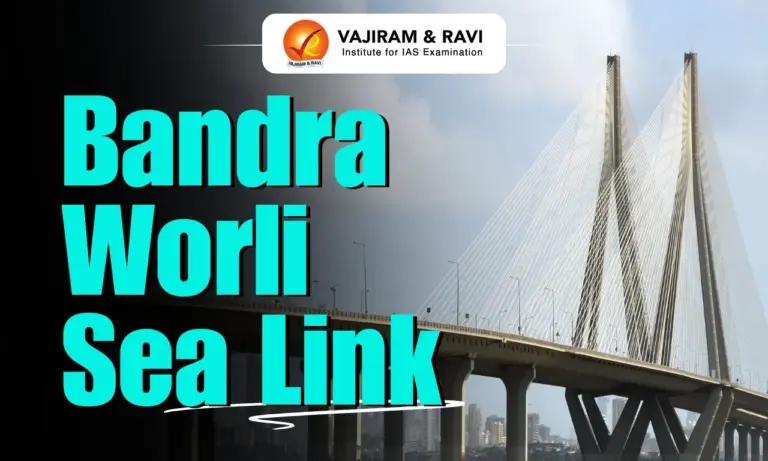
The Bandra Worli Sea Link, officially known as the Rajiv Gandhi Sea Link, is one of Mumbai’s most important transport and engineering projects. The bridge connects Bandra in Mumbai’s western suburbs with Worli in South Mumbai and provides a faster route across Mahim Bay. It has not only eased traffic congestion but has also become one of the most recognisable landmarks of Mumbai.
Bandra Worli Sea Link History Location
- The Bandra Worli Sea Link was planned as part of the proposed Western Freeway project, which was intended to improve connectivity between Mumbai’s western suburbs and the main business districts of South Mumbai.
- Before the sea link was constructed, the Mahim Causeway was the main road connection between the western suburbs and the island city.
- The project was commissioned by the Maharashtra State Road Development Corporation (MSRDC) and constructed by the Hindustan Construction Company (HCC). The idea of creating a sea link had been discussed for several decades before it finally became a reality.
- The first four lanes of the bridge were opened to the public on 30 June 2009, while all eight lanes became operational on 24 March 2010.
- Located across Mahim Bay, the bridge connects Bandra on the northern side with Worli on the southern side. It provides an additional high-speed route between the western suburbs and South Mumbai.
- Construction was challenging because of the marine environment and varying seabed conditions, requiring specialised foundation techniques.
Bandra Worli Sea Link Key Features and Architecture
- The Bandra Worli Sea Link is an eight-lane, twin-carriageway cable-stayed bridge designed for fast-moving vehicles with controlled access.
- The bridge uses a combination of pre-stressed concrete and steel technology. Its approach viaducts are made using pre-stressed concrete segments, while the main sections are supported by large cable-stayed structures.
- One of its most distinctive features is its pair of tall pylon towers, which rise approximately 126 metres above the sea. Large cables extend from these towers to support the bridge deck.
- The bridge incorporates seismic arresters, making it capable of withstanding strong seismic forces. It was among Mumbai’s early major infrastructure projects to use such technology for earthquake protection.
- The bridge was developed with modern systems for traffic monitoring, surveillance, information guidance and emergency support, giving it the features of an intelligent bridge.
- Its construction involved expertise from engineers and specialists from India, Egypt, China, Canada and Switzerland, making it an example of international cooperation in large-scale infrastructure development.


Bandra Worli Sea Link Significance
- The Bandra Worli Sea Link is more than just a transport route; it has become an iconic symbol of Mumbai’s modern infrastructure and engineering capabilities.
- The bridge demonstrates how advanced engineering techniques can be used to overcome challenges associated with marine construction, heavy traffic and difficult seabed conditions.
- Its distinctive cable-stayed design, tall pylons and long spans have given the Mumbai skyline a unique architectural landmark that is easily recognisable from different parts of the city.
- The project has helped improve connectivity between Mumbai’s western suburbs and South Mumbai, supporting the movement of people between residential areas and important commercial centres.
- The bridge has also become a major visual symbol of Mumbai, particularly because of its setting against the Arabian Sea and the city skyline. Its appearance is especially striking during sunset and at night when Mumbai’s lights illuminate the surrounding landscape.
- The project also incorporated landscaping and waterfront development around its approaches, adding to the visual appeal of the surrounding area.
- The sea link was expected to have no significant adverse impact on fisheries, marine life and the livelihood of fishermen, while environmental improvements were also expected along roads experiencing reduced traffic.
- The bridge has strengthened Mumbai’s image as a city capable of undertaking large and technically challenging infrastructure projects.
- Today, the Bandra Worli Sea Link is widely recognised as one of Mumbai’s most important transport infrastructure projects and engineering landmarks, combining improved connectivity with modern design and technology.

 Last updated on Oct, 2026
→ UPSC 2027 Notification will be released on 13 January 2027 at upsconline.nic.in.
→ Check Nobel Prize 2026 Winners List here.
→ Download PIB PRiSM Monthly Magazine 2026 here.
→ Check UPSC Monthly Current Affairs Magazine The Recitals here.
→ Check out the latest UPSC Syllabus here.
→ Download UPSC Model Answers for Mains 2026
→ UPSC Mains Question Paper 2026 is out now for Essay & GS Paper 1, 2, 3 & 4.
→ UPSC Calendar 2027 has been released.
→ Enroll in Vajiram & Ravi’s UPSC Mains Test Series 2027 for structured answer writing practice, expert evaluation, and exam-oriented feedback.
→ Join Vajiram & Ravi’s UPSC Mentorship Program 2027 for personalized guidance, strategy planning, and one-to-one support from experienced mentors.
→ Go through the UPSC Mains Previous Year Papers to enhance your preparation.
→ UPSC has released UPSC Toppers List 2025 with the Civil Services final result on its official website.
→ Also check Best UPSC Coaching in India
Bandra Worli Sea Link FAQs
Q1. What is the Bandra Worli Sea Link?+
Q2. Where is the Bandra Worli Sea Link located?+
Q3. When was the Bandra Worli Sea Link opened?+
Q4. How long is the Bandra Worli Sea Link?+
Q5. Who built the Bandra Worli Sea Link?+
Q6. What type of bridge is the Bandra Worli Sea Link?+
Tags: bandra worli sea link economy economy notes worli sea link