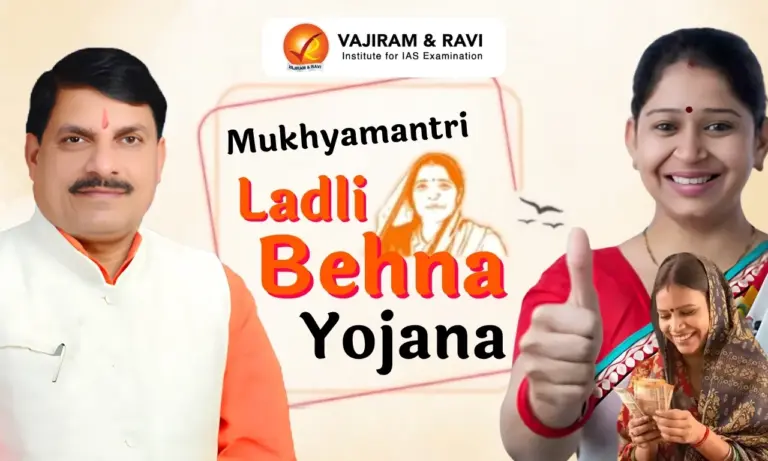
The Mukhyamantri Ladli Behna Yojana is a major women-focused welfare scheme of the Madhya Pradesh Government aimed at promoting women’s economic independence, health, nutrition and participation in family decision-making. The scheme was announced on 28 January 2023 and provides eligible women with monthly financial assistance through Direct Benefit Transfer (DBT).
Mukhyamantri Ladli Behna Yojana Latest News
- The Chief Minister of Madhya Pradesh, Mohan Yadav, is going to release the 39th instalment of the Mukhyamantri Ladli Behna Yojana. Under this instalment, eligible beneficiaries will receive the regular ₹1,500 monthly assistance along with an additional ₹250 as a Raksha Bandhan gift, taking the total amount to ₹1,750 per beneficiary.
- The total amount to be transferred by the Madhya Pradesh government under the 39th instalment is expected to be more than ₹2,148 crore, providing financial support to a large number of women beneficiaries across the state.
Mukhyamantri Ladli Behna Yojana Objectives and Benefits
The Mukhyamantri Ladli Behna Yojana focuses on improving the overall well-being and financial independence of women in Madhya Pradesh. Its key objectives and benefits are discussed below.
- Addressing the gender gap in employment: The scheme was introduced in the context of the lower female labour force participation rate compared with men. In rural areas, the labour force participation rate was stated as 23.3% for women compared with 57.7% for men, while in urban areas it was 13.6% for women compared with 55.9% for men.
- Promoting women’s economic independence: Regular financial assistance gives women greater control over financial resources and allows them to make expenditure decisions according to their own priorities and household needs.
- Improving health and nutrition: The scheme aims to support better health and nutritional outcomes for women and their dependent children by providing women with a regular source of financial assistance.
- Supporting livelihood opportunities: The financial assistance can help women develop self-employment and livelihood activities by making use of locally available resources and opportunities.
- Strengthening decision-making: By improving women’s financial independence, the scheme seeks to increase their participation in family-level decision-making and strengthen their role within the household.
- Direct financial support: Under the scheme, eligible women receive ₹1,500 per month directly into their Aadhaar-linked, Direct Benefit Transfer (DBT) enabled bank accounts.
- Support for women receiving other pensions: A woman below 60 years of age who is already receiving less than ₹1,000 per month under another Social Security Pension Scheme is provided assistance to bring the amount up to ₹1,000 per month, subject to the scheme’s eligibility conditions.


Mukhyamantri Ladli Behna Yojana Eligibility Criteria
The Mukhyamantri Ladli Behna Yojana eligibility criteria specify the basic conditions that women must fulfil to receive benefits under the scheme. The key eligibility requirements are given below.
- Madhya Pradesh resident: The applicant must be a local resident of Madhya Pradesh to be eligible for the scheme.
- Marital status: The scheme is available to married women, including widows, divorced women and abandoned women.
- Age criteria: As per the provided eligibility criteria, the applicant should have completed 23 years and be below 60 years of age as on 1 January of the year in which she applies.
- DBT-enabled bank account: The eligible woman should have an Aadhaar-linked, Direct Benefit Transfer (DBT)-enabled bank account to receive the financial assistance directly.
Exclusions under Mukhyamantri Ladli Behna Yojana
The Mukhyamantri Ladli Behna Yojana exclusions specify the circumstances in which an applicant or her family may not qualify for the scheme. The major exclusion criteria are given below.
- Annual family income: Women whose family’s self-declared annual income is more than ₹2.5 lakh are not eligible for the scheme.
- Income-tax payer in the family: A woman is excluded if any member of her family is an income-tax payer.
- Government employment: Women are excluded if any family member is working as a regular, permanent or contract employee in a Central or State Government department, undertaking, board, local body or similar government institution.
- Government pension: Families in which a member is receiving a pension after retirement are excluded from the scheme.
- Other government employment conditions: The exclusion also covers family members employed in government-linked institutions or bodies under the Government of India or Madhya Pradesh Government, as specified in the scheme criteria.
Significance of Mukhyamantri Ladli Behna Yojana
- Promotes women’s economic independence: Regular financial assistance provides women with greater financial security and independence, enabling them to spend according to their own priorities and household requirements.
- Improves health and nutrition: The financial support can contribute to better health and nutritional outcomes for women and their dependent children.
- Strengthens women’s decision-making: Greater control over financial resources can increase women’s participation in family-level decisions and strengthen their role within the household.
- Supports livelihood opportunities: The assistance can help women develop self-employment and livelihood activities by making better use of locally available resources and opportunities.
- Addresses gender-based economic inequality: By providing direct financial support to eligible women, the scheme seeks to reduce the economic gap between men and women and promote greater financial inclusion.
- Encourages financial inclusion: Direct transfer of assistance into Aadhaar-linked, DBT-enabled bank accounts strengthens women’s access to formal financial channels.
- Provides social security: Regular financial assistance can provide women, particularly those with limited independent earnings, with greater economic stability and social security.
- Strengthens women-centred welfare: The scheme takes a broader approach to women’s welfare by connecting economic assistance with health, nutrition, livelihood opportunities and decision-making, rather than focusing only on financial support.

 Last updated on Oct, 2026
→ UPSC 2027 Notification will be released on 13 January 2027 at upsconline.nic.in.
→ Check Nobel Prize 2026 Winners List here.
→ Download PIB PRiSM Monthly Magazine 2026 here.
→ Check UPSC Monthly Current Affairs Magazine The Recitals here.
→ Check out the latest UPSC Syllabus here.
→ Download UPSC Model Answers for Mains 2026
→ UPSC Mains Question Paper 2026 is out now for Essay & GS Paper 1, 2, 3 & 4.
→ UPSC Calendar 2027 has been released.
→ Enroll in Vajiram & Ravi’s UPSC Mains Test Series 2027 for structured answer writing practice, expert evaluation, and exam-oriented feedback.
→ Join Vajiram & Ravi’s UPSC Mentorship Program 2027 for personalized guidance, strategy planning, and one-to-one support from experienced mentors.
→ Go through the UPSC Mains Previous Year Papers to enhance your preparation.
→ UPSC has released UPSC Toppers List 2025 with the Civil Services final result on its official website.
→ Also check Best UPSC Coaching in India
Mukhyamantri Ladli Behna Yojana FAQs
Q1. What is Mukhyamantri Ladli Behna Yojana?+
Q2. When was Mukhyamantri Ladli Behna Yojana launched?+
Q3. How much financial assistance is given under Ladli Behna Yojana?+
Q4. Who is eligible for Mukhyamantri Ladli Behna Yojana?+
Q5. What is the age limit for Ladli Behna Yojana?+
Q6. What are the major objectives of Mukhyamantri Ladli Behna Yojana?+
Q7. Who is excluded from Mukhyamantri Ladli Behna Yojana?+
Q8. How does Ladli Behna Yojana promote women's empowerment?+
Tags: governance governance notes indian polity indian polity notes ladli behna yojana mukhyamantri ladli behna yojana