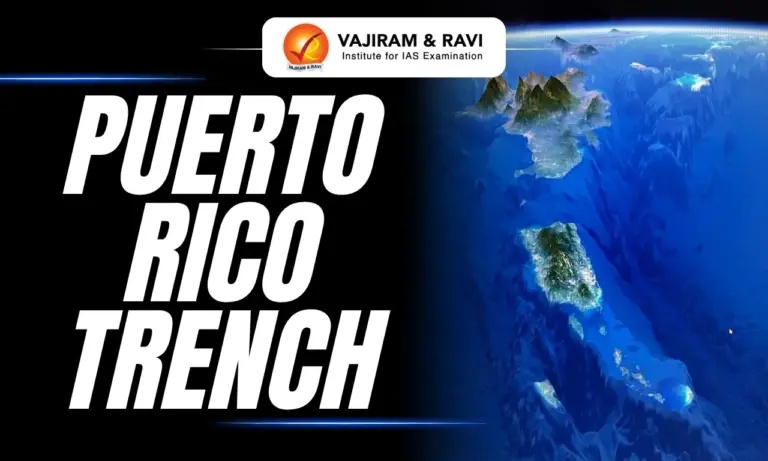
The Puerto Rico Trench is a major geological feature located in the Atlantic Ocean near the Caribbean region. It is known for its great depth and its connection with the movement of tectonic plates. The trench is an important geographical feature as it helps in understanding oceanic landforms, plate tectonics and geological activity in the region. Its location and tectonic setting also make it significant from the perspective of earthquakes, tsunamis and disaster management.
Puerto Rico Trench Location and Physical Features
- The Puerto Rico Trench is located in the North Atlantic Ocean, close to the northern coast of Puerto Rico and the Dominican Republic. It extends eastward towards the Virgin Islands and forms a major submarine depression in the region.
- The trench stretches for about 1,090 kilometres and is relatively narrow compared with its great length. Its steep sides descend sharply from the surrounding ocean floor, giving it the characteristic shape of a deep ocean trench.
- Its deepest point is known as the Milwaukee Deep, which reaches about 8,376 metres below sea level. This makes it the deepest known point in the Atlantic Ocean.
- The trench is much shallower than the Mariana Trench, the deepest point in the world’s oceans, but it remains one of the most significant deep-sea features outside the Pacific Ocean.
Puerto Rico Trench Geological Formation and Plate Tectonics
- The Puerto Rico Trench developed because of the complex tectonic interaction between the North American Plate and the Caribbean Plate. The movement of these plates has shaped the seafloor over millions of years.
- The region shows a combination of convergent and horizontal plate movements. The North American Plate moves beneath the Caribbean Plate in parts of the region, while sideways movement also occurs along major fault systems.
- These movements have created a highly complex tectonic zone around the Caribbean. The trench is connected with other important geological features, including the Muertos Trough and tectonic systems extending towards the Lesser Antilles.
- The trench has a long geological history and is believed to have remained active for tens of millions of years. Sediments have accumulated in parts of the trench over this period, providing valuable information about the region’s geological past.


Puerto Rico Trench Earthquakes and Tsunami Risk
- The Puerto Rico Trench is located in an active tectonic region, making earthquakes a major natural hazard. Continuous movement along faults and plate boundaries can generate tremors of varying intensity.
- The region also has the potential for tsunamis. Underwater earthquakes or sudden movements of the seafloor can displace large amounts of water and produce tsunami waves that may affect nearby Caribbean islands.
- The 1918 Puerto Rico earthquake is one of the most important historical examples. It generated a destructive tsunami that affected parts of Puerto Rico and demonstrated the serious hazard associated with the region’s tectonic setting.
- Because of its location near populated islands and coastal areas, understanding the trench is important for earthquake monitoring, tsunami warning systems and disaster preparedness.
Puerto Rico Trench Oceanographic and Scientific Importance
- The extreme depth of the Puerto Rico Trench makes it an important location for studying deep-sea geology, oceanography and marine ecosystems. Conditions at such depths include extremely high pressure, low temperatures and complete darkness.
- Scientists use sonar mapping, remotely operated vehicles (ROVs), submersibles and other advanced technologies to study the trench and its surrounding seafloor. These studies help researchers understand its structure and tectonic activity.
- The deep waters support specialised forms of marine life that have adapted to harsh conditions. Microorganisms and other deep-sea organisms provide valuable information about adaptation and life in extreme environments.
- The trench also has importance in understanding ocean circulation and the movement of water masses between the Caribbean region and the wider Atlantic Ocean.
Puerto Rico Trench Importance for Geography and Disaster Management
- The Puerto Rico Trench is an important example of how plate tectonics can create deep oceanic features and influence the physical geography of a region.
- Its location at an active tectonic boundary makes it significant for studying the relationship between ocean trenches, earthquakes, faults and tsunamis.
- For disaster management, research on the trench helps improve seismic monitoring, tsunami preparedness and coastal risk assessment in the Caribbean.
- Puerto Rico Trench is significant not only because it contains the deepest point of the Atlantic Ocean, but also because it provides valuable insights into plate movements, deep-sea environments and natural hazards.

 Last updated on Oct, 2026
→ UPSC 2027 Notification will be released on 13 January 2027 at upsconline.nic.in.
→ Check Nobel Prize 2026 Winners List here.
→ Download PIB PRiSM Monthly Magazine 2026 here.
→ Check UPSC Monthly Current Affairs Magazine The Recitals here.
→ Check out the latest UPSC Syllabus here.
→ Download UPSC Model Answers for Mains 2026
→ UPSC Mains Question Paper 2026 is out now for Essay & GS Paper 1, 2, 3 & 4.
→ UPSC Calendar 2027 has been released.
→ Enroll in Vajiram & Ravi’s UPSC Mains Test Series 2027 for structured answer writing practice, expert evaluation, and exam-oriented feedback.
→ Join Vajiram & Ravi’s UPSC Mentorship Program 2027 for personalized guidance, strategy planning, and one-to-one support from experienced mentors.
→ Go through the UPSC Mains Previous Year Papers to enhance your preparation.
→ UPSC has released UPSC Toppers List 2025 with the Civil Services final result on its official website.
→ Also check Best UPSC Coaching in India
Puerto Rico Trench FAQs
Q1. What is the Puerto Rico Trench?+
Q2. Where is the Puerto Rico Trench located?+
Q3. How deep is the Puerto Rico Trench?+
Q4. What is the deepest point of the Puerto Rico Trench called?+
Q5. How was the Puerto Rico Trench formed?+
Q6. Is the Puerto Rico Trench an active tectonic zone?+
Q7. Can the Puerto Rico Trench cause tsunamis?+
Q8. What is the significance of the Puerto Rico Trench?+
Q9. What is the difference between the Puerto Rico Trench and Mariana Trench?+
Tags: geography geography notes puerto rico puerto rico trench