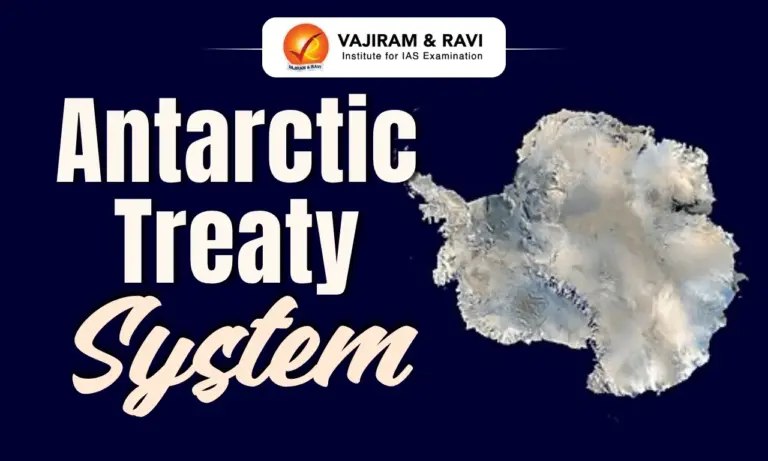
The Antarctic Treaty System is one of the most successful international governance frameworks in the world. It regulates activities in Antarctica and ensures that the continent remains dedicated to peace and scientific research. The framework began with the Antarctic Treaty 1959 and has expanded through several legally binding agreements.
In 2026, the treaty marks 65 years since it entered into force on 23 June 1961. Today, the Antarctic Treaty System continues to play a vital role amid climate change, growing geopolitical competition and increasing interest in Antarctic resources.
What is the Antarctic Treaty System?
The Antarctic Treaty System is a group of international agreements that govern Antarctica and the Southern Ocean region. Its main objective is to ensure that Antarctica is used only for peaceful purposes and scientific cooperation. The system applies to all land, islands and ice shelves south of 60° South Latitude, covering nearly 10% of the Earth’s surface. The Antarctic Treaty System has become a global model of international cooperation by preventing conflict, promoting research and protecting one of the planet’s most fragile environments.
Antarctic Treaty 1959
The Antarctic Treaty 1959 is the foundation of Antarctic governance and remains central to the Antarctic Treaty System.
- Treaty Background: The Antarctic Treaty was signed in Washington on 1 December 1959 after the successful International Geophysical Year of 1957-58, which encouraged unprecedented scientific cooperation among nations operating in Antarctica.
- Entry into Force: The treaty officially entered into force on 23 June 1961. The year 2026 marks its 65th anniversary, highlighting decades of peaceful international collaboration in Antarctica.
- Original Signatories: Twelve countries signed the treaty initially. These were Argentina, Australia, Belgium, Chile, France, Japan, New Zealand, Norway, South Africa, the Soviet Union, the United Kingdom and the United States.
- How Many Countries Signed The Antarctic Treaty?: The original treaty had 12 signatories. Over time, many countries joined the framework. The treaty now has 58 Parties, including Consultative and Non Consultative members.
- Membership Structure: Consultative Parties possess voting rights because they conduct substantial scientific research in Antarctica. Non Consultative Parties participate in meetings but do not have voting authority.
- Geographical Scope: The Antarctic Treaty covers all areas south of 60° South Latitude. This includes the Antarctic continent, surrounding islands and extensive ice shelves.
- Why Was The Antarctic Treaty Created: The treaty was created to prevent international conflict in Antarctica. It aimed to preserve the continent for peaceful activities and scientific research rather than military or territorial competition.
- Headquarter (Secretariat of the Antarctic Treaty): The Secretariat of the Antarctic Treaty is located in Buenos Aires, Argentina. It supports treaty operations and assists annual Antarctic Treaty Consultative Meetings.
- Antarctic Treaty System Flag: The Antarctic Treaty System does not have an officially recognized sovereign flag. However, the Antarctic Treaty System has an official emblem showing a white map of Antarctica on a dark blue background, often flown as a flag to represent the treaty and its Secretariat.
- Antarctic Treaty System Expiration: The Antarctic Treaty has no fixed expiration date. It continues indefinitely and remains legally binding on all parties that have joined the agreement.


Antarctic Treaty Major Provisions
The Antarctic Treaty established rules that transformed Antarctica into a zone of peace, cooperation and scientific advancement.
- Peaceful Use Only: Article I states that Antarctica shall be used exclusively for peaceful purposes. Military bases, weapons testing and military exercises are prohibited across the continent.
- Scientific Freedom: Articles II and III guarantee freedom of scientific investigation. Research findings, scientific observations and data must be exchanged and made freely available among participating countries.
- Territorial Claims Frozen: Article IV neither recognizes nor rejects territorial claims. Seven claimant countries retain their positions, but no new claims or expansions are permitted while the treaty remains active.
- Nuclear Free Region: Article V prohibits nuclear explosions and radioactive waste disposal. This provision makes Antarctica one of the world’s largest nuclear free regions.
- Inspection Mechanism: Article VII allows inspection of stations, facilities and equipment. This transparency mechanism helps ensure compliance and builds trust among treaty members.
- Open Scientific Cooperation: The Antarctic Treaty System promotes international scientific partnerships. Researchers from different nations frequently collaborate on climate, geology, biodiversity and atmospheric studies.
- Conflict Prevention: The treaty prevents Antarctica from becoming a source of international disputes. This principle remains one of the strongest reasons for its long term success.
Role of India in Antarctic Treaty System
India has emerged as an important participant in Antarctic research and governance through sustained scientific activity and policy engagement.
- Treaty Membership: India joined the Antarctic Treaty in 1983 and obtained Consultative Party status in the same year, giving it voting rights within the Antarctic Treaty System.
- Madrid Protocol Ratification: India ratified the Madrid Protocol in 1998. This strengthened its commitment to environmental protection and sustainable Antarctic governance.
- Indian Antarctic Programme: India launched its Antarctic research programme in 1981. The initiative supports scientific exploration, climate studies and long term polar observations.
- Dakshin Gangotri Station: Established in 1983, Dakshin Gangotri became India’s first Antarctic research station. It currently functions mainly as a logistics and supply base.
- Antarctic Post Office: India opened its first Antarctic post office at Dakshin Gangotri in 1984. This represented a significant milestone in India’s permanent Antarctic presence.
- Maitri Research Station: Maitri was established in 1989 in the Schirmacher Oasis. It remains operational and supports year round scientific activities across multiple disciplines.
- Lake Priyadarshini: India developed Lake Priyadarshini near Maitri. The freshwater lake supports station operations and scientific work in the region.
- Bharati Research Station: Bharati became operational in 2012 between Thala Fjord and Quilty Bay. The station is located nearly 3,000 km east of Maitri and supports continuous research.
- Maitri II Project: India plans to establish Maitri II by 2032 in East Antarctica. The proposed green research base will use solar and wind energy with advanced automated systems.
- Role of NCPOR: The National Centre for Polar and Ocean Research was established in Goa in 1998. It coordinates India’s Antarctic missions and broader polar research activities.
- Indian Antarctic Act 2022: India enacted this legislation to implement the Antarctic Treaty, Madrid Protocol and CCAMLR domestically while regulating tourism and commercial activities.
- Tourism Governance Leadership: During the 46th Antarctic Treaty Consultative Meeting in Kochi in 2024, India facilitated focused discussions on Antarctic tourism regulation.
Antarctic Treaty System International Agreements
Several agreements strengthen the Antarctic Treaty System and provide comprehensive environmental protection for the region.
- Antarctic Treaty 1959: The original treaty remains the core legal instrument. It establishes peace, scientific cooperation, nuclear restrictions and territorial claim management.
- Convention for the Conservation of Antarctic Seals (1972): This agreement regulates seal harvesting and promotes sustainable conservation of Antarctic seal populations and habitats.
- Convention on the Conservation of Antarctic Marine Living Resources (CCAMLR) 1980: CCAMLR protects marine ecosystems, especially krill populations, through an ecosystem based conservation approach.
- Madrid Protocol 1991: The Protocol on Environmental Protection designates Antarctica as a natural reserve devoted to peace and science and prohibits commercial mineral extraction activities.
- Environmental Protection Framework: The protocol established strict environmental impact assessment procedures, waste management standards and biodiversity protection measures across Antarctica.
- Relationship with Global Agreements: Antarctic governance complements broader international environmental frameworks such as the Montreal Protocol, Kyoto Protocol and UNCLOS in supporting environmental sustainability and responsible resource management.
- Adaptive Governance: The Antarctic Treaty System has evolved through additional agreements and protocols. This flexibility has enabled it to address emerging environmental, scientific and geopolitical challenges effectively.

 Last updated on Oct, 2026
→ UPSC 2027 Notification will be released on 13 January 2027 at upsconline.nic.in.
→ Check Nobel Prize 2026 Winners List here.
→ Download PIB PRiSM Monthly Magazine 2026 here.
→ Check UPSC Monthly Current Affairs Magazine The Recitals here.
→ Check out the latest UPSC Syllabus here.
→ Download UPSC Model Answers for Mains 2026
→ UPSC Mains Question Paper 2026 is out now for Essay & GS Paper 1, 2, 3 & 4.
→ UPSC Calendar 2027 has been released.
→ Enroll in Vajiram & Ravi’s UPSC Mains Test Series 2027 for structured answer writing practice, expert evaluation, and exam-oriented feedback.
→ Join Vajiram & Ravi’s UPSC Mentorship Program 2027 for personalized guidance, strategy planning, and one-to-one support from experienced mentors.
→ Go through the UPSC Mains Previous Year Papers to enhance your preparation.
→ UPSC has released UPSC Toppers List 2025 with the Civil Services final result on its official website.
→ Also check Best UPSC Coaching in India
Antarctic Treaty System FAQs
Q1. What is the Antarctic Treaty System?+
Q2. When was the Antarctic Treaty signed?+
Q3. How many countries are Parties to the Antarctic Treaty?+
Q4. Why was the Antarctic Treaty created?+
Q5. What does the Antarctic Treaty prohibit?+
Tags: antarctic treaty antarctic treaty system