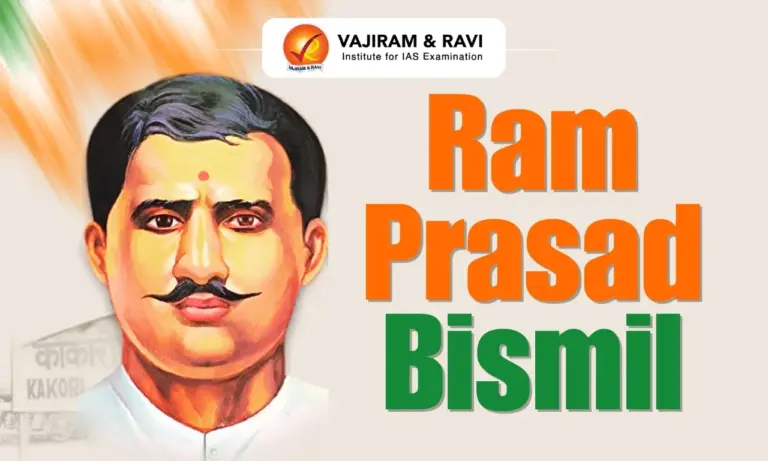
Ram Prasad Bismil (11 June 1897-19 December 1927) was an Indian revolutionary, poet, writer and translator who opposed British rule. He became associated with the Arya Samaj and revolutionary nationalism. He participated in the Mainpuri Conspiracy of 1918 and the Kakori Train Action of 1925. His writings, revolutionary activities and commitment to Hindu-Muslim unity made him a significant figure in India’s freedom struggle.
Ram Prasad Bismil Biography
Ram Prasad Bismil’s early life in Shahjahanpur shaped his literary talent, nationalist ideas and commitment to revolutionary action against British colonial rule.
- Birth and Family: Ram Prasad Bismil was born on 11 June 1897 in Shahjahanpur district of present day Uttar Pradesh to Murlidhar and Moolmati Devi.
- Education: He learned Hindi from his father and Urdu from a local maulvi. He later studied in an English medium school despite his father’s initial disapproval.
- Arya Samaj Association: Bismil joined the Arya Samaj in Shahjahanpur. The organisation was founded by Swami Dayananda Saraswati in 1875 and strongly influenced his ideas and discipline.
- Early Revolutionary Inspiration: At the age of 18, he read about the death sentence awarded to Bhai Parmanand. The incident deeply affected him and strengthened his opposition to British rule.
- First Revolutionary Poem: Bismil expressed his anguish through the Hindi poem “Mera Janm”. His early writings reflected his growing commitment to India’s freedom.
- Pen Names: He wrote in Hindi and Urdu under the names Bismil, Ram and Agyat. The word Bismil means wounded or restless and became his most recognised pen name.
Ram Prasad Bismil Contributions and Activities
Ram Prasad Bismil believed that organised revolutionary action was necessary for independence and worked to build networks, organisations and resources for resistance.
- Matrivedi Organisation: Bismil founded Matrivedi and worked with Genda Lal Dixit to organise young people for armed resistance against British rule.
- Mainpuri Conspiracy: In 1918, Bismil participated in the Mainpuri Conspiracy. He distributed prohibited nationalist literature and worked to collect funds for revolutionary activities.
- Nationalist Publications: On 28 January 1918, he circulated Deshvasiyon ke Naam Sandesh and Mainpuri ki Pratigya. These writings communicated revolutionary ideas and nationalist messages to the public.
- Underground Activities: During 1919-1920, Bismil remained underground in different parts of Uttar Pradesh. He continued writing, publishing and supporting revolutionary activities during this period.
- Ahmedabad Congress: In 1921, Bismil attended the Ahmedabad session of the Indian National Congress. He supported the demand for Poorna Swaraj and worked with younger nationalists.
- Hindustan Republican Association: Bismil helped establish the Hindustan Republican Association with Sachindra Nath Sanyal and Jadugopal Mukherjee. The organisation sought an armed revolution and a federal Republic of United States of India.
- HRA Manifesto: Bismil played an important role in preparing the organisation’s constitutional framework. The HRA manifesto, The Revolutionary, was circulated on 1 January 1925.
- Kakori Train Action: On 9 August 1925, Bismil and fellow revolutionaries stopped the Saharanpur-Lucknow passenger train at Kakori. They targeted government treasury funds to finance revolutionary activities.
- Kakori Conspiracy Case: More than 40 revolutionaries were arrested following the Kakori action, although only 10 had participated directly. The legal proceedings continued for about 18 months.
- Hindu-Muslim Unity: Bismil’s friendship with Ashfaqulla Khan represented communal harmony within the revolutionary movement. His final writings also emphasised Hindu-Muslim unity for national service.


Ram Prasad Bismil Literary Contributions
Ram Prasad Bismil used Hindi and Urdu literature as a means of spreading nationalism, revolutionary ideas, equality and human dignity.
- Mera Janm: Bismil composed Mera Janm after learning about Bhai Parmanand’s death sentence. The poem expressed his early anger against British colonial control.
- Mainpuri ki Pratigya: Mainpuri ki Pratigya became an important nationalist composition associated with his revolutionary activities. It expressed his determination to resist British rule.
- Deshvasiyon ke Naam Sandesh: He wrote and circulated Deshvasiyon ke Naam Sandesh in 1918. The pamphlet communicated revolutionary ideas directly to Indian countrymen.
- Man Ki Lahar: Man Ki Lahar was a collection of poems written by Bismil and others. It reflected patriotic emotions and his literary engagement with nationalism.
- Swadeshi Rang: Swadeshi Rang was among the literary works associated with Bismil. His writings used patriotic themes to encourage resistance and national consciousness.
- Bolshevikon Ki Kartoot: Bismil translated Bolshevikon Ki Kartoot from Bengali. He also translated Yogik Sadhan and produced literary material through the Sushil Mala publication series.
- Swadhinta Ki Devi: Catherine or Swadhinta Ki Devi was adapted into Hindi from an English text. Bismil used translation and adaptation to expand access to nationalist literature.
- Sarfaroshi Ki Tamanna: Sarfaroshi Ki Tamanna was originally written by Bismil Azimabadi and not Ram Prasad Bismil who popularized it. It became strongly associated with the revolutionary movement and was widely recited as a patriotic war cry.
- Mera Rang De Basanti Chola: Mera Rang De Basanti Chola is popularly associated with the revolutionary tradition surrounding Bismil. It became part of the wider patriotic memory of India’s freedom struggle.
- Autobiography: Bismil wrote his autobiography while imprisoned in Gorakhpur Jail. It was later published under the cover title Kakori ke Shaheed in 1928.
Ram Prasad Bismil Death
Ram Prasad Bismil was executed following the Kakori Conspiracy trial, becoming one of the most remembered martyrs of the revolutionary movement.
- Execution Date: Ram Prasad Bismil was hanged on 19 December 1927 at Gorakhpur Jail. He was 30 years old at the time of his execution.
- Kakori Sentences: Bismil, Ashfaqulla Khan, Rajendra Nath Lahiri and Thakur Roshan Singh were sentenced to death for their revolutionary activities connected with the Kakori case.
- Other Executions: Rajendra Nath Lahiri was hanged two days earlier at Gonda Jail. Ashfaqulla Khan and Thakur Roshan Singh were executed on 19 December 1927 at Faizabad and Naini Allahabad respectively.
- Final Resting Place: Bismil’s body was taken to the banks of the Rapti River for Hindu cremation. The site later became known as Raj Ghat.
Ram Prasad Bismil Recognition and Honours
Ram Prasad Bismil continues to be remembered through memorials, public institutions, railway infrastructure, postage stamps and commemorations across India.
- Birthplace Memorial: The Shaheed Smarak Samiti of Shahjahanpur established the Amar Shaheed Ram Prasad Bismil Smarak at Khirni Bagh. A white marble statue was inaugurated by Governor Motilal Vora on 18 December 1994.
- Railway Station: The Northern Railway zone named a railway station near Shahjahanpur as Pt Ram Prasad Bismil railway station. It is located about 11 kilometres from Shahjahanpur.
- Kakori Memorial: A memorial dedicated to the Kakori conspirators was established at Kakori. Prime Minister Indira Gandhi inaugurated it on 19 December 1983.
- Commemorative Stamp: The Government of India issued a multicoloured commemorative postal stamp featuring Ram Prasad Bismil on 19 December 1997 during his birth centenary year.
- Ram Prasad Bismil Udyan: The Government of Uttar Pradesh named a park near Rampur Jagir village as Amar Shaheed Pt. Ram Prasad Bismil Udyan. Bismil had lived underground in this area after the Mainpuri Conspiracy.
- Historical Legacy: Ram Prasad Bismil remains associated with revolutionary nationalism, patriotic literature, the HRA, the Mainpuri Conspiracy and the Kakori Train Action of 1925.

 Last updated on Oct, 2026
→ UPSC 2027 Notification will be released on 13 January 2027 at upsconline.nic.in.
→ Check Nobel Prize 2026 Winners List here.
→ Download PIB PRiSM Monthly Magazine 2026 here.
→ Check UPSC Monthly Current Affairs Magazine The Recitals here.
→ Check out the latest UPSC Syllabus here.
→ Download UPSC Model Answers for Mains 2026
→ UPSC Mains Question Paper 2026 is out now for Essay & GS Paper 1, 2, 3 & 4.
→ UPSC Calendar 2027 has been released.
→ Enroll in Vajiram & Ravi’s UPSC Mains Test Series 2027 for structured answer writing practice, expert evaluation, and exam-oriented feedback.
→ Join Vajiram & Ravi’s UPSC Mentorship Program 2027 for personalized guidance, strategy planning, and one-to-one support from experienced mentors.
→ Go through the UPSC Mains Previous Year Papers to enhance your preparation.
→ UPSC has released UPSC Toppers List 2025 with the Civil Services final result on its official website.
→ Also check Best UPSC Coaching in India
Ram Prasad Bismil FAQs
Q1. Who was Ram Prasad Bismil?+
Q2. When was Ram Prasad Bismil born?+
Q3. What was Ram Prasad Bismil’s role in the Kakori Train Action?+
Q4. When and where was Ram Prasad Bismil executed?+
Q5. Which poems and literary works are associated with Ram Prasad Bismil?+
Q6. Was Sarfaroshi Ki Tamanna written by Ram Prasad Bismil?+
Tags: ram prasad ram prasad bismil