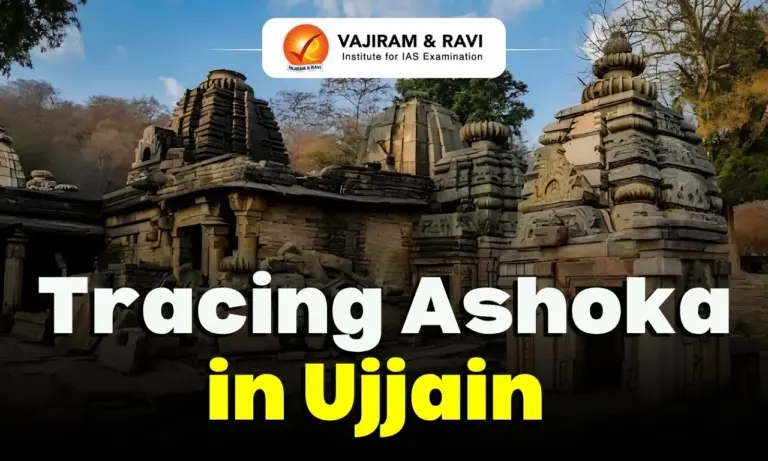
Tracing Ashoka in Ujjain Latest News
- The Madhya Pradesh government has begun restoring Buddhist monuments linked to the Mauryan emperor Ashoka, starting with a fresh excavation at Vaishya Tekri in Ujjain.
- The initiative has renewed scholarly interest in Ashoka’s connection to the city and raised questions about how much the site can actually confirm historically.
The Vaishya Tekri Stupa: Scale and Earlier Findings
- According to academic Peter Skilling’s 2011 paper, Vaishya Tekri — the largest stupa at the site — measures about 350 feet at its base and 100 feet high, notably larger than the 54-foot stupa at Sanchi.
- Nearby stands a smaller structure called Kumbhar (or Kumhar) Tekri; both remain relatively undisturbed, save for a power line and pylon running through the area.
- Initial excavations by the Department of Archaeology of the erstwhile Gwalior State in 1938-39 uncovered large bricks and punch-marked coins, leading archaeologists to date the structures to the Mauryan period.
- However, historians have urged caution, noting that this excavation report is decades old and its interpretation was shaped by earlier accounts — particularly Alexander Cunningham’s writings on Ashoka.
- They argue that further investigation beyond the 1938-39 findings is needed before drawing firm conclusions.


Ashoka’s Years in Ujjain
- Ujjayini (modern Ujjain), located on the Sipra river (a tributary of the Chambal), was the capital of the Avanti kingdom and a major commercial centre.
- Historian Romila Thapar notes that Ujjain linked trade routes to western coastal ports like Broach and Sopara, as well as to Pataliputra — Ptolemy referred to it as “Ozene.”
- Ashoka was sent to Avanti as viceroy by his father, Emperor Bindusara. Unlike his brief posting in Taxila, he is believed to have spent nearly a decade in Avanti, headquartered at Ujjain — reportedly in recognition of his earlier work at Taxila.
- Historians call Ujjain the “Greenwich of India,” since Hindu astronomers calculated the prime meridian of longitude from the city.
- They suggest Ashoka arrived around 282 BCE, roughly a decade before Bindusara’s death, by which time Ujjain was already an urban centre with 300 years of history along the Sipra.
- Mud fortifications first appeared around Ujjain in the 7th century BCE, and by the 6th century BCE, Avanti had emerged as a powerful independent kingdom.
Where Ashoka Met Devi
- En route to Ujjain, Ashoka stopped at Vidisha, where he met and married Vedisadevi (Devi), daughter of a local merchant — though Thapar notes historical records do not confirm a legal marriage. The couple had two children: Mahinda and Samghamitta.
- Evidence for Ashoka’s Ujjain posting includes his own edicts, issued later as emperor, which mention a prince (kumara) stationed at Ujjain.
- Experts also note that Vidisha, where Ashoka met Devi, lies directly on the route from Pataliputra to Ujjain.
- However, scholars disagree on physical evidence: while Skilling considers it plausible that Ashoka erected pillars or edicts at such an important site, they point out that no Ashokan pillars have been found in Ujjain, particularly near the stupas, and that the excavations reveal little about Ujjain’s political structure during Ashoka’s time.
The Stupa and the ‘Hell’
- Local traditions in Sri Lanka associate Vaishya Tekri with Devi — its name reportedly deriving from her merchant (Vaishya) family background.
- In contrast, Kumhar Tekri carries a starkly different association: Chinese scholar-pilgrim Xuanzang, who visited Ujjain in the 7th century, recorded a stupa marking the site where “King Ashoka made a hellish prison.”
- Thapar notes that earlier excavations at Kumhar Tekri revealed a burial-cum-cremation ground dating to the 3rd century BCE, corroborating Xuanzang’s account.
- About a decade into his Ujjain viceroyalty, Ashoka returned to Pataliputra after Bindusara fell critically ill — setting the stage for his subsequent, and violent, struggle for the Mauryan throne.
The Fresh Excavation: Promise and Caution
- Scholars have welcomed the government’s renewed funding for excavation, noting archaeology typically receives limited financial support.
- However, they caution that the focus should extend beyond the stupa structure itself to the broader cultural landscape — drawing a parallel with Sanchi, where the ashes of Buddhist teachers were found buried in cemeteries surrounding the stupas.
- They suggest the excavation should aim to understand how the site evolved over time, including other structures and the monks associated with it, rather than treating the stupa as an isolated monument.
- Concerns have also been raised about encroaching urbanisation, with the once-rural site now bordered by an expanding industrial zone around Ujjain.
Conclusion
- The Vaishya Tekri excavation offers a valuable opportunity to deepen understanding of Ashoka’s decade-long Ujjain viceroyalty and early Buddhist history in Malwa.
- Yet, as historians caution, the site’s grand scale and evocative local traditions must be weighed against the limits of decades-old evidence — making a broader, landscape-level investigation essential for the fresh dig to yield historically reliable conclusions rather than reinforce old assumptions.
Source: IE

 Last updated on August, 2026
→ UPSC Mains 2026 commenced on 21st August 2026 and will continue through 30th August 2026, as per the official examination schedule.
→ UPSC Mains Question Paper 2026 is out now for Essay & GS Paper 1, 2, 3 & 4.
→ UPSC Mains GS Paper 1 2026 is out now.
→ UPSC Mains GS Paper 2 2026 is out now.
→ UPSC Mains GS Paper 3 2026 is out now.
→ UPSC Mains GS Paper 4 2026 is out now.
→ Check out the latest UPSC Syllabus 2026 here.
→ UPSC Mains Admit Card 2026 is now out.
→ Enroll in Vajiram & Ravi’s UPSC Mains Test Series 2027 for structured answer writing practice, expert evaluation, and exam-oriented feedback.
→ Join Vajiram & Ravi’s UPSC Mentorship Program 2027 for personalized guidance, strategy planning, and one-to-one support from experienced mentors.
→ Go through the UPSC Mains Previous Year Papers to enhance your preparation.
→ Download UPSC Mains Essay Paper 2025, UPSC Mains GS Paper-I 2025, UPSC Mains GS Paper-II 2025, UPSC Mains GS Paper-III 2025, UPSC Mains GS Paper-IV 2025, UPSC Mains English (Compulsory) Paper 2025, UPSC Mains Hindi (Qualifying) Paper 2025 here.
→ UPSC has released UPSC Toppers List 2025 with the Civil Services final result on its official website.
→ UPSC Calendar 2027 has been released.
→ Also check Best UPSC Coaching in India
Tracing Ashoka in Ujjain FAQs
Q1. What does Tracing Ashoka in Ujjain reveal about Vaishya Tekri?+
Q2. Why is Ujjain important while Tracing Ashoka in Ujjain?+
Q3. What is Devi's connection with Tracing Ashoka in Ujjain?+
Q4. What archaeological limits affect Tracing Ashoka in Ujjain?+
Q5. Why is the fresh excavation important for Tracing Ashoka in Ujjain?+
Tags: mains articles Tracing Ashoka in Ujjain upsc current affairs upsc mains current affairs