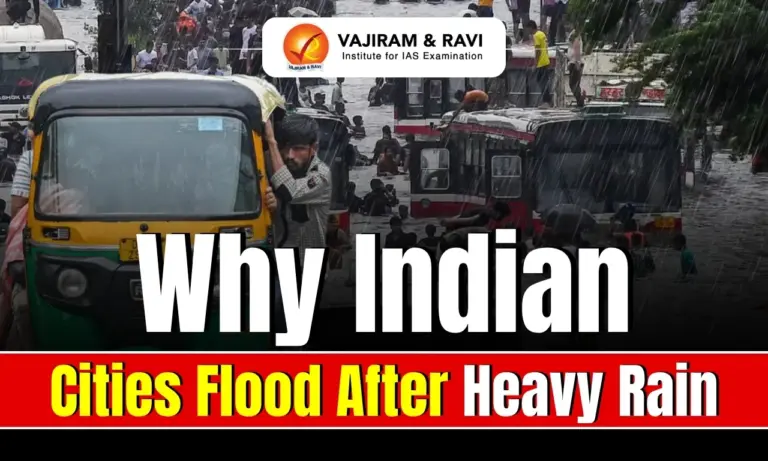
Indian cities such as Gurugram, Bengaluru and Delhi frequently face severe waterlogging after heavy rain. While intense rainfall can overwhelm urban systems, recurring flooding is also linked to concretisation, inadequate drainage, encroachment of natural water bodies and unplanned urban expansion.
Why Do Indian Cities Flood After Heavy Rain? – Key Reasons
Indian cities flood when intense rainfall exceeds the capacity of urban land and drainage systems to absorb, store and carry excess water.
- Rapid concretisation: Roads, buildings and parking areas create impervious surfaces that reduce rainwater absorption and increase surface runoff.
- For Example: In Bengaluru, IISc research found that built-up land increased from around 8% in 1973 to nearly 74% in 2013, while vegetation declined from 68% to less than 15%.
- Loss of natural drainage: Encroachment of lakes, wetlands, floodplains and natural drainage channels removes spaces that naturally store and carry excess water, increasing the risk of urban waterlogging.
- Inadequate drainage systems: Storm-water drains are often undersized, poorly maintained or blocked by silt, waste and construction debris.
- Unplanned urban expansion: Construction in low-lying areas, floodplains and natural drainage paths obstructs the movement of stormwater and increases the exposure of people and infrastructure to flooding.
- Increasing rainfall extremes: Climate change is increasing the risk of short-duration, high-intensity rainfall, which can overwhelm drainage systems designed for older rainfall patterns.
- Loss of urban vegetation: Declining green cover reduces rainwater infiltration and increases surface runoff. It also contributes to the urban heat island effect, with the World Bank estimating that temperatures in Indian city centres can be 3-4°C higher than in surrounding areas.
India’s urban population is projected to reach around 951 million by 2050, increasing pressure on land, drainage and basic infrastructure. Since more than half of the infrastructure Indian cities will need by 2050 is yet to be built, poor planning could make urban flooding more frequent and severe in the future.
Why Does the Same Flooding Problem Keep Recurring?
Repeated flooding of the same roads and neighbourhoods shows that the underlying vulnerability is not being adequately addressed.
- Planning deficit: A 2021 NITI Aayog report found that around 65% of India’s 7,933 urban settlements had no master plan, reflecting a major planning gap.
- Shortage of urban planners: State planning departments had fewer than 4,000 sanctioned town-planner posts against an estimated requirement of around 12,000, with many positions vacant.
- Weak protection of natural systems: Even where master plans exist, floodplains, lakes, drainage channels and open spaces may not be adequately protected through zoning and building regulations.
- Fragmented governance: Municipal corporations, district administrations and State departments often share responsibility for drainage, roads, water, land use and emergency response, making coordination and accountability difficult.
- Planning-implementation gap: Climate and flood action plans have limited impact if road projects, building approvals and land-use changes continue without considering identified risks.
Urban flooding is therefore not merely a drainage problem; it reflects wider weaknesses in land-use planning, institutional capacity and urban governance.


What Are the Costs of Urban Flooding?
The damage from urban flooding extends well beyond visible losses to roads and buildings.
- Livelihood disruption: Informal workers can lose wages when transport, markets and workplaces become inaccessible.
- Economic disruption: Flooding affects businesses, supply chains, mobility and essential urban services.
- Health risks: Waterlogging and contaminated floodwater can increase health risks, particularly for vulnerable populations.
- Repeated infrastructure damage: Roads, drainage systems and public assets require repeated repairs when underlying vulnerabilities remain unaddressed.
- Large avoidable losses: The World Bank estimates that timely adaptation could prevent annual urban flood losses of around $5 billion by 2030 and $30 billion by 2070.
What Has the Government Done?
India has gradually strengthened its institutional and financial framework for managing urban disasters, but implementation remains a major challenge.
- The Disaster Management Act, 2005 established disaster management authorities at the national, State and district levels, providing the basic institutional framework for disaster preparedness and response.
- The Disaster Management (Amendment) Act, 2025 introduced Section 41A, enabling State governments to constitute Urban Disaster Management Authorities (UDMAs) in every State capital and city having a municipal corporation, except Delhi and Chandigarh.
- These authorities are responsible for preparing and implementing urban disaster management plans, bringing disaster-risk reduction into city-level planning.
- The 2025 amendment also provides for a national disaster database containing risk assessments, mitigation plans and real-time disaster-related information.
- Disaster Financing: In August 2026, heatwaves and lightning were included in the list of natural calamities eligible for disaster-related financial assistance during the 2026-31 Finance Commission period. This enables States to use disaster funds for eligible relief and mitigation measures.
However, these measures have not yet translated into uniform implementation. In February 2026, the Home Ministry informed Parliament that Karnataka was the only State to have reported establishing an Urban Disaster Management Authority, for Bengaluru. This highlights the continuing gap between institutional provisions and implementation on the ground.
What Should Be Done?
Urban disaster management must shift from responding to floods after they occur to reducing vulnerability before the rain arrives.
- Make risk maps part of statutory planning: Flood maps should guide construction restrictions, drainage capacity and building plinth levels, while heat maps should inform shade, tree cover, ventilation and building materials.
- Protect natural water systems: Lakes, wetlands, floodplains, drainage channels and open spaces should be mapped and protected through enforceable zoning and building regulations.
- Integrate climate risk into development decisions: Flood and heat risks should influence building approvals, road projects, zoning and land-use changes.
- Strengthen urban planning capacity: Municipalities and Urban Disaster Management Authorities need qualified planners, engineers, geospatial experts and climate-risk specialists.
- Improve institutional coordination: Urban disaster authorities should have adequate budgets and powers to coordinate municipal engineering, water, health, transport and emergency services.
- Link finance with resilience: Municipal grants and infrastructure spending should be linked to compliance with flood, heat and land-use plans.
- Connect early warnings with action: Weather warnings should trigger pre-agreed measures such as hospital preparedness, school closures, traffic diversions and changes in outdoor working hours.

 Last updated on Oct, 2026
→ UPSC 2027 Notification will be released on 13 January 2027 at upsconline.nic.in.
→ Check Nobel Prize 2026 Winners List here.
→ Download PIB PRiSM Monthly Magazine 2026 here.
→ Check UPSC Monthly Current Affairs Magazine The Recitals here.
→ Check out the latest UPSC Syllabus here.
→ Download UPSC Model Answers for Mains 2026
→ UPSC Mains Question Paper 2026 is out now for Essay & GS Paper 1, 2, 3 & 4.
→ UPSC Calendar 2027 has been released.
→ Enroll in Vajiram & Ravi’s UPSC Mains Test Series 2027 for structured answer writing practice, expert evaluation, and exam-oriented feedback.
→ Join Vajiram & Ravi’s UPSC Mentorship Program 2027 for personalized guidance, strategy planning, and one-to-one support from experienced mentors.
→ Go through the UPSC Mains Previous Year Papers to enhance your preparation.
→ UPSC has released UPSC Toppers List 2025 with the Civil Services final result on its official website.
→ Also check Best UPSC Coaching in India
Why Do Indian Cities Flood After Heavy Rain FAQs
Q1. Why do Indian cities flood after heavy rain?+
Q2. Why does the same area flood repeatedly?+
Q3. How does rapid urbanisation increase urban flooding?+
Q4. What has the government done to address urban flooding?+
Q5. How can Indian cities reduce flooding?+
Tags: why do indian cities flood after heavy rain