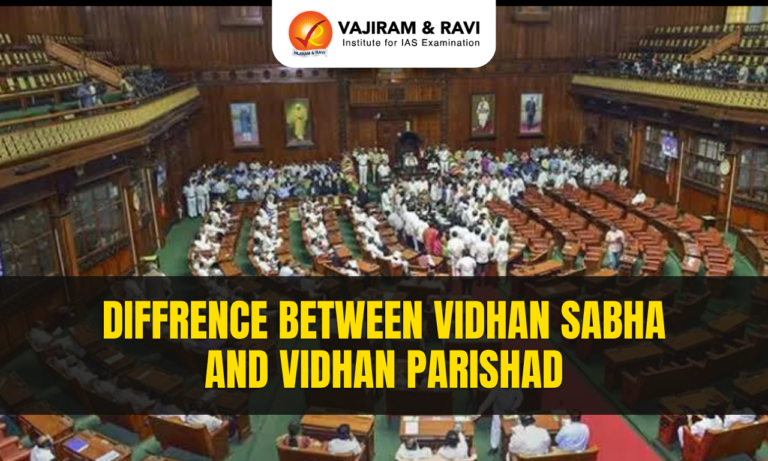
The Vidhan Sabha and Vidhan Parishad are the two Houses of the State Legislature in India. The Vidhan Sabha is known as the Legislative Assembly, while the Vidhan Parishad is called the Legislative Council. A state may have either a unicameral legislature, with only the Vidhan Sabha, or a bicameral legislature, with both the Vidhan Sabha and Vidhan Parishad.
The major difference between Vidhan Sabha and Vidhan Parishad lies in their composition, method of election, tenure, powers and role in the legislative process. These differences has been discussed below in this article.
What is Vidhan Sabha?
Vidhan Sabha, or Legislative Assembly, is the lower House of the State Legislature. It consists of representatives directly elected by the people of the state from different territorial constituencies.
The Vidhan Sabha is the most important representative institution at the state level because it directly reflects the popular mandate. The state government is also accountable to the Vidhan Sabha.
The Constitution provides for the composition and functioning of Legislative Assemblies under various provisions, particularly Articles 168 and 170.
What is Vidhan Parishad?
Vidhan Parishad, or Legislative Council, is the upper House of the State Legislature. Unlike the Vidhan Sabha, it is a permanent House and cannot be dissolved.
The Legislative Council is not present in every state. It exists only in states that have adopted a bicameral legislature.
The Constitution deals with the composition of the Legislative Council mainly under Article 171.
The Vidhan Parishad is intended to provide a second chamber for legislative review and discussion. Its composition is also different from the Vidhan Sabha because its members represent different groups such as local authorities, graduates and teachers, along with nominated members.


Difference Between Vidhan Sabha and Vidhan Parishad
The Vidhan Sabha is the directly elected and more powerful lower House of the State Legislature, while the Vidhan Parishad is the permanent upper House with mainly indirect representation and a revising role.
| Difference Between Vidhan Sabha and Vidhan Parishad | ||
|
Basis of Difference |
Vidhan Sabha |
Vidhan Parishad |
|
Meaning |
Vidhan Sabha means the Legislative Assembly of a state. |
Vidhan Parishad means the Legislative Council of a state. |
|
Position |
It is the lower House of the State Legislature. |
It is the upper House of the State Legislature. |
|
Constitutional Provision |
The Constitution provides for the Legislative Assembly under Article 168 and deals with its composition under Article 170. |
The Constitution provides for the Legislative Council under Article 168 and deals with its composition under Article 171. |
|
Type of Legislature |
It forms part of a unicameral or bicameral State Legislature. |
It exists only in states having a bicameral legislature. |
|
Direct Representation |
Members are directly elected by the people of the state. |
Members are mostly indirectly elected, with some members nominated by the Governor. |
|
Method of Election |
Members are elected from territorial constituencies through direct elections. |
Members are elected by local authorities, graduates, teachers and MLAs, while some are nominated by the Governor. |
|
Nature of House |
It is a temporary House because it can be dissolved. |
It is a permanent House because it cannot be dissolved. |
|
Term of House |
Normally 5 years. |
The House has no fixed term because it is permanent. |
|
Retirement System |
There is no system of periodic retirement. |
One-third of members retire every two years. |
|
Dissolution |
The Vidhan Sabha can be dissolved before the completion of five years. |
The Vidhan Parishad cannot be dissolved. |
|
Minimum Age |
A person must be at least 25 years old to become a member. |
A person must be at least 30 years old to become a member. |
|
Maximum Membership |
Generally, the Legislative Assembly can have 60 to 500 members, subject to constitutional exceptions for certain smaller states. |
The Legislative Council cannot have more than one-third of the total membership of the Legislative Assembly and generally cannot have fewer than 40 members. |
|
Composition |
Members are directly elected from territorial constituencies. |
About one-third are elected by local authorities, one-third by MLAs, one-twelfth by graduates, one-twelfth by teachers, and one-sixth are nominated by the Governor. |
|
Presiding Officer |
The Speaker presides over the House. |
The Chairman presides over the House. |
|
Deputy Presiding Officer |
The House has a Deputy Speaker. |
The House has a Deputy Chairman. |
|
A Money Bill can be introduced only in the Vidhan Sabha. |
A Money Bill cannot be introduced in the Vidhan Parishad. |
|
|
Role in Money Bill |
It has the final authority over the Money Bill at the state level. |
It can only make recommendations on a Money Bill. |
|
Time Limit for Money Bill |
It is not required to wait for the Council’s approval to finally proceed with the Bill. |
It must return the Money Bill with its recommendations within 14 days. |
|
Acceptance of Recommendations |
The Vidhan Sabha may accept or reject the recommendations of the Vidhan Parishad. |
Its recommendations on a Money Bill are not binding on the Vidhan Sabha. |
|
Ordinary Bills |
Has greater authority in passing ordinary legislation. |
Can examine and suggest changes to ordinary Bills. |
|
Power to Delay Ordinary Bill |
Can ultimately pass the Bill even if the Council does not agree. |
Can delay an ordinary Bill, but cannot permanently veto it. |
|
Joint Sitting |
There is no provision for a joint sitting of the two Houses of a State Legislature to resolve legislative deadlocks. |
Same constitutional position; there is no state-level joint sitting mechanism like that available for Parliament. |
|
Control Over Executive |
The Council of Ministers is collectively responsible to the Vidhan Sabha. |
The Council of Ministers is not collectively responsible to the Vidhan Parishad. |
|
Can pass a no-confidence motion against the Council of Ministers. |
Cannot remove the government through a no-confidence motion. |
|
|
Financial Control |
Exercises major control over state finances, taxation and expenditure. |
Has a comparatively limited role in financial matters. |
|
State Budget |
Plays the primary role in considering and approving the state budget. |
Can discuss financial matters but does not enjoy the same financial authority as the Vidhan Sabha. |
|
Electoral Role |
Elected members participate in the election of the President of India. |
Members of the Legislative Council do not participate in the Presidential election. |
|
Representation of Society |
Mainly represents people through territorial constituencies. |
Provides representation to local authorities, teachers, graduates, MLAs and distinguished persons. |
|
Role in Law-Making |
Acts as the principal law-making chamber at the state level. |
Acts mainly as a revising and deliberative chamber. |
|
Parliamentary Privileges |
Members enjoy constitutional and legislative privileges necessary for their functions. |
Members also enjoy parliamentary privileges. |
|
Creation |
Every state with a State Legislature has a Legislative Assembly. |
A Legislative Council can be created in a state under Article 169. |
|
Abolition |
The Legislative Assembly cannot be abolished as a separate House while a State Legislature exists. |
The Legislative Council can be abolished under Article 169. |
|
Role of State Assembly in Creation/Abolition |
The State Assembly must pass the required resolution for creation or abolition of a Legislative Council. |
Its own existence can therefore depend on a constitutional process involving the State Assembly and Parliament. |
|
Required Resolution for Council |
The Assembly must pass the resolution by a majority of total membership and two-thirds of members present and voting. |
This process is used for the creation or abolition of the Legislative Council. |
|
Governor’s Role in Membership |
The Governor does not normally nominate members to the Vidhan Sabha. |
The Governor nominates one-sixth of the members from persons with special knowledge or practical experience in specified fields. |
|
Political Accountability |
Provides the primary forum for holding the elected government accountable. |
Provides additional scrutiny but does not determine the survival of the government. |

 Last updated on Oct, 2026
→ UPSC 2027 Notification will be released on 13 January 2027 at upsconline.nic.in.
→ Check Nobel Prize 2026 Winners List here.
→ Download PIB PRiSM Monthly Magazine 2026 here.
→ Check UPSC Monthly Current Affairs Magazine The Recitals here.
→ Check out the latest UPSC Syllabus here.
→ Download UPSC Model Answers for Mains 2026
→ UPSC Mains Question Paper 2026 is out now for Essay & GS Paper 1, 2, 3 & 4.
→ UPSC Calendar 2027 has been released.
→ Enroll in Vajiram & Ravi’s UPSC Mains Test Series 2027 for structured answer writing practice, expert evaluation, and exam-oriented feedback.
→ Join Vajiram & Ravi’s UPSC Mentorship Program 2027 for personalized guidance, strategy planning, and one-to-one support from experienced mentors.
→ Go through the UPSC Mains Previous Year Papers to enhance your preparation.
→ UPSC has released UPSC Toppers List 2025 with the Civil Services final result on its official website.
→ Also check Best UPSC Coaching in India
Difference Between Vidhan Sabha and Vidhan Parishad FAQs
Q1. What is the main difference between Vidhan Sabha and Vidhan Parishad?+
Q2. Which is more powerful, Vidhan Sabha or Vidhan Parishad?+
Q3. Is Vidhan Parishad present in every state?+
Q4. What is the minimum age for Vidhan Sabha membership?+
Q5. What is the minimum age for Vidhan Parishad membership?+
Q6. Can Vidhan Parishad be abolished?+
Tags: difference between vidhan sabha and vidhan parishad vidhan parishad vidhan sabha