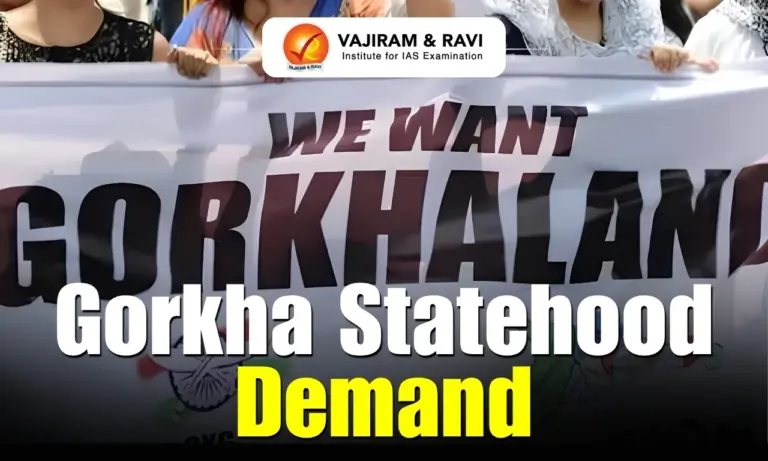
Gorkha Statehood Demand Latest News
- Recently, the govt constituted a high-level committee following a key meeting between Gorkha leaders, Union Home Minister, and West Bengal government representatives in Siliguri.
- The committee has been tasked with preparing a framework for a “permanent political solution” to the Gorkha issue — a demand whose roots stretch back over a century.
Roots of the Gorkha Demand
- The Gorkha movement for a separate administrative identity is among the oldest such movements in India.
- Darjeeling and its adjoining areas — Kalimpong, Kurseong, the Terai, and the Dooars — are culturally, ethnically, and linguistically distinct from the rest of West Bengal.
- Because the region’s population predominantly speaks Nepali and has distinct physical features, residents frequently face racial profiling and are mistakenly identified as citizens of Nepal or China.
- This persistent alienation has fuelled a deep identity crisis, driving demands for a separate state to affirm their Indian citizenship.


Early Political History (1907-1947)
- The movement formally began in 1907, when the Darjeeling Hillmen’s Association, led by Sonam Wangel Laden La, submitted a petition to the Minto-Morley Reforms Committee seeking to separate Darjeeling and Jalpaiguri from Bengal.
- Over subsequent decades, other groups joined the cause — the Gorkha Officers’ Association and the Kurseong Gorkha Library among them.
- They presented their case before the Simon Commission (1929) and British officials Sir Samuel Hoare and Lord Pethick-Lawrence, proposing alternative governance arrangements such as a Chief Commissioner’s Province for direct rule.
- By 1947, the undivided Communist Party of India (CPI) formally submitted a memorandum demanding a separate “Gorkhasthan” to interim leaders Jawaharlal Nehru and Liaquat Ali Khan.
The Gorkhaland Movement: Post-Independence Escalation
- The demand took a violent, high-profile turn in the 1980s under Subhas Ghising, founder of the Gorkha National Liberation Front (GNLF), who coined the term “Gorkhaland.”
- The resulting unrest led to the creation of the Darjeeling Gorkha Hill Council (DGHC) in 1988 — a semi-autonomous body that governed the hills for 23 years.
- In 2007, Bimal Gurung formed the Gorkha Janmukti Morcha (GJM), reviving the statehood demand and leading to the establishment of the Gorkha Territorial Administration (GTA) in 2011, replacing the DGHC.
- Agitations flared again in 2013 after the Centre’s decision to carve Telangana out of Andhra Pradesh, triggering fresh strikes and central security deployment in the hills.
The 2017 Crisis: Longest Period of Unrest
- The Darjeeling hills witnessed their most intense unrest in 2017, sparked by the West Bengal government’s decision to make Bengali a mandatory language in state-run schools across the region.
- GJM supporters clashed with security forces, burning outposts and prompting military intervention.
- The agitation lasted 104 days, resulting in 11 protestor deaths, bomb blasts in Darjeeling and Kalimpong (killing a civic volunteer), and a complete collapse of the region’s tourism economy.
Mandate of the New Committee
- The newly formed committee will examine all dimensions of the Gorkha issue within the framework of the Indian Constitution.
- Beyond structural governance, the panel will also assess financial assistance for the region and review a roadmap to grant Scheduled Tribe (ST) status to 11 key Gorkha communities.
Conclusion
- The Gorkha statehood demand represents one of India’s oldest sub-regional political movements, evolving from a constitutional petition in 1907 into a decades-long struggle marked by both peaceful advocacy and violent agitation.
- While repeated administrative arrangements — the DGHC and GTA — have offered partial autonomy, the underlying demand for identity recognition remains unresolved.
- The Centre’s new committee, with its constitutional mandate and focus on ST status and financial support, signals a fresh attempt at a lasting political settlement, though its success will depend on balancing Gorkha aspirations with West Bengal’s territorial integrity.

 Last updated on August, 2026
→ UPSC Mains 2026 commenced on 21st August 2026 and will continue through 30th August 2026, as per the official examination schedule.
→ UPSC Mains Question Paper 2026 is out now for Essay & GS Paper 1, 2, 3 & 4.
→ UPSC Mains GS Paper 1 2026 is out now.
→ UPSC Mains GS Paper 2 2026 is out now.
→ UPSC Mains GS Paper 3 2026 is out now.
→ UPSC Mains GS Paper 4 2026 is out now.
→ Check out the latest UPSC Syllabus 2026 here.
→ UPSC Mains Admit Card 2026 is now out.
→ Enroll in Vajiram & Ravi’s UPSC Mains Test Series 2027 for structured answer writing practice, expert evaluation, and exam-oriented feedback.
→ Join Vajiram & Ravi’s UPSC Mentorship Program 2027 for personalized guidance, strategy planning, and one-to-one support from experienced mentors.
→ Go through the UPSC Mains Previous Year Papers to enhance your preparation.
→ Download UPSC Mains Essay Paper 2025, UPSC Mains GS Paper-I 2025, UPSC Mains GS Paper-II 2025, UPSC Mains GS Paper-III 2025, UPSC Mains GS Paper-IV 2025, UPSC Mains English (Compulsory) Paper 2025, UPSC Mains Hindi (Qualifying) Paper 2025 here.
→ UPSC has released UPSC Toppers List 2025 with the Civil Services final result on its official website.
→ UPSC Calendar 2027 has been released.
→ Also check Best UPSC Coaching in India
Gorkha Statehood Demand FAQs
Q1. What is the Gorkha Statehood Demand?+
Q2. When did the Gorkha Statehood Demand begin?+
Q3. Why has the Gorkha Statehood Demand continued for so long?+
Q4. What administrative arrangements followed the Gorkha Statehood Demand?+
Q5. What will the new committee examine regarding the Gorkha Statehood Demand?+
Tags: Gorkha Statehood Demand mains articles upsc current affairs upsc mains current affairs