Nepal Flash Floods Latest News
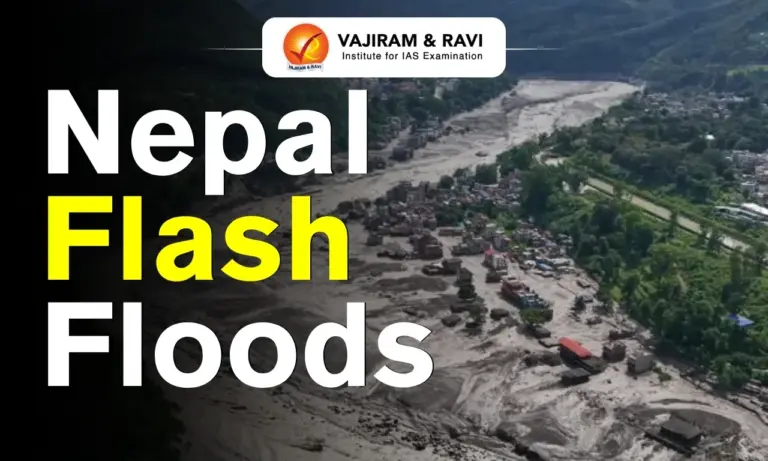
- Devastating flash floods struck Nepal’s Rasuwa district, sending water, sediment, and boulders surging through the Bhote Koshi and Trishuli rivers near the Nepal-Tibet border.
- The disaster damaged settlements, roads, bridges, and power infrastructure, with many people confirmed dead and hundreds reported missing, including foreign travellers.
- Scientists and meteorologists are now examining multiple possible triggers — an ice-rock avalanche, an earthquake, and a western disturbance interacting with monsoon rainfall.
Scale of the Flood
- Experts highlighted the “exceptional speed and magnitude” of the flood: water levels reportedly rose as much as 9 metres within 30 minutes on the Trishuli river at Galchhi, and by 7 metres at Malekhu — both in Dhading district, roughly 80 km from Kathmandu.
- They are also examining whether debris temporarily blocked the river at a narrow section, forming a landslide dam that could pose a “secondary hazard” if the impounded water were suddenly released.
- Early seismic analysis identified unusual signals during the disaster period, though no immediate causal link to the floods has been established.


The Ice-Rock Avalanche Theory
- Scientists from the International Centre for Integrated Mountain Development (ICIMOD) — a Nepal-based intergovernmental institution leading efforts to protect the Hindu Kush Himalaya (HKH) region —are investigating whether an ice-rock avalanche from a high-altitude area triggered the flash flood.
- ICIMOD’s preliminary assessment suggests a large volume of ice and rock debris may have entered the Lende Khola, a tributary of the Bhote Koshi river, generating a sudden surge that carried water, sediment, and large boulders downstream.
- An ice avalanche involves the sudden collapse and downhill movement of a large ice mass from a hanging glacier or an ice-covered mountain.
- It noted that the same site was devastated by a similar flood last year, and warned that with a blockage still lodged upstream on the Nepal-China border, a second flood is imminent — prompting evacuation orders for Jilong port.
The Earthquake and Landslide Angle
- Nepal’s Foreign Minister indicated that an earthquake occurred in the area shortly before the flooding and may have triggered an avalanche or landslide behind the surge.
- Nepal and China are jointly investigating the exact sequence of events.
- Separately, researchers’ preliminary assessment suggested an ice avalanche may have blocked a river, allowing water to accumulate before its sudden downstream release.
The Western Disturbance and Monsoon Link
- According to experts at India Meteorological Department (IMD), a western disturbance that brought rain to parts of northern India and subsequently moved eastwards towards the Himalayas may have contributed to the weather conditions preceding the floods.
- They noted that the interaction between weather systems and hilly terrain “might have played a role,” as the same western disturbance system moved eastwards, increasing rainfall activity toward the northeast and Himalayan region.
- However, they cautioned there was insufficient information to confirm a cloudburst had occurred.
- They stressed that the western disturbance should be seen as “a possible contributor to the broader rainfall environment rather than an established direct cause” — with the immediate mechanism behind the sudden water release still under investigation.
- The western disturbance persisted as a cyclonic circulation over north Haryana as of August 26.
Ten Days of Rain: How Monsoon and Orographic Lifting Fed the Nepal Floods
- Nepal had experienced persistent rainfall for about 10 days under the influence of the southwest monsoon and “orographic lifting” (moving air masses rising upon colliding with mountains) along the southern Himalayan foothills.
- Accumulated rainfall between August 16-25 reached heavy to intense levels at some locations, while southern Tibet — upstream of Nepal — also received moderate to heavy rain with localised intense downpours.
- The experts at World Meteorological Centre, Beijing, linked the flash floods and debris flows to this combination of local and upstream rainfall.
- It warned that a monsoon depression over northern India would keep bringing moderate to heavy rain to Nepal for three more days, with heavy to intense spells possible in the south.
Conclusion
- The Nepal flash floods illustrate the complex, layered nature of Himalayan disaster triggers — where glacial hazards, seismic activity, and monsoon weather systems can interact to produce catastrophic outcomes.
- With causation still under investigation and a second flood warned as imminent, the event underscores the urgent need for enhanced early-warning systems and deeper regional scientific cooperation between Nepal, India, and China to monitor glacial lake and ice-avalanche risks across the fragile Hindu Kush Himalaya region.

 Last updated on August, 2026
→ UPSC Mains 2026 commenced on 21st August 2026 and will continue through 30th August 2026, as per the official examination schedule.
→ UPSC Mains Question Paper 2026 is out now for Essay & GS Paper 1, 2, 3 & 4.
→ UPSC Mains GS Paper 1 2026 is out now.
→ UPSC Mains GS Paper 2 2026 is out now.
→ UPSC Mains GS Paper 3 2026 is out now.
→ UPSC Mains GS Paper 4 2026 is out now.
→ Check out the latest UPSC Syllabus 2026 here.
→ UPSC Mains Admit Card 2026 is now out.
→ Enroll in Vajiram & Ravi’s UPSC Mains Test Series 2027 for structured answer writing practice, expert evaluation, and exam-oriented feedback.
→ Join Vajiram & Ravi’s UPSC Mentorship Program 2027 for personalized guidance, strategy planning, and one-to-one support from experienced mentors.
→ Go through the UPSC Mains Previous Year Papers to enhance your preparation.
→ Download UPSC Mains Essay Paper 2025, UPSC Mains GS Paper-I 2025, UPSC Mains GS Paper-II 2025, UPSC Mains GS Paper-III 2025, UPSC Mains GS Paper-IV 2025, UPSC Mains English (Compulsory) Paper 2025, UPSC Mains Hindi (Qualifying) Paper 2025 here.
→ UPSC has released UPSC Toppers List 2025 with the Civil Services final result on its official website.
→ UPSC Calendar 2027 has been released.
→ Also check Best UPSC Coaching in India
Nepal Flash Floods FAQs
Q1. What caused the Nepal Flash Floods in Rasuwa district?+
Q2. How did an ice-rock avalanche possibly trigger the Nepal Flash Floods?+
Q3. Did an earthquake trigger the Nepal Flash Floods?+
Q4. What role did weather systems play in the Nepal Flash Floods?+
Q5. Why do the Nepal Flash Floods highlight Himalayan vulnerability?+
Tags: mains articles Nepal Flash Floods upsc current affairs upsc mains current affairs