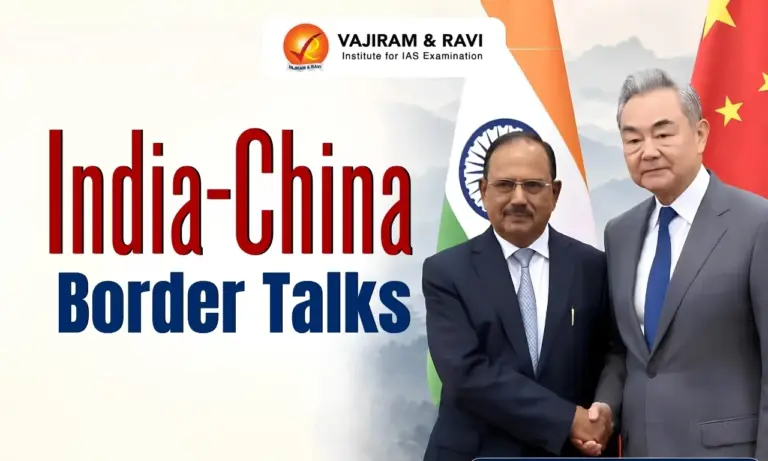
India-China Border Talks Latest News
- India and China have agreed to accelerate discussions on an “Early and Substantial Harvest” in boundary delimitation and border management, while strengthening military-to-military communication along the Line of Actual Control (LAC).
- The decisions emerged from the 25th round of Special Representative (SR)-level talks between National Security Adviser Ajit Doval and Chinese Foreign Minister Wang Yi in Beijing.
- The eight-point consensus seeks to consolidate the relative stabilisation of India-China ties by preventing border incidents from escalating and creating conditions for broader bilateral engagement.
India-China Boundary Dispute
- It covers an approximately 3,488-km contested frontier and involves differing perceptions of the LAC, where both nations claim overlapping territories rooted in British colonial-era agreements.
- Key sectors of the dispute:
-
- Western sector (Aksai Chin): China controls roughly 38,000 square kilometers of land that India claims as part of Ladakh.
- Eastern sector (Arunachal Pradesh): China claims nearly 90,000 square kilometers of territory, referring to the region as Zangnan or Southern Tibet, based on its rejection of the 1914 McMahon Line.
- Central sector: A smaller overlapping segment spanning Himachal Pradesh and Uttarakhand where differences are relatively minor.
- The 2020 eastern Ladakh crisis significantly disrupted bilateral relations, making restoration of peace and tranquillity a prerequisite for normalisation.


Towards an “Early and Substantial Harvest” on the Boundary
- Both sides reaffirmed their commitment to negotiations for a fair, reasonable and mutually acceptable settlement of the boundary question.
- This must be guided by the 2005 Agreement on Political Parameters and Guiding Principles and subsequent SR-level consensus.
- Two mechanisms under the Working Mechanism for Consultation and Coordination (WMCC) will advance the process –
- Expert Group on Boundary Delimitation – to discuss an early harvest in boundary delimitation (Delimitation determines the alignment of the boundary, while demarcation involves physically marking an already agreed boundary).
- Working Group on Border Management – to improve management of the disputed frontier.
- Their immediate task is to finalise their respective Terms of Reference (ToR). The current discussions do not amount to a final boundary settlement.
Strengthening Military Communication
- The two countries agreed to –
- Establish two additional meeting points for General/Senior Highest Military Commander-level interactions.
- Create two additional military hotlines in the Eastern and Middle Sectors.
- Address ground situations promptly through diplomatic and military channels, including the WMCC and local commander-level meetings.
- The objective is to prevent misunderstanding, miscalculation and escalation arising from localised incidents along the LAC.
Border Trade, Pilgrimage and People-to-People Engagement
- Both sides welcomed the reopening of three designated border trading points and agreed to strengthen cooperation in border trade, pilgrimage, and other exchanges in border areas.
- India also appreciated China’s efforts to increase the number of batches for the Kailash-Mansarovar Yatra.
- These measures indicate an attempt to shift border areas from being exclusively security-centric towards dialogue, consultation and cooperation.
Trans-Border Rivers and the Brahmaputra
- India and China agreed to hold the next meeting of the Expert-Level Mechanism on Trans-border Rivers in September.
- Discussions will cover hydrological data sharing, renewal of relevant MoUs, and cooperation on trans-border river management.
- This is particularly important for the Brahmaputra (Yarlung Tsangpo), whose upper reaches originate in Tibet before flowing into India and Bangladesh.
- India’s concerns include downstream ecological impacts, flood management, sediment flows and the implications of Chinese hydropower projects in the Brahmaputra’s upper basin.
- Reliable and timely hydrological data is therefore crucial for disaster preparedness and water security.
Institutionalising the Peace Process
- The talks reaffirmed the importance of maintaining peace and tranquillity along the border as the foundation for stable bilateral relations.
- The two countries also agreed to hold the 26th round of Special Representatives’ talks in India in 2027.
- Significance for India:
- The latest understanding is important because it moves beyond crisis management towards institutionalised border management.
- Strengthens confidence-building measures (CBMs) and military communication.
- Keeps the long-term goal of boundary settlement alive.
- Creates space for restoration of broader bilateral engagement.
- Reduces the risk of accidental escalation along the LAC.
- Provides a framework for cooperation on trans-border rivers, trade and pilgrimage.
Conclusion
- India must pursue a dual-track approach—maintaining military preparedness and infrastructure along the LAC while sustaining diplomatic engagement.
- Progress on delimitation should be incremental, verifiable and based on established agreements.

 Last updated on Oct, 2026
→ UPSC 2027 Notification will be released on 13 January 2027 at upsconline.nic.in.
→ Asian Games 2026 are being held in Aichi-Nagoya, Japan, from 19 September to 4 October.
→ Check Nobel Prize 2026 Winners List here.
→ Download PIB PRiSM Monthly Magazine 2026 here.
→ Check UPSC Monthly Current Affairs Magazine The Recitals here.
→ Check out the latest UPSC Syllabus here.
→ Download UPSC Model Answers for Mains 2026
→ UPSC Mains Question Paper 2026 is out now for Essay & GS Paper 1, 2, 3 & 4.
→ UPSC Calendar 2027 has been released.
→ Enroll in Vajiram & Ravi’s UPSC Mains Test Series 2027 for structured answer writing practice, expert evaluation, and exam-oriented feedback.
→ Join Vajiram & Ravi’s UPSC Mentorship Program 2027 for personalized guidance, strategy planning, and one-to-one support from experienced mentors.
→ Go through the UPSC Mains Previous Year Papers to enhance your preparation.
→ UPSC has released UPSC Toppers List 2025 with the Civil Services final result on its official website.
→ Also check Best UPSC Coaching in India
India-China Border Talks FAQs
Q1. What is the significance of the “Early and Substantial Harvest” approach in India-China boundary negotiations?+
Q2. How can additional military hotlines and commander-level meeting points contribute to India-China border stability?+
Q3. Why is the India-China Expert-Level Mechanism on Trans-border Rivers strategically important for India?+
Q4. What is the role of the 2005 Agreement in resolving the India-China boundary dispute?+
Q5. How can India balance border security with the need for normalisation of India-China relations?+
Tags: india-china border talks