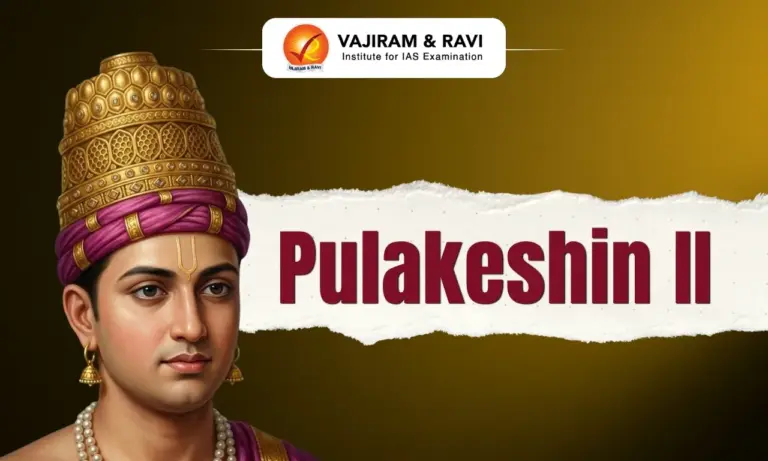
Pulakeshin II was one of the most important rulers of the Badami Chalukya dynasty and played a major role in strengthening the Chalukya Empire in the Deccan. He ruled during the 7th century CE and is particularly remembered for his military victories, territorial expansion and strong administration. One of his most famous achievements was defeating Harshavardhana and stopping his southward expansion at the Narmada River. The Aihole Inscription, written by his court poet Ravikirti, is an important source of information about his rule and achievements. His reign is considered a significant period in the history of the Chalukyas and early medieval India.
Pulakeshin II Early Life, Rise to Power and Reign
- Pulakeshin II was one of the most powerful rulers of the Badami Chalukya dynasty. He ruled approximately from 610 to 642 CE and brought the Chalukya kingdom to the height of its power in the Deccan.
- His original name was Ereya, and he was the son of Kirtivarman I. Since Pulakeshin was still young when his father died, his uncle Mangalesha took control of the kingdom as regent.
- Mangalesha later refused to hand over the throne to Pulakeshin. This resulted in a struggle for succession. Pulakeshin joined hands with the Banas, one of the Chalukya feudatories, and challenged his uncle.
- Pulakeshin eventually defeated Mangalesha at Elpattu-Simbhige and secured the Chalukya throne. His victory marked the beginning of a new and powerful phase in Chalukya history.
- After becoming king, Pulakeshin had to deal with several chiefs who had taken advantage of the succession dispute.
- He defeated Appayika and Govinda, while also bringing the Gangas of Talakad, Kadambas of Banavasi, Alupas of Aluvakheda and Mauryas of Konkana back under Chalukya authority.
- Pulakeshin II strengthened the administration and military organization of his kingdom. His rule helped turn the Chalukya state into a major political power in peninsular India.
- Much of what is known about his reign comes from the famous Aihole inscription, a prashasti composed by his court poet Ravikirti. The inscription records his victories and praises his achievements.
- Pulakeshin adopted important administrative practices and developed a strong system of provincial and local governance.
- His empire was supported by a powerful army consisting of infantry, cavalry and elephants, along with naval strength along the western coast.
- He was known by several titles, including Satyashraya, Parameshvara, Prithivivallabha, Bhattaraka and Maharajadhiraja.
- He also acquired the title Dakshinapatheshvara, meaning the lord of the southern region.
Pulakeshin II and the Expansion of the Chalukya Empire
- After securing the throne, Pulakeshin II concentrated on expanding and consolidating Chalukya power. His military campaigns brought large parts of the Deccan under his influence.
- He defeated the Kadambas of Banavasi, the Alupas of South Canara, the Mauryas of Konkana and other regional powers. These victories strengthened Chalukya control over present-day Karnataka and parts of western India.
- His campaigns also extended Chalukya influence towards Maharashtra, Gujarat and Andhra Pradesh. At its greatest extent, his kingdom stretched broadly from the Narmada in the north to the Kaveri in the south.
- Pulakeshin also came into conflict with the Pallavas of Kanchi. During his early southern campaign, he defeated Mahendravarman I, the Pallava ruler, and advanced towards the Cauvery River.
- His success against the Vishnukundins, who were associated with the Pallavas, further brought him into confrontation with the Pallava kingdom.
- The struggle with the Pallavas continued after Mahendravarman I was succeeded by his son Narasimhavarman I. The new Pallava ruler reorganized his forces and prepared to challenge Chalukya power.
- Pulakeshin’s second campaign against the Pallavas initially involved victories against their feudatories, including the Banas. However, Narasimhavarman I eventually turned the situation in favour of the Pallavas.
- The Pallavas defeated the Chalukya forces in battles at Pariyala, Suramana and Manimangala near Kanchi. They then advanced into Chalukya territory.
- Around 642 CE, the Pallavas captured Vatapi (modern Badami), the Chalukya capital. Pulakeshin II was defeated and is believed to have died during this conflict.
- Despite his eventual defeat, Pulakeshin II’s campaigns established the Badami Chalukyas as one of the strongest powers of early medieval peninsular India.


Pulakeshin II vs Harshavardhana The Battle of the Narmada
- One of the most important achievements of Pulakeshin II was his successful resistance against Harshavardhana, the powerful ruler of northern India.
- Harsha had built a large empire in northern India and sought to extend his influence towards the Deccan.
- Pulakeshin’s growing power in the north-western Deccan brought the two rulers into direct competition.
- The rulers of Malava and Gurjara are said to have accepted Pulakeshin’s authority, which increased tensions between the Chalukyas and Harsha.
- The two powers eventually came into conflict near the Narmada River. Pulakeshin II successfully stopped Harsha’s southward expansion.
- The Aihole inscription celebrates this victory by describing how Harsha lost his confidence after seeing the destruction caused to his elephant forces.
- The Chinese traveller Xuanzang (Hiuen Tsang) also provides evidence of Pulakeshin’s successful resistance to Harsha. He refers to Pulakeshin’s kingdom as Mo-ho-la-cha, generally identified with the powerful Deccan kingdom of Maharashtra.
- The victory was politically important because the Narmada effectively became a boundary between Harsha’s northern dominions and Pulakeshin’s southern empire.
- Following this achievement, Pulakeshin adopted the prestigious title Dakshinapatheshvara, presenting himself as the dominant ruler of the southern region.
- The confrontation with Harsha established Pulakeshin II as a ruler capable of resisting one of the most powerful monarchs of his time. It also confirmed the Chalukyas of Badami as a major force in the Deccan.
Pulakeshin II Achievements, Legacy and Historical Significance
- Pulakeshin II is remembered as the greatest ruler of the Badami Chalukyas because his reign witnessed extensive territorial expansion, military success and political consolidation.
- One of his most important achievements was bringing large parts of the Deccan under Chalukya authority. His empire covered areas corresponding to parts of modern Karnataka, Maharashtra, Gujarat and Andhra Pradesh.
- His victory over Harshavardhana was particularly significant because it prevented the expansion of northern imperial power into the Deccan. The Narmada consequently became an important political boundary.
- Pulakeshin was also an important patron of art, architecture and literature. His reign coincided with the development of the distinctive Chalukyan architectural tradition visible at places such as Badami, Aihole and Pattadakal.
- His court poet Ravikirti composed the celebrated Aihole Prashasti, which is one of the most important sources for understanding Pulakeshin II’s reign and military achievements.
- The Meguti Jain Temple at Aihole was associated with Ravikirti, while Shaivite shrines such as the Upper Shivalaya, Lower Shivalaya and Malegitti Shivalaya were constructed during this period.
- Although Pulakeshin II was a Vaishnavite, inscriptions such as the Lohner and Pimpalner copper plates indicate his association with Vishnu worship. At the same time, his reign reflected considerable religious tolerance.
- Shaivism, Buddhism and Jainism also flourished during his period. Xuanzang reported the presence of numerous Buddhist monasteries in the Chalukya kingdom, while Jain monuments were also supported.
- Pulakeshin maintained contacts beyond the Indian subcontinent. His period is associated with diplomatic relations with the Sassanian Empire, and evidence from the Ajanta paintings has often been connected with foreign embassies at his court.
- His reign also encouraged trade and commercial activity, particularly through ports on the western coast. These connections linked the Deccan with wider networks of trade and diplomacy.
- His final defeat at the hands of Narasimhavarman I and the fall of Vatapi around 642 CE marked a major setback for the Chalukyas. However, the dynasty later recovered under Vikramaditya I.
- Pulakeshin II’s lasting historical importance lies in his ability to build a strong Deccan empire, resist Harsha’s expansion, promote cultural development and establish the Badami Chalukyas as one of the leading powers of early medieval India.
- His reign remains an important chapter in Indian history because it demonstrates the political strength of the Deccan and its ability to stand independently against powerful northern and southern kingdoms.

 Last updated on August, 2026
→ UPSC Mains 2026 commenced on 21st August 2026 and will continue through 30th August 2026, as per the official examination schedule.
→ UPSC Mains Question Paper 2026 is out now for Essay & GS Paper 1, 2, 3 & 4.
→ UPSC Mains GS Paper 1 2026 is out now.
→ UPSC Mains GS Paper 2 2026 is out now.
→ UPSC Mains GS Paper 3 2026 is out now.
→ UPSC Mains GS Paper 4 2026 is out now.
→ UPSC Mains Indian Language Paper & English Compulsory Paper are out now.
→ Check out the latest UPSC Syllabus 2026 here.
→ UPSC Mains Admit Card 2026 is now out.
→ Enroll in Vajiram & Ravi’s UPSC Mains Test Series 2027 for structured answer writing practice, expert evaluation, and exam-oriented feedback.
→ Join Vajiram & Ravi’s UPSC Mentorship Program 2027 for personalized guidance, strategy planning, and one-to-one support from experienced mentors.
→ Go through the UPSC Mains Previous Year Papers to enhance your preparation.
→ Download UPSC Mains Essay Paper 2025, UPSC Mains GS Paper-I 2025, UPSC Mains GS Paper-II 2025, UPSC Mains GS Paper-III 2025, UPSC Mains GS Paper-IV 2025, UPSC Mains English (Compulsory) Paper 2025, UPSC Mains Hindi (Qualifying) Paper 2025 here.
→ UPSC has released UPSC Toppers List 2025 with the Civil Services final result on its official website.
→ UPSC Calendar 2027 has been released.
→ Also check Best UPSC Coaching in India
Pulakeshin II FAQs
Q1. Who was Pulakeshin II?+
Q2. Who was the father of Pulakeshin II?+
Q3. How did Pulakeshin II become king?+
Q4. Why is Pulakeshin II famous in Indian history?+
Q5. Who defeated Harshavardhana?+
Q6. What was the significance of the Battle of the Narmada?+
Q7. Who defeated Pulakeshin II?+
Q8. What is the Aihole Inscription of Pulakeshin II?+
Q9. What was the contribution of Pulakeshin II to art and culture?+
Tags: history history notes pulakeshin pulakeshin ii