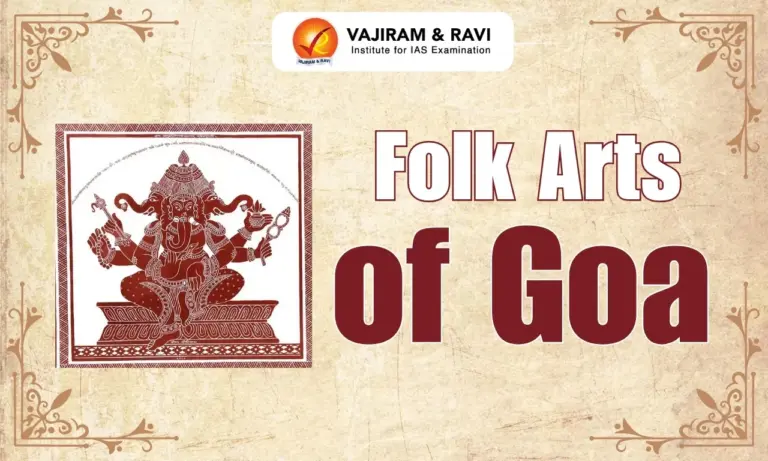
Folk Arts of Goa reflect the cultural diversity and historical evolution of Goa, combining indigenous Konkan traditions with influences introduced during Portuguese colonial rule. From intricate murals and wooden paintings to traditional textiles and ceramic tiles, these art forms represent the region’s religious beliefs, social life, craftsmanship and connection with nature.
Major Folk Arts of Goa
Goa has several distinctive traditional art forms, each reflecting a different aspect of its cultural heritage. The major folk art traditions include Kaavi art, Chitari art, Azulejos, Kunbi weaving and Sgraffito.
1. Kaavi Art
Kaavi Art is a traditional mural technique associated with the Konkan region, particularly Goa and neighbouring areas. It is characterised by intricate designs created by scraping or carving patterns into a prepared surface containing red mud and natural red oxide.
The artwork commonly depicts deities, floral patterns, geometric designs and scenes from everyday life. Kaavi murals can be seen on the walls of traditional homes, temples and other heritage structures.
Key features of Kaavi Art:
- Uses natural red oxide to create its distinctive reddish appearance.
- Involves scratching or carving designs into a prepared plaster surface.
- Features deities, flora, geometric patterns and everyday scenes.
- Represents the indigenous artistic traditions of the Konkan region.
- Has been traditionally used to decorate religious and heritage structures.
2. Chitari Art
Chitari Art is a traditional hand-painting practice associated with the Chitari community of Goa. The craft has a history of around 300 years and is particularly known for its application on wooden objects used during religious and cultural occasions.
Traditional Chitari artists decorate objects such as temple chariots, ceremonial stools known as paath, and festive items. One of the most recognisable elements of this art is the twin-parrot motif, along with the use of bright natural colours.
Key features of Chitari Art:
- A traditional craft with a history of around 300 years.
- Practised by the Chitari community.
- Commonly seen on wooden objects and ceremonial items.
- Uses vivid colours derived traditionally from natural sources.
- The twin-parrot motif is an important characteristic.
- Closely connected with Goan religious and festive traditions.
Also Read:- Tribes of Goa
3. Azulejos
Azulejos are decorative hand-painted ceramic tiles associated with the Portuguese cultural influence in Goa. These tiles became an important feature of Goan architecture and can be found decorating heritage homes, churches and institutional buildings.
They are especially recognised for their blue-and-white colour combinations, geometric patterns and pictorial compositions. Azulejos demonstrate how Portuguese artistic traditions became integrated into Goa’s architectural landscape.
Key features of Azulejos:
- Made from ceramic tiles.
- Strongly influenced by Portuguese artistic traditions.
- Often feature blue-and-white designs.
- Include geometric, floral and pictorial patterns.
- Commonly found on heritage buildings and institutional walls.
- Represent the colonial influence on Goan art and architecture.
4. Kunbi Weaving
Kunbi Weaving is an indigenous textile tradition associated with the Kunbi community of Goa. The tradition produces comfortable and durable cotton fabrics that historically suited the region’s climate and lifestyle.
Traditional Kunbi textiles are recognised for their checkered and striped patterns and have traditionally used natural dyes. The fabrics are lightweight, making them suitable for everyday wear in Goa’s warm and humid climate.
Key features of Kunbi Weaving:
- Associated with the Kunbi community.
- Represents an indigenous Goan textile tradition.
- Uses cotton to produce lightweight fabrics.
- Known for checks and stripes.
- Traditionally used natural dyes.
- Combines practicality, durability and distinctive design.
Also Read:- Folk Dances of Goa
5. Sgraffito
Sgraffito is a decorative mural technique that involves scratching designs into layers of plaster. It shares similarities with Kaavi art because both techniques involve creating designs by working into a prepared surface.
However, Sgraffito in Goa is particularly associated with historical Christian architecture and church facades. Its presence reflects the interaction between local artistic techniques and the religious and architectural traditions that developed during the Portuguese period.
Key features of Sgraffito:
- Uses a plaster-scratching technique.
- Similar in method to Kaavi art.
- Frequently associated with Christian motifs in Goa.
- Found on some historical churches and architectural surfaces.
- Reflects the interaction between local craftsmanship and Portuguese-era influences.
Folk Arts of Goa Importance
Folk Arts of Goa are important for several reasons:
- Preservation of heritage: It keeps traditional artistic practices alive across generations.
- Cultural identity: These forms represent the distinctive cultural identity of Goa.
- Architectural heritage: Kaavi, Azulejos and Sgraffito contribute to the visual character of Goan heritage buildings.
- Community traditions: Chitari art and Kunbi weaving are closely connected with traditional communities.
- Historical evidence: These art forms reflect the interaction between indigenous Konkan culture and Portuguese influence.
- Craftsmanship: They showcase the skills of local artisans and traditional knowledge of materials and techniques.
- Tourism: Traditional art and crafts contribute to Goa’s cultural tourism and provide visitors with insight into its heritage.


 Last updated on Oct, 2026
→ UPSC 2027 Notification will be released on 13 January 2027 at upsconline.nic.in.
→ Check Nobel Prize 2026 Winners List here.
→ Download PIB PRiSM Monthly Magazine 2026 here.
→ Check UPSC Monthly Current Affairs Magazine The Recitals here.
→ Check out the latest UPSC Syllabus here.
→ Download UPSC Model Answers for Mains 2026
→ UPSC Mains Question Paper 2026 is out now for Essay & GS Paper 1, 2, 3 & 4.
→ UPSC Calendar 2027 has been released.
→ Enroll in Vajiram & Ravi’s UPSC Mains Test Series 2027 for structured answer writing practice, expert evaluation, and exam-oriented feedback.
→ Join Vajiram & Ravi’s UPSC Mentorship Program 2027 for personalized guidance, strategy planning, and one-to-one support from experienced mentors.
→ Go through the UPSC Mains Previous Year Papers to enhance your preparation.
→ UPSC has released UPSC Toppers List 2025 with the Civil Services final result on its official website.
→ Also check Best UPSC Coaching in India
Folk Arts of Goa FAQs
Q1. What are the major folk arts of Goa?+
Q2. What is Kaavi Art in Goa?+
Q3. What is Chitari Art?+
Q4. What are Azulejos in Goa?+
Q5. What is Kunbi weaving?+
Q6. What is Sgraffito art?+
Tags: folk arts folk arts of goa